Stairs Alternative for Dachshunds: Ramp vs Steps Guide
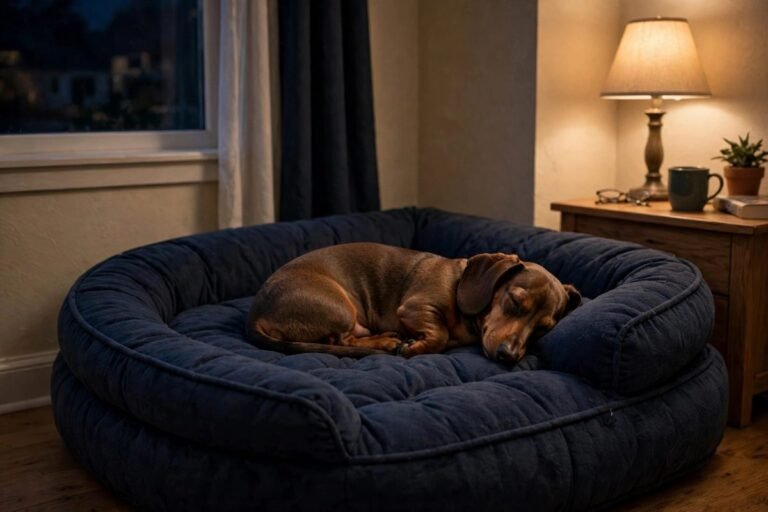
Stairs look harmless, but for a Dachshund they are a repeated daily load on a very long back. If your dog runs up and down stairs many times a day, a safer way up and down is worth sorting out before stiffness or soreness shows up. A stairs alternative for dachshunds is usually a ramp or a set of pet steps, and the right choice depends on height, space, and how your dog moves. In short: a gentle ramp is usually the safest choice for back care, while wide, low pet steps are a practical compromise when space is tight and the height is low.
Why Stairs Are Hard on a Dachshund Back
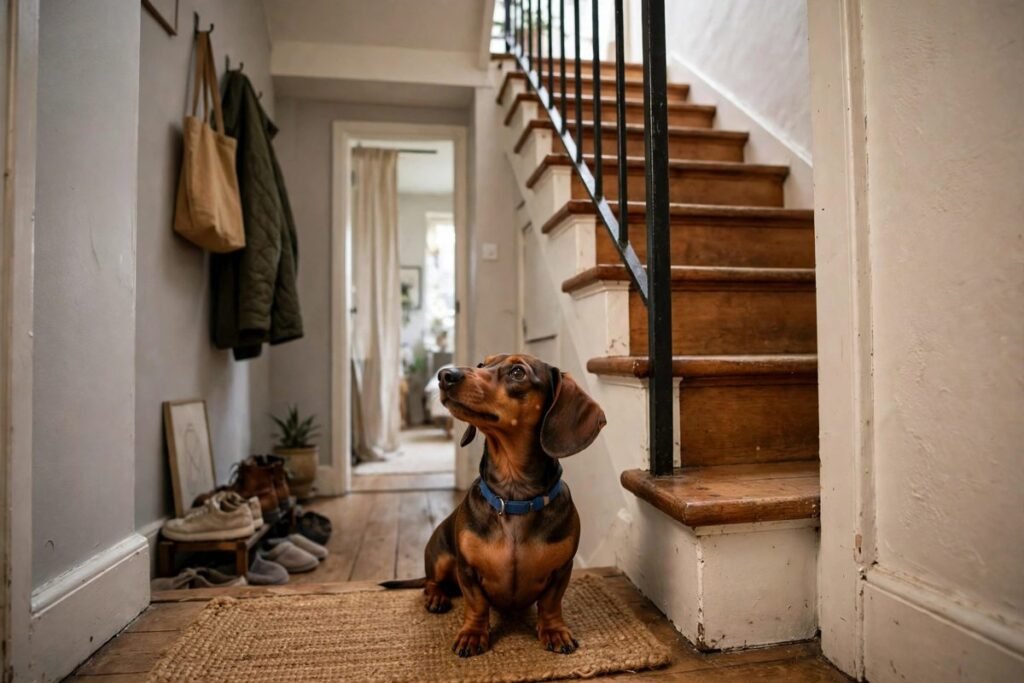
A Dachshund has a long spine carried on short legs, so every stair step asks the back to flex, twist, and absorb impact. Going down is often harder than going up, because the front legs and shoulders take more load and many dogs rush or jump the last step or two. In an apartment building, that load is repeated: stairs to the flat, stairs to the sofa, stairs to the bed, and sometimes stairs in the car park as well.
Repeated stair use does not mean a back problem will follow, and a single step now and then is not the same as constant stair running. The risk builds with frequency, height, speed, and the dog’s age, weight, and existing back sensitivity. Older dogs, overweight dogs, and dogs that already show stiffness tend to cope less well. Slippery, narrow, or crowded apartment stairs add another risk, because a slip can twist the back suddenly. The American Kennel Club’s Dachshund breed page is a useful starting point for the breed’s long-backed build and why owners watch back health closely.
That is why many apartment owners change the routine rather than the dog. If the sofa, bed, and car all have a safer route, the dog does not need to jump or climb stairs to join family life. A gate on the main staircase, a ramp at the bed, and steps at a low sofa can work together as one system.
Stairs Alternative for Dachshunds: When a Ramp Wins
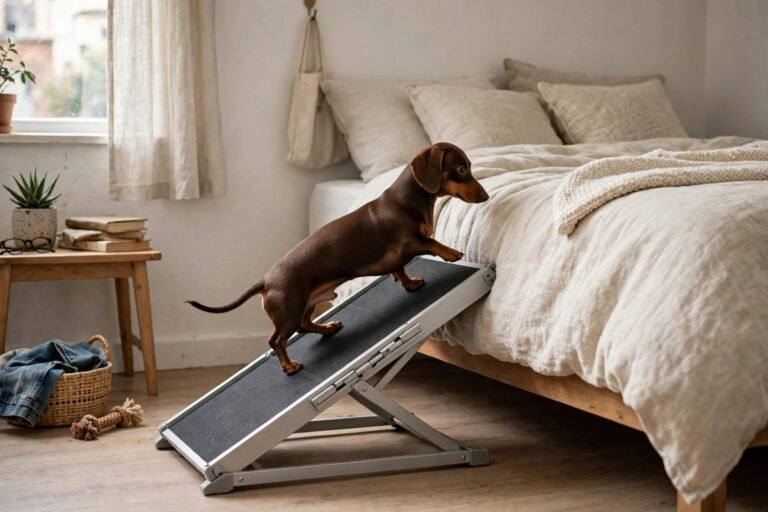
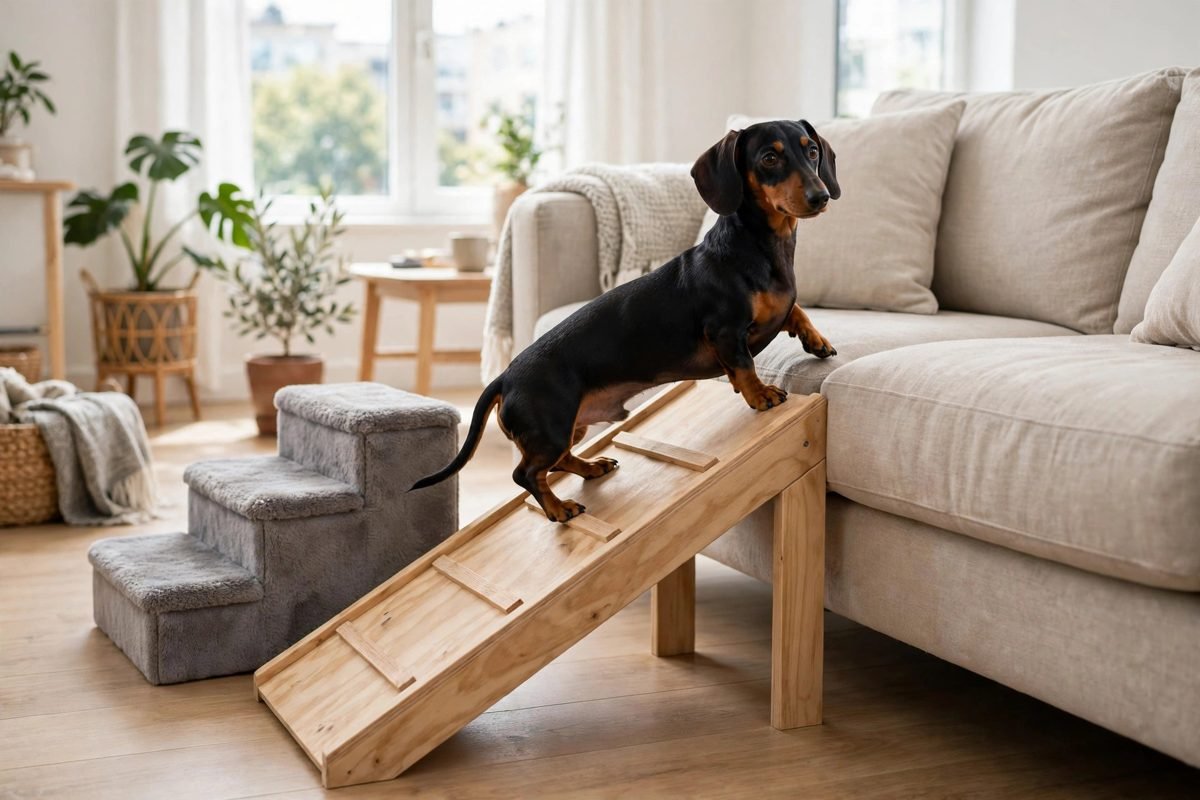
A ramp gives a continuous, gentle slope with no step impact at all. Your dog walks up and down in a steady rhythm, which suits nervous dogs, older dogs, and dogs with existing stiffness. Ramps also suit higher furniture, because a long ramp keeps the slope gentle where a set of steps for the same height would be steep.
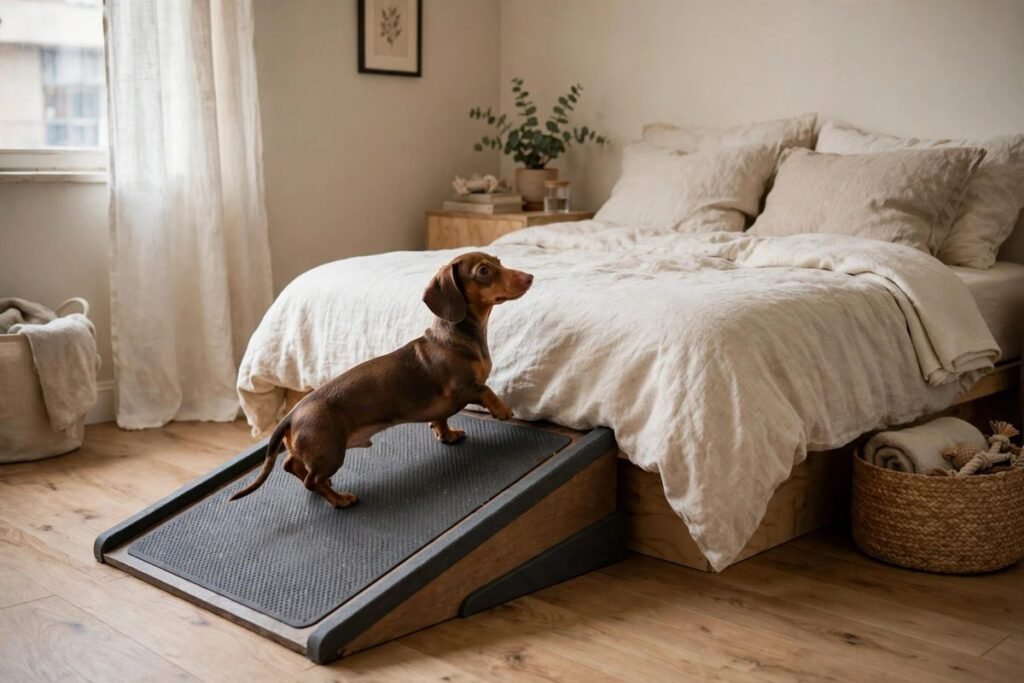
Look for a ramp that is wide enough for your dog to walk confidently, with a non-slip surface that works even with wet paws, and a base that does not slide on smooth floors. A ramp that wobbles or shifts will teach your dog to avoid it, so test stability yourself first and add a non-slip mat underneath if needed. For a bed, a longer ramp is usually better than a short, steep one, even if it takes more floor space beside the bed.
Portable folding ramps are the usual pick for cars. They store in a boot, work on different surfaces, and give a gentle slope into the vehicle without lifting the dog by the front legs alone. If you use a ramp for the car, practise at home first at a low height, so the car is not the first place your dog meets it.
When Pet Steps Make More Sense
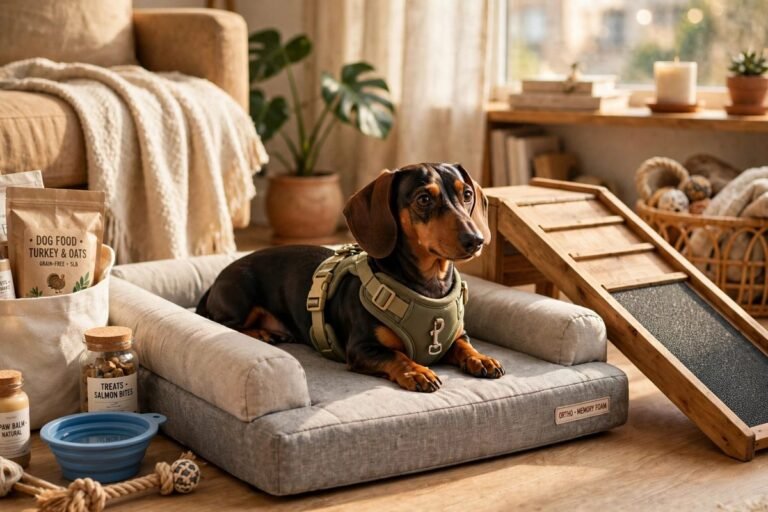
Pet steps are a series of small, stable platforms. They suit small apartments where a long ramp would block a walkway, and they suit lower furniture where only two or three steps are needed. Some dogs learn steps quickly because the movement feels familiar, like a small staircase, and steps can look tidier in a living room than a long ramp.
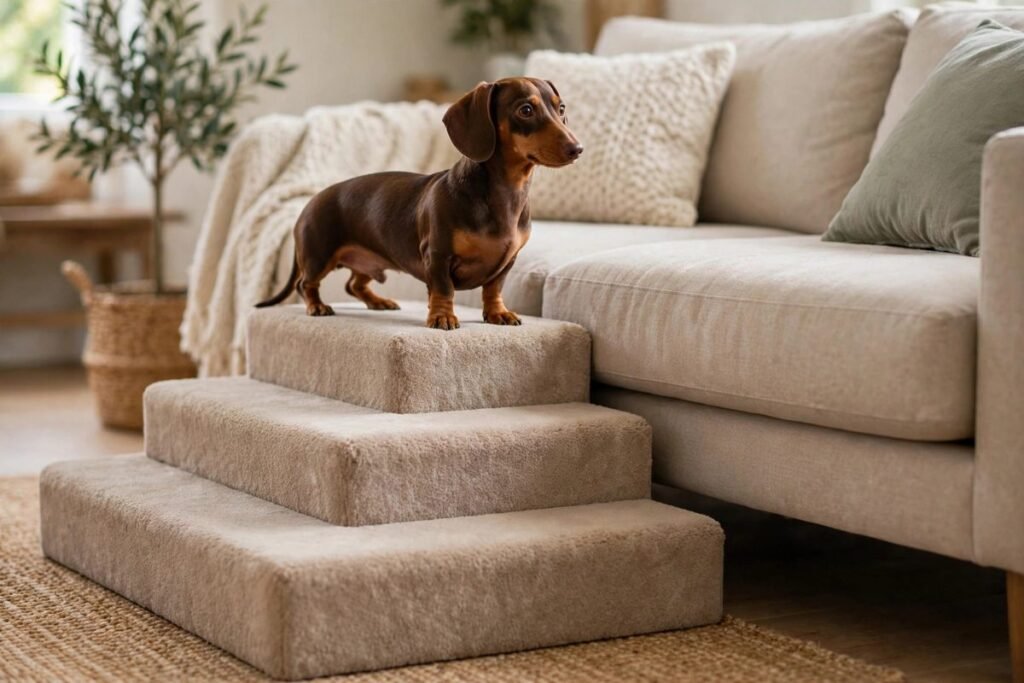
The trade-off is real: each step still involves a small lift or step up and down, so steps are less ideal than a ramp for a dog with a sensitive back. Choose wide steps with a deep tread, a non-slip top, and a solid base that does not rock. Very narrow, tall, or slippery steps defeat the purpose, because the dog will jump between them or avoid them entirely. For a low sofa in a tight flat, two or three wide steps can be a sensible, space-saving answer.
Ramp vs Pet Steps Comparison
Use this comparison to narrow the choice before you buy anything. Height and space usually decide it faster than brand or style.
| Feature | Ramp | Pet steps |
| Impact on the back | Lowest, no step impact | Low, but each step is a small lift |
| Best for | High beds, older or stiff dogs, nervous dogs | Low sofas, tight spaces, confident dogs |
| Floor space | More, needs length for a gentle slope | Less, fits beside most sofas |
| Portability | Folding ramps travel well for cars | Light sets move room to room easily |
| Learning curve | Some dogs need slow, treat-based training | Often learned quickly |
If you want a deeper buying checklist, this guide to choosing the right ramp for a Dachshund covers slope, width, surface, and stability in more detail.
Choosing for Sofa, Bed and Car
Sofa
Measure the sofa height first. For a low sofa, two or three wide steps or a short ramp can both work. Pick whichever your dog will actually use every day, because the safest option is the one that becomes routine. Place it in the same spot, keep the surface non-slip, and leave enough room for your dog to approach in a straight line rather than at an angle.
Bed
Beds are usually higher, so a longer, gentler ramp is usually the better pick. Steps for a high bed can become steep and hard to use at night, when your dog is sleepy and the room is dark. Check that the ramp fits beside the bed without blocking a walkway, and that your dog can get on and off without turning sharply at the top.
Car
For a car, a portable folding ramp is usually the best choice. It stores away, gives a gentle slope, and works on driveways, pavements, and car parks.
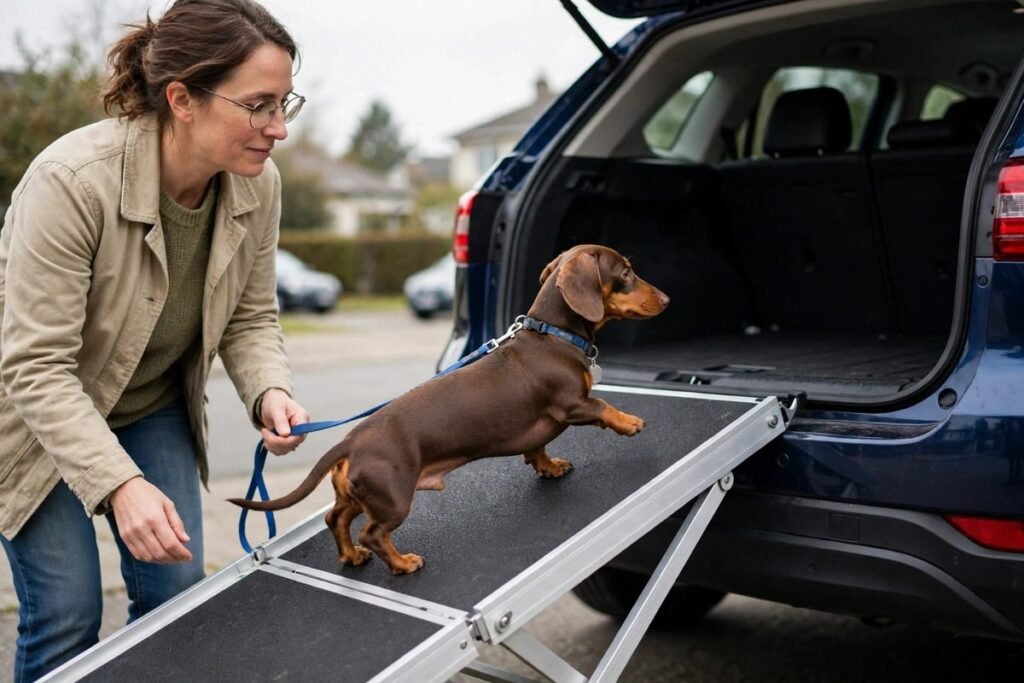
Practise at home, keep sessions short, and reward calm walking rather than rushing. If your dog is very nervous in the car, sort the ramp training indoors first, then move to the car in small steps.
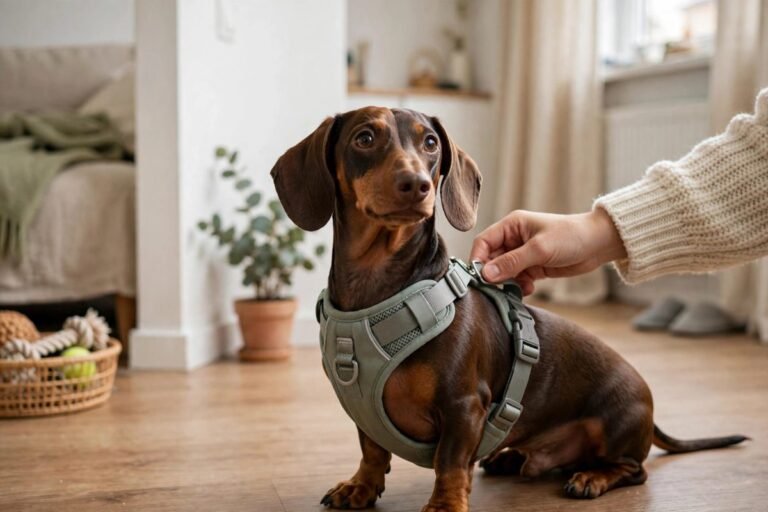
A ramp or steps rarely works alone. Harnesses, beds, and a calm leaving routine all sit together in a small flat, and this apartment essentials guide shows how those pieces fit around the same back-care routine.
Measure First: The 2-Minute Apartment Ramp Plan
This is the part most guides skip, and it is the part that decides whether a ramp or steps will actually work in your flat. Do not buy by looks first. Measure first, in two minutes, with a tape measure or a phone ruler.
- Measure the height. Measure from the floor straight up to the top of the sofa, bed, or car entry. Write it down for each place separately, because a sofa, a bed, and a car are rarely the same height.
- Check the floor space. Measure how much straight floor you have in front of that furniture. A ramp needs length to stay gentle, so a short space in front of a high bed is a warning sign.
- Use this simple slope guide. As a practical rule of thumb, aim for a ramp length at least twice the height for a sofa, and closer to three times the height for a high bed. For example, a sofa 45 cm high suits a ramp around 90 cm or longer, while a bed 60 cm high suits a ramp around 150 to 180 cm if space allows. If that length will not fit, wide low steps or a different route may be a better choice than a steep ramp.
- Test the route. Walk the route yourself. Is there a straight approach, a non-slip floor, and room to turn at the top without a sharp twist? If not, move the ramp or steps, add a mat, or gate the stairs instead.
This plan is built from apartment measurements, not from a product list: height first, floor space second, slope third, and the real route last. If those four checks point the same way, the choice is usually clear.
| Your situation | Usually the better first pick | Why |
| Studio flat, low sofa, tight space | Wide, low pet steps | Fits, easy to learn, height is low |
| High bed, dog is older or stiff | Long, gentle ramp | No step impact, easier at night |
| Car trips, different places | Portable folding ramp | Travels, gives a gentle slope anywhere |
| Multi-storey building, no lift | Gate the stairs plus ramp or steps inside | Reduces repeated stair runs, keeps a safe indoor route |
How to Train Your Dachshund to Use a Ramp or Steps
Train slowly, with treats and praise, and keep sessions short and positive. Start with the ramp or steps flat on the floor or at a very low height, let your dog sniff and explore, and reward any calm step onto it. Gradually raise it to its real height over several days, not in one session. Never push, drag, or lift your dog onto it by force, because fear will undo the training faster than treats can rebuild it.
Keep the item in the same place so it becomes part of the daily route, and block off the main stairs with a gate if your dog tends to run up and down them unsupervised. If your dog hesitates, go back a step: lower the height, add a treat trail, and end on a success. Short, calm sessions beat one long, frustrating session every time.
Common Mistakes to Avoid
- Buying for looks instead of slope, width, and stability, and ending up with a steep or wobbly option.
- Putting a long ramp in a walkway where it gets moved daily, so the dog never learns a fixed route.
- Using narrow, slippery steps for a high bed, where the dog jumps between steps.
- Training once, at full height, and then giving up when the dog refuses.
- Forgetting the car: a dog that uses a ramp at home still needs car training before a trip.
- Leaving stairs open while expecting the dog to choose the ramp every time.
When to Call Your Vet
A ramp or steps help with daily strain, but they are not treatment. If your Dachshund shows back pain, wobbliness, sudden weakness, difficulty walking, crying when picked up, or a sudden change in movement, see a vet promptly and do not rely on a ramp to delay care. This article is general information only, not a diagnosis, and your vet can advise for your dog’s specific health, weight, and history. The Dachshund Club of America also points owners toward breed health resources and responsible care.
What Vets Actually Say, and What Is Not Proven
Back advice online often sounds certain when the evidence is not. That matters, because an owner who believes one simple cause may miss the wider picture and delay a vet visit.
Cornell University College of Veterinary Medicine explains that intervertebral disc disease is a common condition in Dachshunds, in which the discs between the bones of the spine can bulge or rupture. VCA Animal Hospitals explains that discs act as shock absorbers between vertebrae, and that a bulging or ruptured disc can press on nerves or the spinal cord.
What is not proven is a simple claim that stairs, jumping, or any single activity causes back disease in a given dog. Breed, body shape, age, weight, and individual health all play a part, and only a vet who examines your dog can judge what matters in that case. A ramp or steps can reduce repeated strain in daily life, but they are not a diagnosis, a treatment, or a guarantee against back problems.
Sources We Used
- Cornell University College of Veterinary Medicine, Riney Canine Health Center: Intervertebral Disc Disease
- VCA Animal Hospitals: Cervical Intervertebral Disc Disease in Dogs
- American Kennel Club: Dachshund breed page
- Dachshund Club of America
These sources were used for general background on disc disease, breed risk, and veterinary guidance.
Frequently Asked Questions
Is a ramp or pet steps better for a Dachshund?
A gentle ramp is usually better for back care, because there is no step impact. Wide, low pet steps are a good compromise for a low sofa in a small space, where a long ramp would not fit.
Can a Dachshund still use stairs sometimes?
An occasional single step is different from repeated stair running many times a day. Reducing frequent, high, or rushed stair use is the goal, and a gate helps when stairs cannot be avoided entirely.
How steep should a ramp be?
Gentler is better. A long, low slope your dog can walk without rushing or slipping beats a short, steep ramp, especially for a bed or a car.
What if a Dachshund refuses the ramp?
Go back to a lower height, use treats and praise, keep sessions short, and end on a success. Check stability and surface too, because a wobbly or slippery ramp is a common reason dogs refuse.
Do pet steps work for a high bed?
They can, but steps for a high bed often become steep. A longer ramp is usually safer and easier to use at night for a high bed.
Pin This: Your Ramp-or-Steps Checklist
Save this checklist before you buy, or pin it for later. It is the whole guide in one screen.
- Measure sofa, bed, and car heights separately.
- Check straight floor space for a gentle ramp.
- High bed or stiff dog? Choose a long, gentle ramp.
- Low sofa, tight space? Choose wide, low steps.
- Car? Choose a portable folding ramp, practised at home first.
- Gate the main stairs if your dog runs them unsupervised.
- Train slowly, in short sessions, with treats and praise.
- Back pain, wobbliness, or weakness? See a vet promptly.
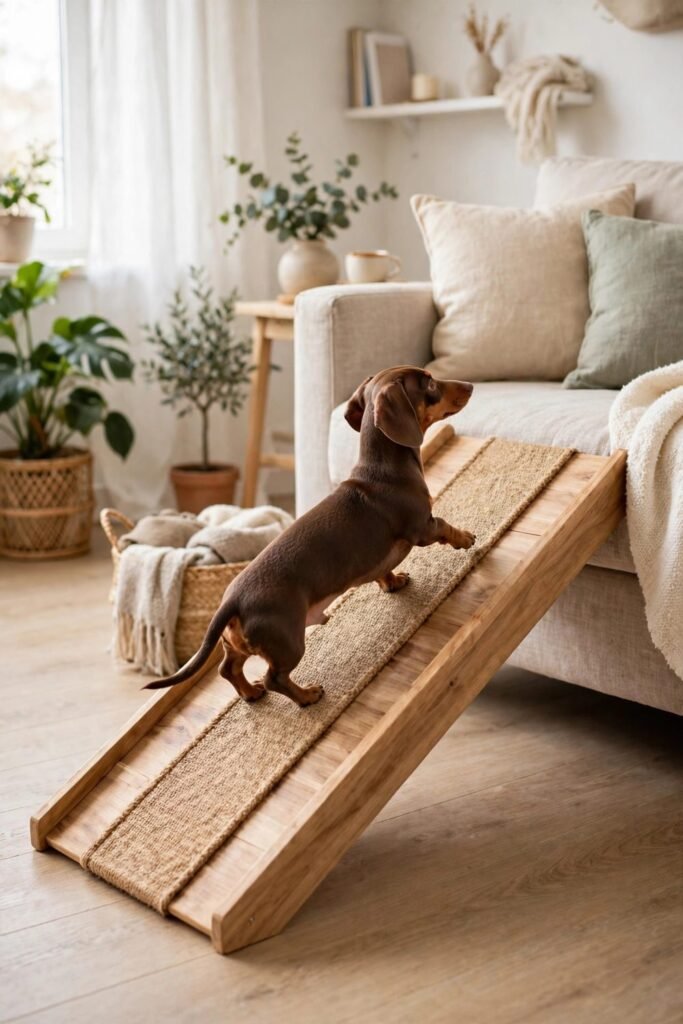
Pin this with one of these titles: “Ramp or Steps for a Dachshund? The Safer Way Up, Measured in 2 Minutes”, “Stop the Stair Jumps: A Dachshund Ramp Plan for Small Apartments”, or “Dachshund Back Care Checklist: Ramp, Steps, or Gate?”. Suggested pin description: “Measure your sofa, bed, and car first, then choose a ramp or pet steps that actually fits your apartment. Vet-sourced back-care guidance, no guesswork.”
Final Take
The best stairs alternative for dachshunds is the one your dog will use calmly, every day, in your actual flat. For most Dachshunds, that means a gentle ramp for the bed and car, and either a ramp or wide, low steps for a low sofa. Measure first, test stability, train slowly, and keep stairs gated where you can. With the right route in place, apartment life becomes much easier on a long Dachshund back, and your dog can still reach the sofa, the bed, and the car without the daily stair strain.