
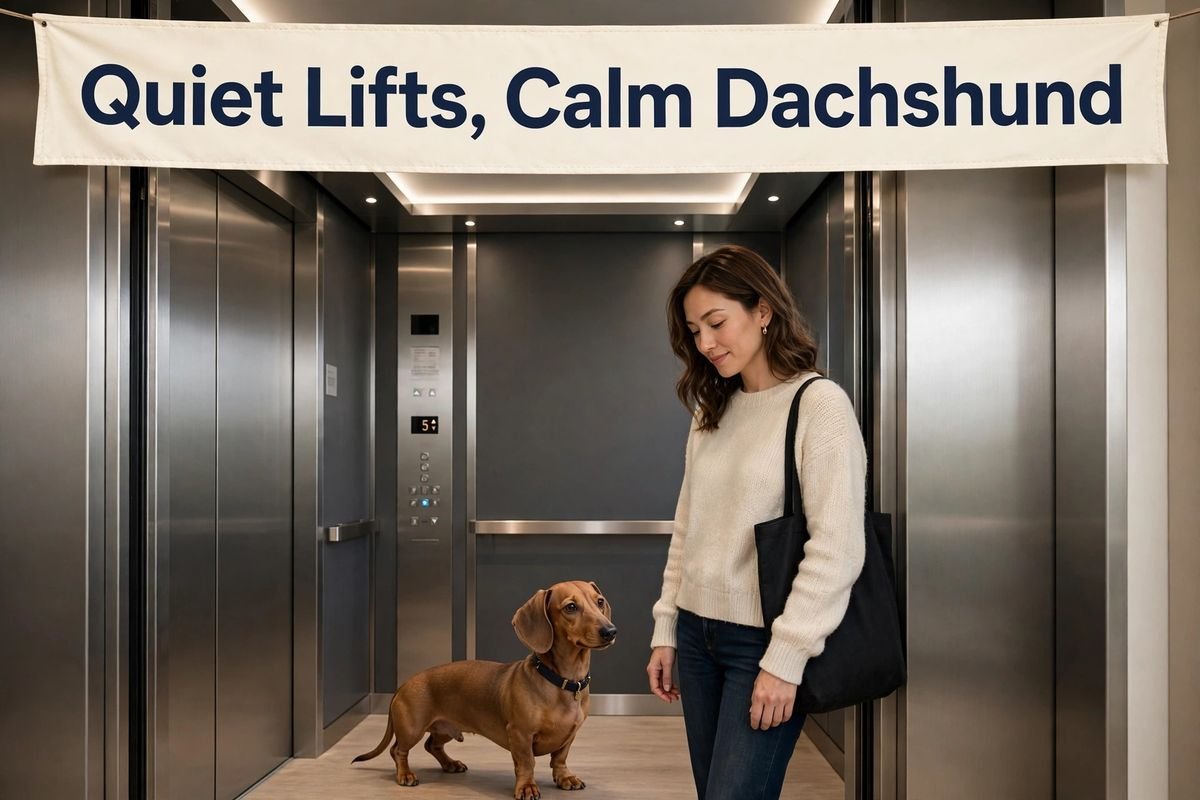
Dachshund Barking in the Elevator: Calm Lift Routine
Quick Answer
- A Dachshund barks in the elevator and stairwell because small, echoing spaces amplify sounds and smells, and strangers appear suddenly at close range with no room to move away.
- Wait for an empty lift, keep the dog close to your leg, reward calm standing, and ride one floor at a time while the routine is new.
- Practice the lift at quiet times, use a short lead, and ask the dog to sit or stand calmly before the doors open.
- Contact a veterinarian if barking comes with shaking, panting, hiding, or refusal to enter the lift, because fear, pain, or anxiety can sit behind sudden lift behaviour.
Contents
- 1. Why Lifts and Stairwells Trigger Barking
- 2. The Calm Wait: Before the Doors Open
- 3. Riding the Lift: One Floor at a Time
- 4. Stairwells, Landings, and Neighbours on the Stairs
- 5. Building a Lift Routine That Holds on Busy Days
- Elevator and Stairwell Comparison Checklist
- Common Mistakes
- When to Call Your Vet
- Pin This: Calm Lift Routine Checklist
- Frequently Asked Questions
- Conclusion
The lift doors open, a neighbour steps out, and the Dachshund erupts. Or the dog barks at every floor the lift passes, at the ding, at the mirror on the wall, at the stranger who gets in at the third floor. In a stairwell it is the same story with echoes: footsteps above, a door slamming below, a voice around the landing, and the dog barks at all of it. For apartment owners, the lift and the stairwell are the two places where barking is hardest to ignore, because every neighbour hears it.
This article explains why small shared spaces trigger barking, how to build a calm lift routine with waiting, short rides, and rewards, and how to handle stairwells and landings the same way. It is general information about training, not veterinary advice. A dog that suddenly fears the lift, or that barks with shaking, panting, or hiding, needs a veterinarian, not only a new routine.
1. Why Lifts and Stairwells Trigger Barking
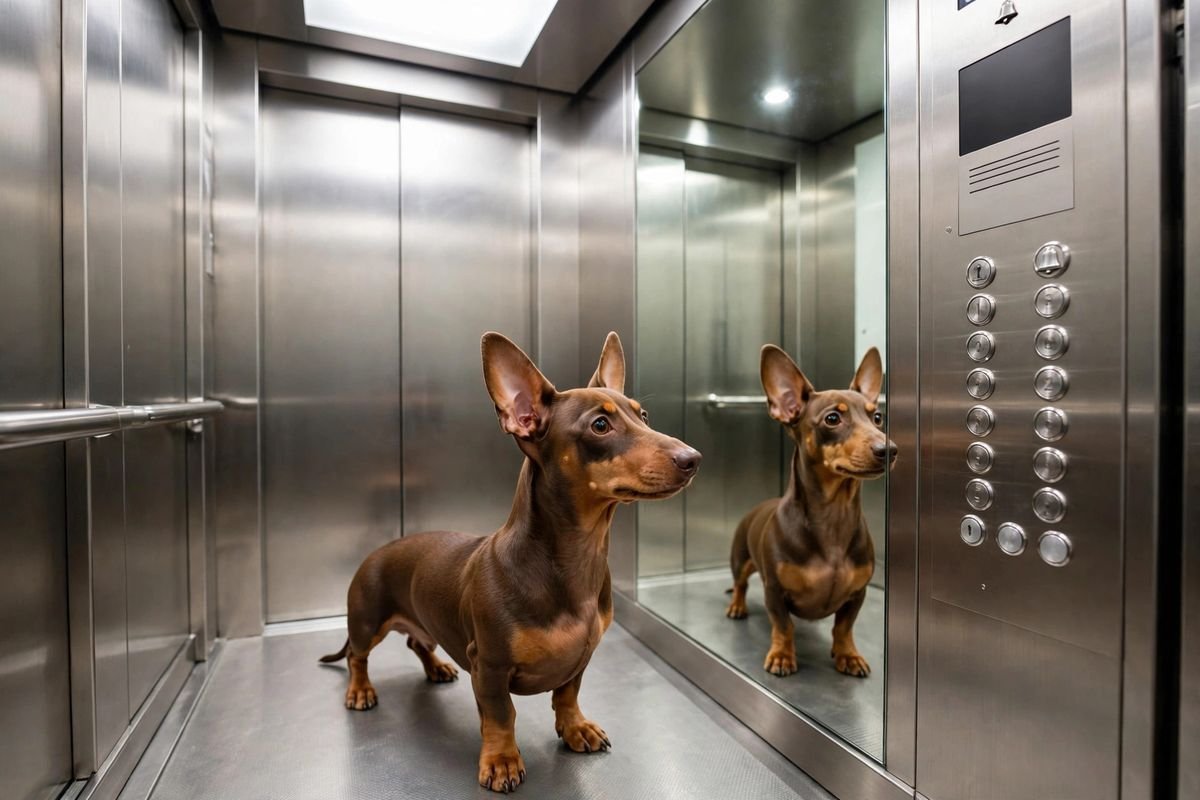
A lift is a small metal box that moves, and a Dachshund experiences it with senses far sharper than yours. The motor hums, the doors ding, the floor shifts under the dog’s feet, and the mirrors show movement on every side. Smells from every floor ride in the air, and a stranger can appear at arm’s length the moment the doors open, with no space to step back. For a small dog, that is a lot of surprise packed into a few square metres, and barking is the dog’s way of pushing the surprise away.
Stairwells add echo. Sound bounces off concrete walls and hard floors, so a footstep two floors up sounds close, and a slamming door sounds like it is right behind the dog. The dog cannot see where the sound came from, so it barks at the landing, the ceiling, and the stairs themselves. Corners make it worse, because a neighbour can round a landing without warning, and a dog that is startled at close range barks first and thinks later.
Trapped feeling drives the volume up. On a street, a dog can move away from a stranger. In a lift, the dog cannot, and the lead is short, so frustration adds to the surprise. The guide to barking at hallway and neighbour sounds covers the same pattern indoors, where sounds without a visible source set a dog off, and the lift is that pattern in its strongest form. The bark is the dog saying the space feels too small and too surprising.
2. The Calm Wait: Before the Doors Open
The lift routine starts before the doors open, in the hallway outside. Stand a little back from the lift doors, keep the lead short but loose, and ask the dog to sit or stand beside your leg. Reward the dog for waiting calmly while the lift arrives. The ding, the doors sliding open, and the light spilling out are all triggers, and a dog that is already calm and focused on you handles them far better than a dog that is straining at the lead.
Wait for an empty lift while the routine is new. If the doors open and a neighbour is inside, let them go and wait for the next one. That is not rude, and it is not a failure. It is training at the distance the dog can handle, and it is far kinder than squeezing a barking dog into a full lift. Press the button again, reward the wait, and ride alone. As the dog improves, you can ride with one calm neighbour, then with two, and the lift becomes ordinary.
Teach a wait cue at home first. Stand at the front door, ask the dog to wait, open the door a crack, and reward the dog for staying put. Repeat it until waiting feels normal, then use the same cue outside the lift. A dog that knows how to wait at a door can learn to wait at a lift, because the skill is the same: pause, look at the owner, and let the surprise pass. Keep the wait short at first, a few seconds, and build it slowly.
3. Riding the Lift: One Floor at a Time
Start with one floor. Step into the lift, stand the dog close to your leg facing the doors, and reward the dog for standing calmly. Ride one floor, step out, and reward again. One quiet floor is a win, and five quiet floors in a row come later. A dog that rides one floor calmly ten times in a week learns the lift faster than a dog that is forced through ten floors of barking in a single day.
Position matters inside the lift. Stand the dog at your side, near the corner, with its back to the wall if the lift is wide enough, so strangers do not step over the dog and the dog does not feel cornered. Keep the lead short so the dog cannot rush the doors when they open, but loose enough that it does not pull. Hold a treat in your closed hand near your leg, so the dog has something to focus on besides the ding and the mirror.
When the doors open at another floor, keep the dog close and reward the calm. If a neighbour steps in, a short “hello” to the neighbour helps, because your calm voice tells the dog this is normal. If the dog barks, do not shout over it. Wait for a pause, reward the pause, and step out at the next floor. The goal is not a silent dog. It is a dog that rides, waits, and steps out calmly, and that takes a week of short rides, not a single long one.

4. Stairwells, Landings, and Neighbours on the Stairs
Stairwells need the same calm routine, at a slower pace. Walk down the stairs on a short lead, pause at each landing, and reward the dog for waiting calmly before the next flight. Landings are the danger spots, because a neighbour can appear around the corner without warning, so pause before every landing, listen for footsteps, and let the dog look round the corner with you. A dog that walks into a surprise barks. A dog that pauses and sees it coming often does not.
Echoes need a different answer: keep moving. When a door slams or footsteps ring out above, do not stop and stare at the ceiling, because the dog will stare too and start barking. Keep walking at a steady pace, speak calmly, and reward the dog for walking with you. Movement gives the dog a job, and a dog with a job barks less than a dog standing still and listening to echoes.
Meet neighbours on the stairs with space and a greeting. Step to the side of the landing, keep the dog close to your leg, and let the neighbour pass with a friendly word. A neighbour who stops to say hello to the dog is a gift, because a calm greeting on the stairs teaches the dog that people in the stairwell are ordinary. The guide to barking when you leave the room covers the same idea of short, calm separations, and a stairwell greeting is a short, calm meeting that builds the same confidence.
5. Building a Lift Routine That Holds on Busy Days
Practice at quiet times first. Early morning and late evening, when the lift is empty and the stairwell is silent, are the best training hours. Ride one floor, wait calmly, step out, and repeat. Keep a small note of each ride: how many floors, how many barks, and whether the lift was empty or shared. The numbers show progress before your ears do, and they tell you when the dog is ready for the next step.
Add difficulty one piece at a time. First ride with one calm neighbour. Then ride two floors with a neighbour. Then ride at a busier time, when the lift stops at three floors. If the barking comes back at a new step, go back to the step that worked and stay there for a few more days. A routine that holds on a quiet Tuesday is the base for a routine that holds on a busy Saturday, and rushing the steps is what breaks it.
Busy days will still test the routine, and that is normal. A lift full of strangers, a dog on the next floor, a child pressing every button: these are hard days for any dog. On hard days, take the stairs if the dog is calmer there, or wait for the next lift. A routine that bends on a hard day and comes back the next morning is a routine that works. The goal is not perfection. It is a dog that rides the lift calmly most days, and a neighbour who no longer flinches when the doors open.

Elevator and Stairwell Comparison Checklist
| Lift or stair choice | Best for | Limit to watch |
|---|---|---|
| Empty lift, one floor | First calm rides, new routine | Needs quiet times, not rush hour |
| Dog at your side, near corner | Less surprise, fewer rushed doors | Small lifts leave little room to place the dog |
| Pause at every landing | See neighbours before they appear | Takes longer, plan extra minutes |
| Keep moving past echoes | Dog has a job, barks less at sounds | Do not rush a dog that is frightened |
Common Mistakes
- Forcing the dog into a crowded lift on the first day of training.
- Standing right at the lift doors, so surprises appear at arm’s length.
- Shouting over the barking inside a small metal box.
- Skipping the wait and stepping straight into the lift.
- Stopping on a landing to stare at the source of an echo.
- Riding ten floors at once before the dog can manage one calm floor.
- Dropping the rewards too early, so the routine falls apart on busy days.
When to Call Your Vet
Contact a veterinarian if a Dachshund suddenly refuses to enter the lift, shakes, pants heavily, hides, or barks far more than before, or if barking comes with limping, stiffness, or reluctance to walk. Sudden fear of a familiar lift can follow pain, hearing or vision changes, or anxiety, and a dog that is hurting may bark more because it feels less safe. Contact a veterinarian also if the dog injures itself lunging in the lift or on the stairs, or if it panics and tries to bolt. This article gives general information only and does not diagnose any condition. A veterinarian can check for pain, anxiety, and hearing or vision problems, and can refer the dog to a qualified behaviour professional if the barking needs more than a lift routine. Do not delay veterinary help for a dog that is frightened, in pain, or suddenly behaving very differently.
Pin This: Calm Lift Routine Checklist
- Wait for an empty lift while training.
- Stand back from the doors, dog at your leg.
- Reward the calm wait before the doors open.
- Ride one floor at a time at first.
- Keep the dog close, near the corner.
- Pause at every stair landing.
- Keep moving calmly past echoes.
Frequently Asked Questions
Why does my Dachshund bark at the lift mirror?
The mirror shows movement on every side, and the dog sees another dog that moves when it moves, but never approaches or leaves. That is confusing, and barking is the dog’s way of pushing the strange dog away. Standing the dog facing the doors, away from the mirror, and rewarding calm standing usually stops the mirror barking quickly.
Should I take the stairs instead of the lift?
Only if the dog is calmer on the stairs, and only for a few floors, because daily stair climbing adds strain to a long back. The lift is the better long-term choice for a Dachshund, so training the lift routine is worth the effort, even if the stairs are a useful backup on hard days.
How long does it take to train a calm lift routine?
Many dogs ride one floor calmly within a week of short daily practice, and ride shared lifts calmly within three to four weeks. Dogs that are already frightened of the lift take longer, and progress is not a straight line. Short daily rides beat one long session, and a bad day does not erase a good week.
What if a neighbour’s dog is in the lift?
Wait for the next lift while the routine is new. When the dog is ready, ride with a calm dog you know, at a distance, and reward your dog for standing calmly. If the other dog barks, step out at the next floor and try again another day. A barking lift is a hard test, not a first test.
Can I carry my Dachshund in the lift instead?
Carrying is a fine backup on a hard day, and it protects the back, but it does not teach the dog to ride calmly. Use carrying for crowded lifts or bad days, and keep practicing short calm rides on quiet days, so the dog learns the lift itself rather than only learning to be carried through it.
Conclusion
Lift barking comes from surprise in a small space, and it changes with waiting, short rides, and rewards for calm. Wait for an empty lift, ride one floor at a time, pause at landings, and keep moving past echoes, and the lift becomes an ordinary part of the day.



One Comment