
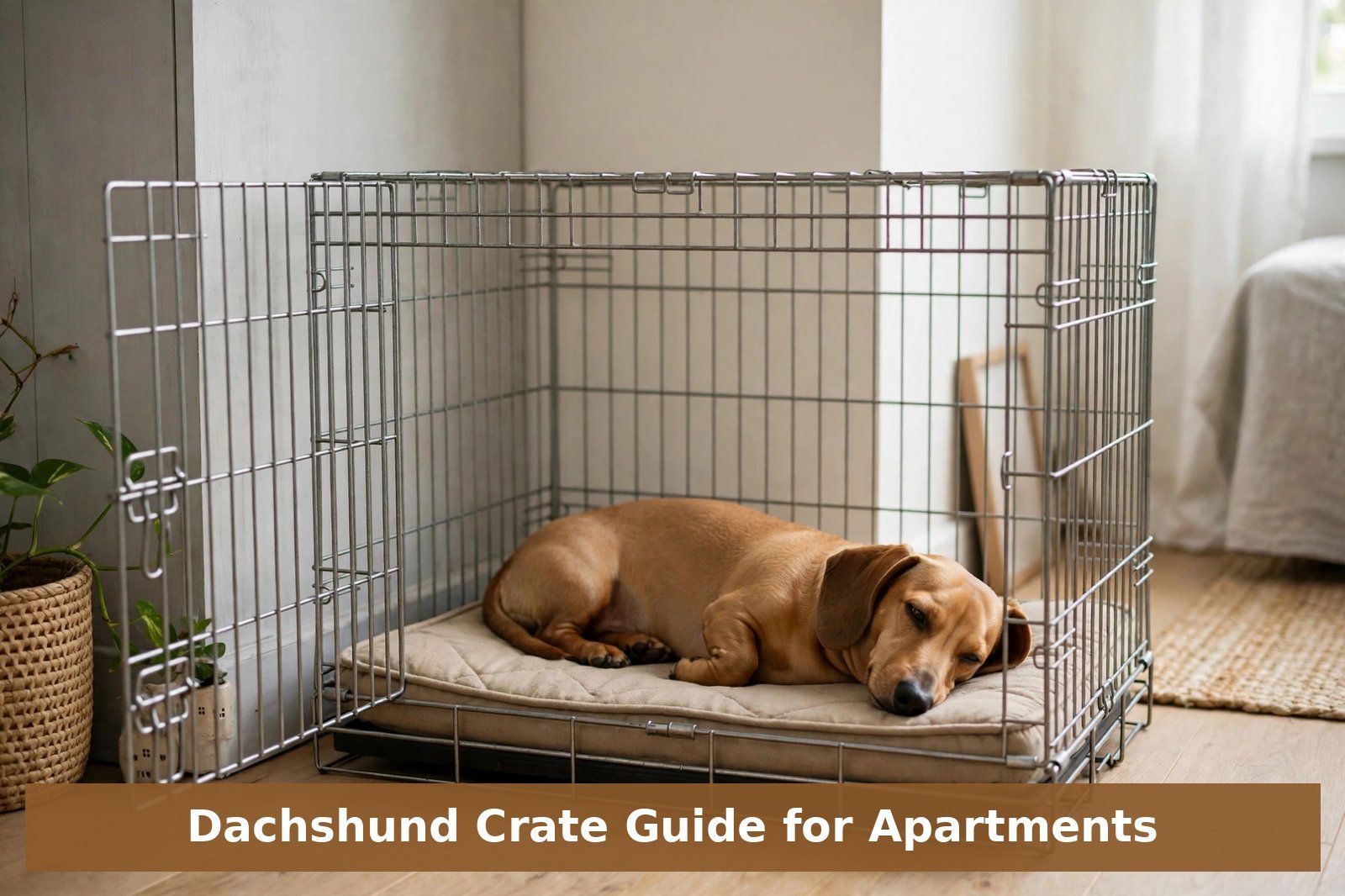
Dachshund Crate Guide for Apartment Living: Size & Setup
Quick Answer
- A crate should work as a calm den, not as a punishment space: large enough for a Dachshund to stand, turn, and stretch out, with a flat, supportive base.
- Choose a sturdy crate with a secure door, good airflow, and a low step-in height, so a short-legged dog can enter without jumping or scrambling.
- Introduce the crate slowly with short, calm sessions, meals inside, and a quiet resting routine, rather than closing the door for long periods on day one.
- Never use a crate to confine a dog for most of the day, and ask a veterinarian about crate rest, back pain, or any sudden change in movement.
Contents
- 1. Why a Crate Helps in a Small Apartment
- 2. Crate Size, Type, and Door Safety
- 3. Setting Up a Back-Friendly Crate Den
- 4. Crate Training Steps That Stay Calm
- 5. Cleaning, Night Use, and When to Stop Using a Crate
- Crate Comparison Checklist
- Common Mistakes
- When to Call Your Vet
- Pin This: Crate Setup Checklist
- Frequently Asked Questions
- Conclusion
A crate gives a Dachshund one clear place to rest in a busy apartment. Doors open and close, visitors arrive, deliveries happen, and a small dog can feel unsure about where to settle. A well-chosen crate answers that uncertainty: a defined den, in a quiet corner, with familiar bedding, where rest is expected and nothing is demanded of the dog.
This guide explains how to choose and set up a crate for apartment living. It covers size, crate types, bedding, training steps, cleaning, and night use, with clear limits. A crate does not train a dog by itself, does not replace walks and play, and does not solve barking, chewing, or house-training problems on its own. Used calmly and for reasonable periods, it supports rest, routine, and safety in a small home.
1. Why a Crate Helps in a Small Apartment
In a small apartment, a dog’s resting space often overlaps with walkways, cooking areas, and doorways. That overlap can make rest harder: the dog is stepped around, startled by passing feet, or drawn to every sound at the door. A crate placed in a quiet corner separates rest from traffic. The dog learns that the crate is the place where nothing happens, which helps calm settling after walks, meals, and play.
A crate also helps during short absences, repairs, and visits. Instead of roaming a room full of cables, cleaning products, and open doors, the dog rests in a safe, enclosed space for a short period. That safety only holds if the crate is introduced kindly and used for limited periods. A dog left crated for most of the day will not become calmer; it will become restless, stiff, and frustrated, and may develop new behaviour problems.
For a Dachshund, low entry matters from the start. A high crate lip forces a short-legged dog to jump or scramble in and out, which is hard on the back over time. Dachshunds are prone to disc problems, and general information from the Animal Medical Center on intervertebral disc disease explains why back care deserves attention in this breed. A low, ramped, or step-assisted entry, plus a flat sleeping surface, keeps crate use consistent with the back-friendly habits used elsewhere in the home.

2. Crate Size, Type, and Door Safety
Size is measured by the dog, not by the room. A Dachshund should be able to stand without crouching, turn around easily, and lie stretched out on its side. Measure the dog from nose to tail base while stretched, and add a little room for bedding. A crate that is too small restricts movement and rest; a crate far too large can feel less den-like, though a divider panel can adjust the space for a growing puppy.
Crate types suit different homes. Wire crates give airflow and visibility, and many fold flat for storage, which helps in a small apartment. Plastic travel-style crates feel more enclosed and den-like, and suit dogs that settle better with less visual stimulation. Soft fabric crates are light and portable but suit only dogs that will not chew or push through fabric. Choose the type the dog settles in, not the type that looks neatest in the room.
Door safety deserves a close check before purchase. Latches should close firmly with one hand, without sticking or popping open under pressure. Door hinges should not pinch paws or fur, and any gap around the door should be too small for a paw or jaw to catch. Test the latch several times in the shop or at home, and check it again after washing, because a worn latch is a common reason a crate stops being safe.
3. Setting Up a Back-Friendly Crate Den
Place the crate in a quiet corner away from the front door, radiators, and draughty windows. The spot should be easy for the dog to reach without stairs or a jump, and easy for the owner to reach for cleaning. In a studio apartment, a corner near the bed or sofa often works, because the dog can rest near people without being in the walkway. Avoid placing the crate in a hallway where every passer-by disturbs rest.
Bedding should be flat, firm, and washable, rather than deep and lumpy. A thin, supportive pad with a washable cover suits a Dachshund’s back better than a pile of loose blankets that bunch under the body. Add one familiar-smelling blanket or item of bedding, and a safe chew or toy only if the dog will not destroy it unsupervised. Water should be available outside crate sessions, and a spill-proof bowl can be used for short periods if the dog is settled.
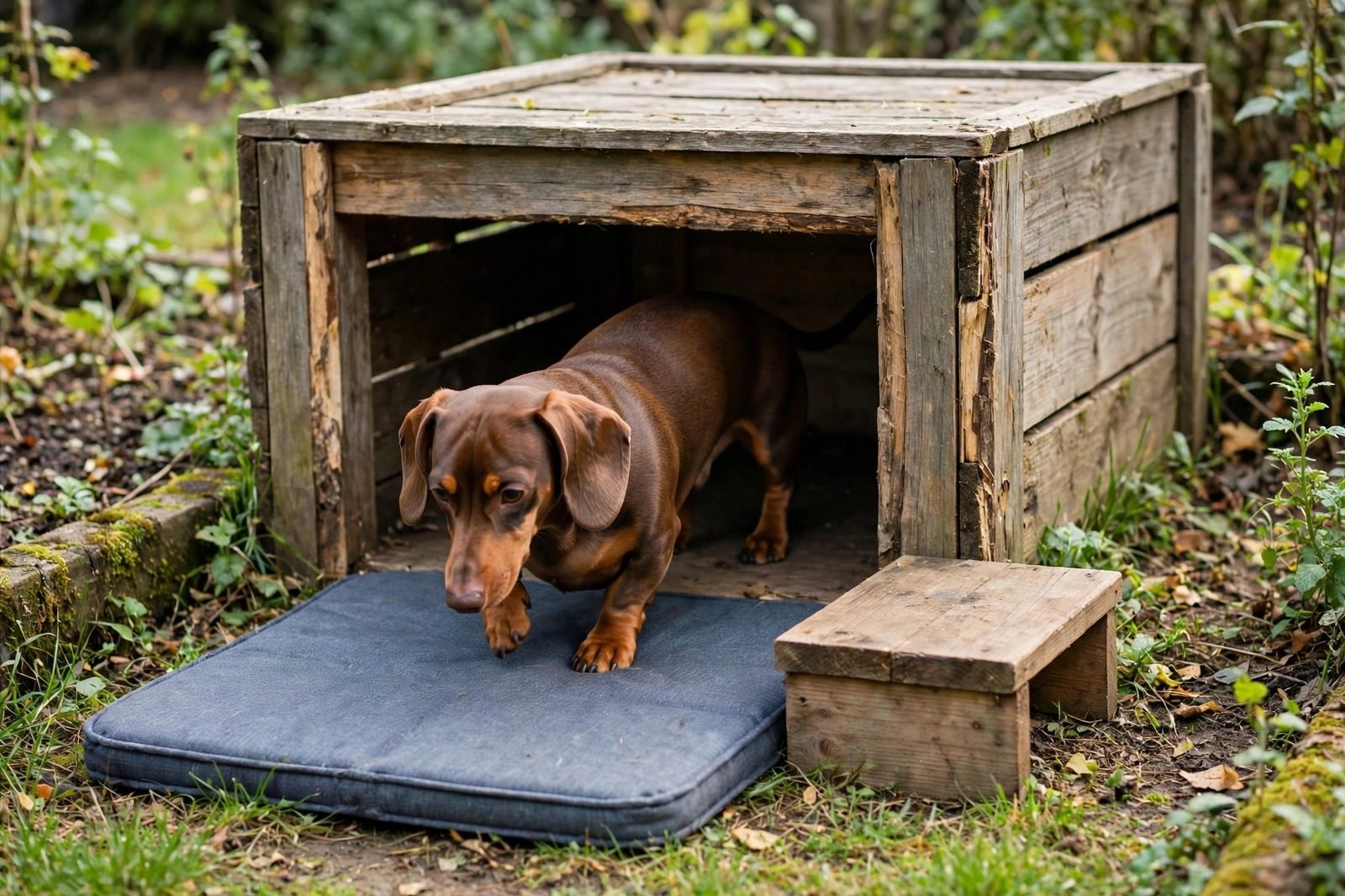
Keep the crate entrance clear and low. A small, stable step or a low ramp at the door helps a short-legged dog enter without jumping, and the same step should be used every time so the habit becomes automatic. The guide to indoor playpen setup for apartments covers similar ideas for defined safe spaces, and a crate and a playpen can work together: the crate for sleep, the playpen for calm daytime space. Covering part of a wire crate with a breathable cover can make it feel more den-like, but leave airflow and the door area uncovered.
4. Crate Training Steps That Stay Calm
Start with the door open and the crate simply present. Place meals, treats, and a favourite toy just inside the door, then gradually further inside, over several days. Let the dog enter and leave freely, and praise calm entry without excitement. The goal in the first days is a simple association: the crate is a safe, boring, pleasant place, not a trap that closes behind the dog.
Next, close the door for very short periods while the owner stays nearby. Begin with a few minutes during a calm activity, such as reading, then open the door before the dog becomes distressed. Build duration slowly, and always let the dog out calmly, without a big fuss. If the dog barks, paws, or panics, the step was too long: go back to a shorter period and rebuild. Forcing a distressed dog to stay inside teaches fear of the crate, not calmness.
Build a simple routine around the crate: a short walk or play session, a toilet break, then a calm crate rest with a safe chew or nothing at all. Keep the routine consistent at night and during short absences. Young puppies need frequent toilet breaks and cannot be crated for long stretches; adult dogs still need regular breaks, exercise, and company. The guide to apartment essentials for Dachshunds places the crate alongside a ramp, harness, and bed as part of a joined-up home setup, rather than a single fix on its own.
5. Cleaning, Night Use, and When to Stop Using a Crate
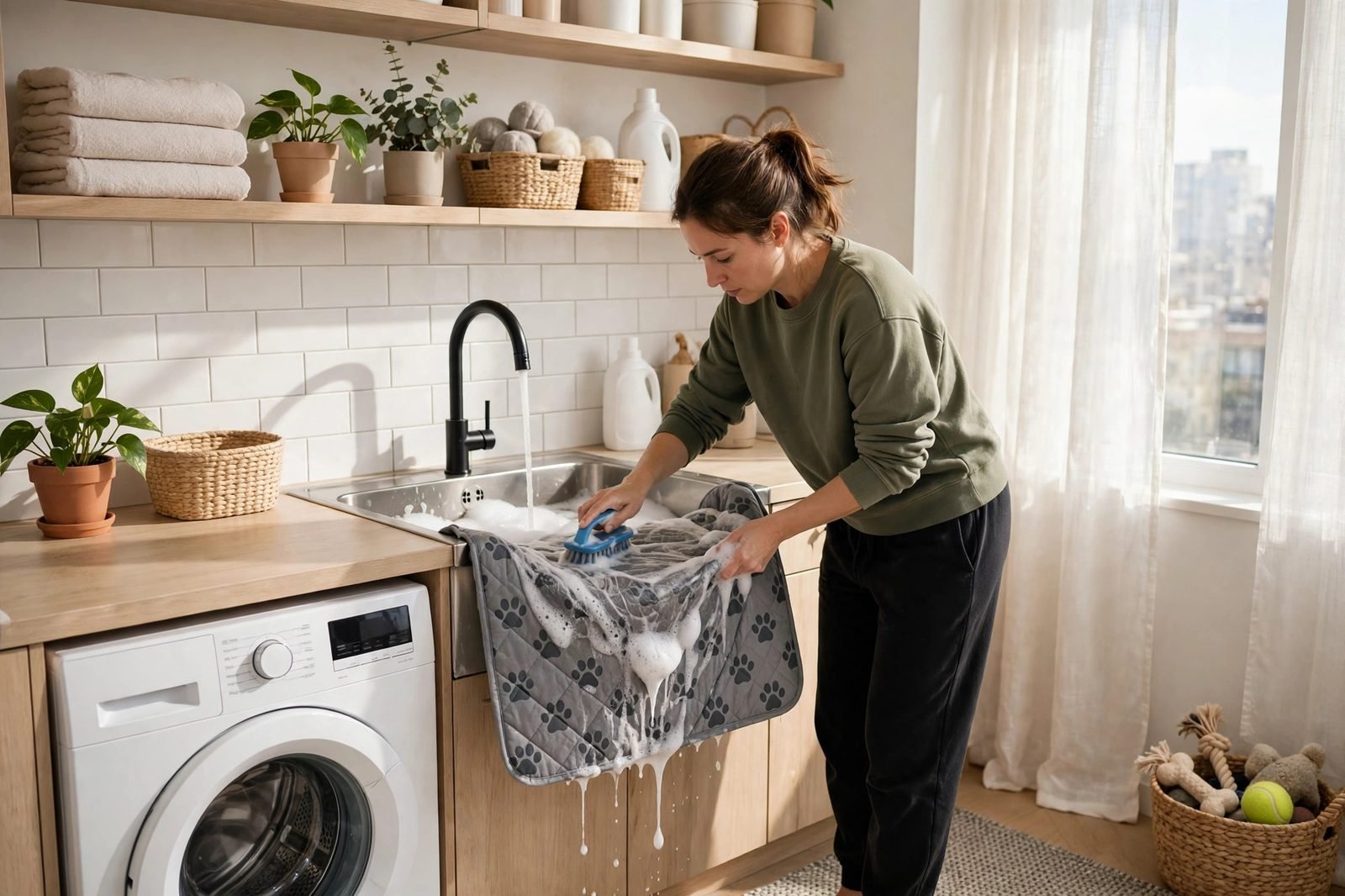
Clean the crate weekly, and spot-clean bedding as needed. Remove the pad and cover, wash them on a gentle cycle, wipe the crate base and bars, and dry everything fully before reassembling. A damp crate smells, irritates skin, and discourages the dog from settling. Check the crate during cleaning for bent wires, cracked plastic, loose latches, and chewed fabric, and repair or replace damaged parts promptly.
At night, keep the crate in the bedroom or nearby for the first weeks, so the dog can hear and smell people close by. A puppy that cries at night may need a toilet break, not discipline. As the dog settles, the crate can move to its long-term corner, provided the dog still sleeps calmly. Some adult dogs continue to use a crate with the door open as a chosen den for life; others prefer a bed. Both are fine, as long as the dog rests well.
Stop or change crate use if the dog shows fear, injury, or distress, or if a veterinarian advises rest in a different setup. Dogs with back pain may need a larger, flatter resting area, or a pen rather than a crate, during recovery. Cornell’s information on chondrodystrophy and disc disease notes that this breed faces higher disc risk, so any change in how a dog moves, jumps, or settles should prompt veterinary advice, not a longer period confined in a crate. A crate is a tool for calm rest, not a treatment for pain or illness.
Crate Comparison Checklist
| Crate type | Best for | Limit to watch |
|---|---|---|
| Wire crate | Airflow, visibility, folding storage | Less den-like, needs a cover for some dogs |
| Plastic crate | Enclosed den feeling, travel use | Heavier, less airflow, harder to store |
| Soft fabric crate | Light travel, calm non-chewing dogs | Not chew-proof, not for unsupervised use |
| Crate with divider | Growing puppies, adjustable space | Divider must stay secure and gap-free |
Common Mistakes
- Choosing a crate too small for the dog to stretch out fully.
- Using the crate as punishment, so the dog fears it.
- Closing the door for long periods on the first day.
- Leaving a dog crated for most of the day without breaks.
- Using a high crate lip that forces jumping in and out.
- Ignoring a worn latch, bent wire, or chewed fabric panel.
- Expecting a crate alone to fix barking or house-training.
When to Call Your Vet
Contact a veterinarian if the dog shows back pain signs, reluctance to move or jump, yelping when lifted, weakness in the legs, loss of bladder or bowel control, or any sudden change in movement or behaviour. This article gives general information only and does not diagnose any condition. A veterinarian can examine the dog and advise whether crate rest, a different resting setup, or further checks are needed. Do not confine a dog in pain in a crate for long periods without veterinary guidance, and seek prompt help for any sudden weakness or collapse. A veterinarian should also be consulted before starting crate rest after an injury, because rest plans differ by condition.
Pin This: Crate Setup Checklist
- Size the crate for standing, turning, and stretching out.
- Choose a low entry so the dog never has to jump in.
- Place the crate in a quiet corner away from traffic.
- Use flat, firm, washable bedding, not a lumpy pile.
- Introduce the crate with the door open first.
- Build door-closed time slowly, in short calm steps.
- Clean weekly and check latches, wires, and fabric.
Frequently Asked Questions
How long can a Dachshund stay in a crate?
Only for short, reasonable periods with regular toilet breaks, exercise, and company. Puppies need very frequent breaks, and no dog should be crated for most of the day. If long absences are unavoidable, a playpen, a dog sitter, or a different plan is kinder.
Should the crate door stay open at night?
Once a dog is crate-trained and settles calmly, many owners leave the door open so the dog can choose the crate as a den. During early training, a closed door for sleep is normal, provided the dog is calm and can be heard if it needs a toilet break.
Is a crate cruel for a Dachshund?
A crate used kindly, for short periods, as a den, is not cruel. A crate used as punishment, or for most of the day, is not fair to the dog. The difference lies in duration, introduction, and whether the dog enters willingly and rests calmly.
What if the dog cries in the crate?
Check for a toilet need, hunger, or distress first. If the dog is settled and safe, shorten the session and rebuild slowly. Persistent panic, injury attempts, or escape behaviour should prompt a change of plan and, if needed, advice from a veterinarian or qualified trainer.
Can a crate help with house-training?
It can support a routine, because most dogs avoid soiling their sleeping area. It does not replace frequent toilet breaks, praise for outdoor success, and patience. Accidents in the crate usually mean the session was too long or the puppy needed a break sooner.
Conclusion
A Dachshund crate for apartment living works when it is sized for stretching, entered without jumping, placed in a quiet corner, and introduced in short, calm steps. That setup gives a small dog a reliable den in a busy home, and supports the rest, routine, and back-friendly habits that matter most for this breed.





One Comment