Dachshund Barking at the Robot Vacuum: Calm Routine
Quick Answer
- A Dachshund that barks at the robot vacuum is reacting to a moving, noisy object that comes toward it. The movement, the hum, and the bumping into furniture all feel threatening.
- Start with the vacuum off and still. Let the dog sniff it, reward calm looking, and only then run it for a few seconds at a time.
- Give the dog a safe spot in another room or on a raised bed, where it can watch from a distance and walk away.
- Run the vacuum on a schedule, at the same time each day, so the dog learns when it starts and when it stops.
- Most Dachshunds settle within two to three weeks of short, calm sessions.
Contents
- 1. Dachshund Barking at the Robot Vacuum Explained
- 2. Reading the Bark: Fear, Herding, or Play
- 3. The Slow Introduction: Off, Then Short Runs
- 4. The Daily Vacuum Routine That Keeps the Peace
- 5. When the Vacuum Moves, Bumps, and Changes Direction
- Robot Vacuum Calm Plan
- Common Mistakes
- When to Call Your Vet
- Pin This: Calm Robot Vacuum Routine
- Frequently Asked Questions
- Conclusion
1. Dachshund Barking at the Robot Vacuum Explained
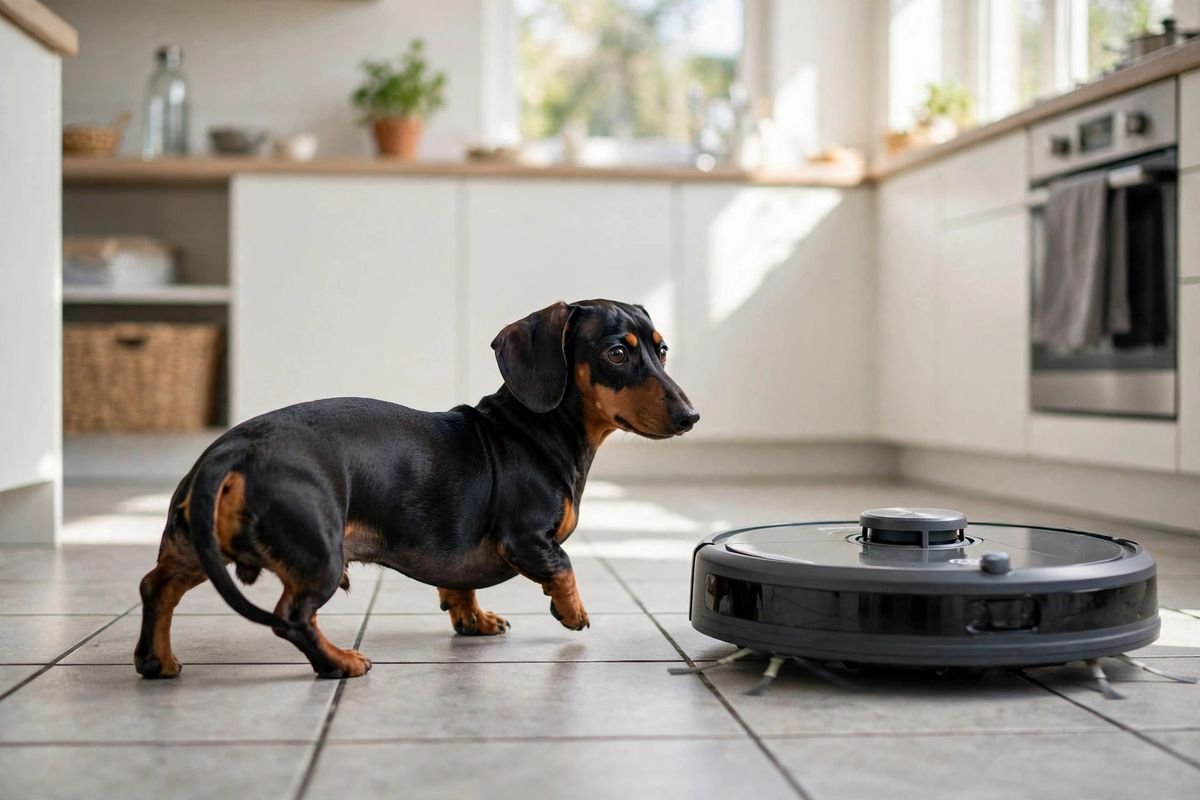
Dachshund barking at the robot vacuum starts with movement. A robot vacuum is a low, round object that moves on its own, changes direction without warning, hums the whole time, and bumps into chair legs and walls. Nothing else in the home behaves like that. The dog cannot predict where it will go next, and a dog that cannot predict a moving object will bark at it. The bark is the dog’s way of trying to control something that will not sit still.
The sound matters as much as the movement. A robot vacuum hums, whirs, and clicks as it crosses different floors, and the pitch changes when it climbs onto a rug or bumps into a wall. A Dachshund hears all of it, and the noise never stops while the vacuum runs. The dog’s hearing is far sharper than a person’s, so a hum that sounds mild to the owner can sound loud and constant to the dog. Add the vibration through the floor, and the vacuum becomes a noisy intruder the dog cannot escape, because it follows the same floor plan.
The vacuum also comes toward the dog. A normal vacuum stays where the owner pushes it, but a robot vacuum wanders, and it will roll straight at a dog lying on the floor. A Dachshund resting on its bed will suddenly find a humming disc heading for its paws, and the natural answer is to bark, jump up, and chase it away. Some dogs learn to chase the vacuum around the room, barking the whole time, and the chase becomes a game that the dog plays every day. The barking is not stubbornness. It is a dog reacting to a strange machine the only way it knows how.
2. Reading the Bark: Fear, Herding, or Play
A fear bark at the robot vacuum is high and sharp, with the dog backing away, ears flat, tail tucked, and the bark coming in fast bursts while the dog keeps its distance. The dog wants the vacuum to stop and go away, and it will often retreat to another room or behind the owner’s legs. A dog in this state needs the vacuum farther away and the sessions shorter. Pushing a frightened dog closer only makes the fear worse.
A herding bark is lower and more rhythmic, with the dog trotting behind the vacuum, nipping at its edges, and barking in time with its movement. Dachshunds were bred to work and to chase, and a moving disc can wake up that old instinct. The dog is not afraid. It is trying to control the vacuum the way it would control a moving animal. This bark is the hardest to fix, because the chase itself is rewarding. The fix is to stop the chase: keep the dog on its bed or behind a barrier while the vacuum runs, and reward lying still.
A play bark is short and broken, with a loose body, a wagging tail, and the dog bouncing toward the vacuum and then away again. The dog thinks the vacuum is a toy, and the barking is part of the game. This bark is the easiest to work with, because the dog is not stressed, only excited. A chew, a settle spot, and a calm owner usually turn play barking into watching, and watching into ignoring, within a week or two of short sessions.
3. The Slow Introduction: Off, Then Short Runs
Start with the vacuum off, still, and unplugged, sitting in the middle of the room. Let the dog walk up to it, sniff it, and walk away. Put a treat on top of the vacuum or on the floor beside it, so the dog has a reason to approach. If the dog barks, wait for a pause and reward the pause. Do this for two or three days, in short sessions of three to five minutes, until the dog walks past the still vacuum without barking. A dog that is calm around a still vacuum has already learned half the lesson.
Next, turn the vacuum on for a few seconds, then off again. The dog hears the hum and sees it move a few inches, and then it stops. Reward the dog for staying calm, or for looking at the vacuum and then looking away. Repeat this five or six times in a session, and keep the sessions short. Over several days, make the runs longer: ten seconds, then thirty, then a minute. If the barking comes back at any step, go back to the last run length where the dog was calm and stay there for another day.
When the dog can watch a one-minute run calmly, run the vacuum in the next room, with the door open, while the dog stays on its bed with a chew. The distance and the chew both help, and the dog learns that the vacuum sound means lying down and chewing, not barking and chasing. Over a week, move the vacuum closer to the dog’s room, a little at a time, until it runs in the same room while the dog lies on its bed. The guide to barking at vacuums and household appliances covers the same slow method for a normal vacuum, a mop, and other noisy machines around the home.

4. The Daily Vacuum Routine That Keeps the Peace
Once the dog accepts the vacuum, a daily routine keeps the peace. Run the vacuum at the same time each day, so the dog learns when it starts and when it stops. A dog that knows the vacuum runs after breakfast will settle faster than a dog that never knows when the noise will begin. Keep the run short at first, twenty or thirty minutes, and give the dog its settle spot and a chew before the vacuum starts.
Set up the dog’s spot before the vacuum starts, not after the barking begins. A bed in a room the vacuum will reach last, a chew, and a door the dog can choose to go behind all help. The dog should have a choice: stay and watch, or leave and rest somewhere quiet. A dog with a choice barks less than a dog that feels trapped with the vacuum. In a small apartment, the bedroom can be the quiet room, with the door left open.
Stay calm while the vacuum runs. The dog watches the owner closely, and an owner who sighs, rushes around, or shouts at the dog teaches the dog that the vacuum is a stressful event. An owner who sits down, reads, or works quietly teaches the dog that the vacuum is boring. If the dog barks, do not look at it or talk to it. Wait for a pause, drop a treat quietly near the bed, and carry on. The treat says that quiet is the behavior that pays, and the vacuum says nothing at all.
5. When the Vacuum Moves, Bumps, and Changes Direction
The hardest moments are the surprises: the vacuum bumps into the dog’s bed, changes direction suddenly, or gets stuck under the couch and whines for help. Each surprise can restart the barking, even in a dog that was calm yesterday. The fix is to make the surprises smaller: clear the floor before the vacuum runs, so it bumps into fewer things. Put the dog’s bed against a wall where the vacuum rarely goes, and block the gap under the couch so the vacuum cannot get stuck there.
Some vacuums have a quiet mode, a slow mode, or a schedule that runs one room at a time. Use the quietest setting that still cleans, and run one room at a time so the dog always has a quiet room to retreat to. A vacuum that cleans the whole apartment at once leaves the dog nowhere to go, while one that cleans room by room gives the dog a break between rooms. The break matters more than the noise level, because a dog that gets a break can settle again before the next room starts.
Leaving the dog alone with a running vacuum is a separate problem. A dog that is calm when the owner is home may bark, chase, or panic when the vacuum starts while the owner is out, and the guide to barking when you leave the room covers the wider problem of being left alone. In general, do not schedule the vacuum to run while the dog is home alone until the dog is fully calm with it while the owner is present. A dog that panics alone can hurt itself chasing the vacuum, and the barking will be worse the next time because the dog remembers the fright.

Robot Vacuum Calm Plan
| Step | What to Do | What Good Looks Like |
|---|---|---|
| Days 1 to 3 | Vacuum off and still; let the dog sniff it; treats nearby | Dog walks past it without barking |
| Days 4 to 6 | Short runs of a few seconds, then off again | Dog watches the hum and stays calm |
| Days 7 to 10 | Runs of a minute in the next room; dog on its bed | Dog lies down and chews during the run |
| Days 11 to 14 | Vacuum in the same room; quiet mode; one room at a time | Dog rests while the vacuum works |
| Daily routine | Same time each day; bed, chew, and quiet room ready | Dog settles before the vacuum starts |
| Surprises | Clear the floor; block gaps under furniture | Fewer bumps and stuck moments |
The plan works best when each step is finished before the next one starts. If the barking comes back, go back one step and stay there for another day or two.
Common Mistakes
- Turning the vacuum on at full power in front of the dog on the first day.
- Letting the dog chase the vacuum around the room, which turns the barking into a daily game.
- Shouting at the dog over the vacuum noise, which adds more noise to an already noisy moment.
- Running the vacuum while the dog is home alone before it is calm with it.
- Moving the dog’s bed into the vacuum’s path, or leaving the dog with nowhere to retreat.
- Skipping the still-vacuum step and going straight to a full cleaning run.
- Rewarding the dog while it is still barking, which teaches the dog that barking earns treats.
- Changing the vacuum schedule every day, so the dog never learns when the noise starts and stops.
When to Call Your Vet
Contact a veterinarian if the barking comes with shaking, hiding for hours, loss of appetite, or a refusal to enter a room for more than a few days. Contact a veterinarian promptly if the dog seems in pain, yelps when touched, or shows sudden changes in behavior, such as barking far more than usual or becoming withdrawn. A veterinarian can check whether anxiety, pain, or a health problem is driving the behavior, and can advise on the next steps. This article gives general information only and is not a diagnosis.
Pin This: Calm Robot Vacuum Routine
- Start with the vacuum off and still; let the dog sniff it.
- Run it for a few seconds at a time, then longer each day.
- Give the dog a safe spot and a chew before the vacuum starts.
- Run it at the same time each day, one room at a time.
- Clear the floor so the vacuum bumps into fewer things.
- Never run it while the dog is home alone until the dog is calm.
Frequently Asked Questions
Why does my Dachshund chase the robot vacuum?
The vacuum moves on its own, and a moving object wakes up the chase instinct in many Dachshunds. The chase is rewarding by itself, so the dog repeats it every day. Stop the chase by keeping the dog on its bed or behind a barrier while the vacuum runs, and reward lying still instead of following.
Should I let my Dachshund sniff the robot vacuum while it is running?
No. Let the dog sniff it only while it is off and still. A running vacuum can catch a nose, a paw, or a long ear, and a fright from a moving machine will make the barking worse. Sniffing the still vacuum teaches the dog what it is, and that is enough.
How long does it take for a Dachshund to accept a robot vacuum?
Most Dachshunds settle within two to three weeks of short, calm sessions. A very fearful dog, or a loud vacuum, can take four weeks. If the barking is getting worse instead of better after two weeks, go back to the last step where the dog was calm and stay there longer.
What if my Dachshund barks at the vacuum even in another room?
Sound travels through a small apartment, so the dog may hear the vacuum even behind a closed door. Use the quietest setting, run one room at a time, and give the dog a chew in the farthest room.
Can I run the robot vacuum at night while my Dachshund sleeps?
It is better to run it during the day, when the dog is awake and can choose where to settle. A vacuum that starts at night can wake the dog suddenly, and a dog woken by a humming machine will bark more. Keep nights quiet.
Conclusion
A robot vacuum is a strange machine to a Dachshund: it moves on its own, hums without stopping, and comes toward the dog. A slow introduction, a safe spot, and the same time each day turn it into background noise within a few weeks. As a next step, put the vacuum in the middle of the room today, switched off, and let the dog sniff it with a treat nearby.