Dachshund Barking at Doorbell and Knocking: Quiet Plan
Quick Answer
- Dachshund barking at doorbell and knocking usually means the dog has learned that both sounds predict a stranger at the door, so it rushes forward and barks to warn the household.
- Train the two sounds separately first, then together, so the dog learns that a ring and a knock both mean the same calm job: go to a mat, lie down, and wait.
- Never shout over the barking, open the door while the dog is barking, or rush to the door, because each of those reactions rewards the noise and teaches the dog that barking works.
- Practice with short, quiet recordings and gentle knocks on a table before using the real doorbell, and keep every session under five minutes.
- Most Dachshunds show clear improvement within two to three weeks of steady daily practice, with calmer greetings and shorter barking bursts at the door.
Contents
- 1. Dachshund Barking at Doorbell and Knocking Explained
- 2. Why Two Sounds Are Harder Than One
- 3. The Two-Sound Quiet Plan: Mat, Wait, and Reward
- 4. Real Door Practice: Visitors, Deliveries, and Surprises
- 5. Keeping the Door Calm for Good
- Doorbell and Knocking Quiet Plan
- Common Mistakes
- When to Call Your Vet
- Pin This: A Quieter Doorbell and Knock
- Frequently Asked Questions
- Conclusion
1. Dachshund Barking at Doorbell and Knocking Explained
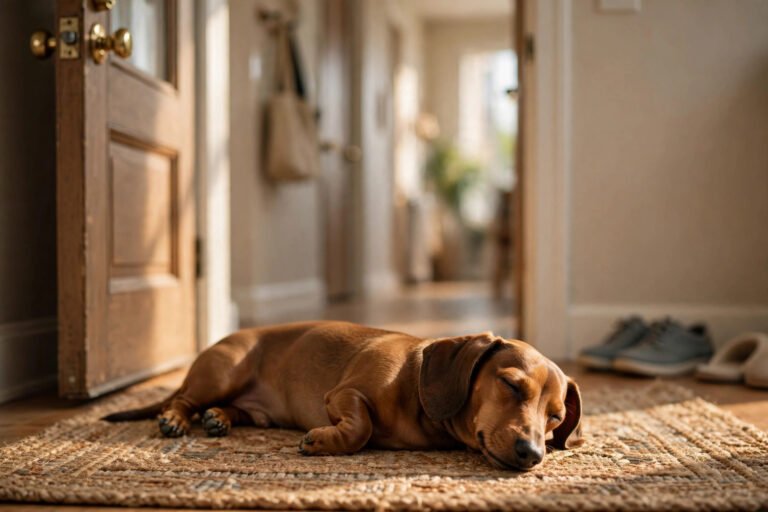
Dachshund barking at doorbell and knocking starts with a simple prediction. The doorbell rings, a stranger appears, and the whole household changes in a few seconds. A knock does the same thing, only without the electronic sound. The dog learns fast that both sounds mean the same event: someone is at the door and something unexpected is about to happen. Barking is the dog’s answer to that prediction, and it often begins before the owner has even stood up.
The sound itself matters too. A doorbell is sharp and sudden, and a knock is lower and heavier, often coming in a burst of thuds. A Dachshund’s hearing is far sharper than a person’s hearing, so both sounds arrive louder for the dog. The dog cannot see who is outside or know when the sound will come next, so barking becomes its way of taking charge of a surprise it cannot predict.
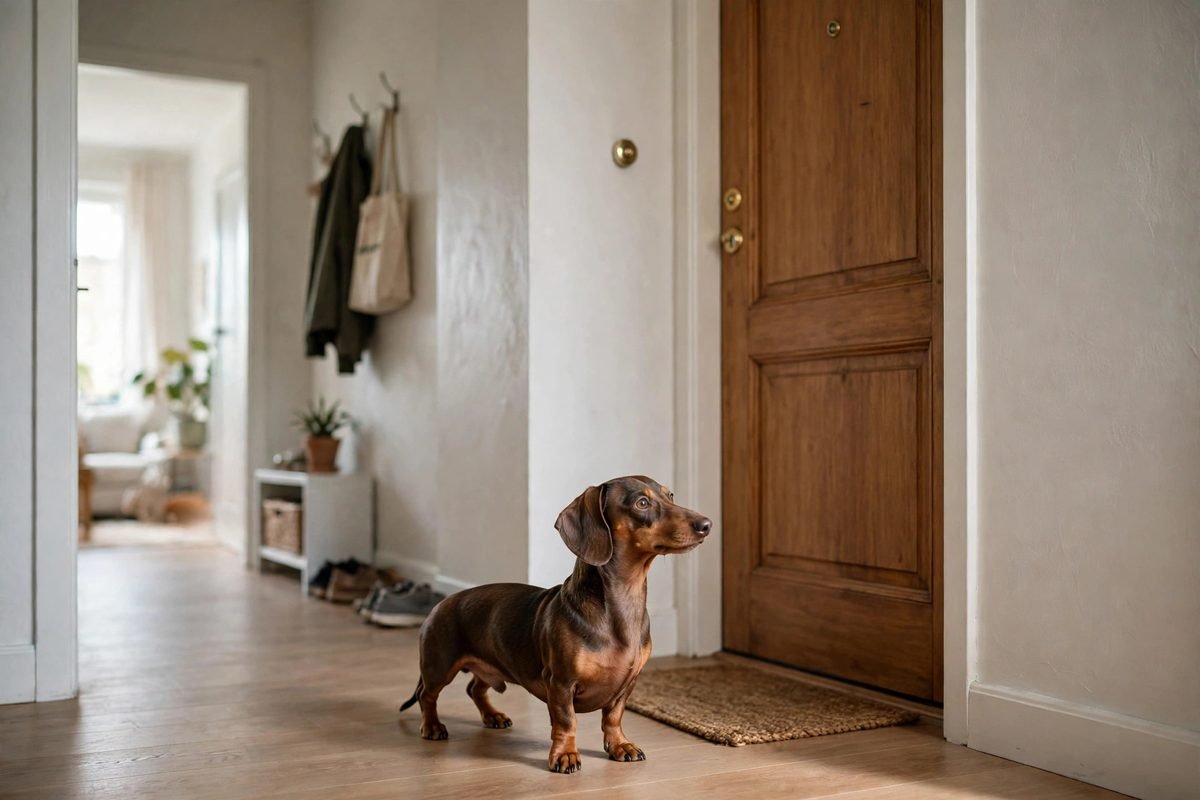
The rush to the door makes the barking worse. The owner jumps up and opens the door while the dog is still barking, and the dog learns that barking brings the door open faster. In a small apartment the dog is only a few steps from the front door, so there is no distance to soften the excitement. Breaking that loop means changing what the sounds predict, so that a ring or a knock leads to a calm mat and a treat instead of a race to the door.
2. Why Two Sounds Are Harder Than One
Many owners train the doorbell and forget the knock, or the other way round, and then wonder why the barking returns. The dog has learned one sound and not the other, so the untrained sound still feels like a surprise. A visitor who knocks instead of ringing can undo a week of doorbell practice in one visit. Training both sounds together, from the start, is the only way to cover the real front door, where visitors ring, knock, or do both.
The two sounds also feel different to the dog. A doorbell is a single clear tone, while a knock can come at any volume and in any rhythm. A gentle tap from a neighbour sounds nothing like a firm knock from a delivery driver, and a dog that has only practiced with one kind of knock will still startle at the other. The plan uses both sounds at low volume first, then builds up volume and variety, so the dog learns the idea behind both sounds rather than memorizing one exact noise.
There is also the question of who is outside. A doorbell often means a friend, while a knock often means a delivery driver or a stranger the dog has never met. The dog may bark less at a familiar voice and far more at an unfamiliar one, which is why the training must include different people outside the door. A calm routine that works for a known visitor and for a stranger alike is the goal, and that routine starts with the dog’s mat.
3. The Two-Sound Quiet Plan: Mat, Wait, and Reward
The quiet plan starts away from the front door, in a calm room, with a mat and a handful of small treats. Place the mat a few steps from the door, where the dog can see the owner but is not blocking the entrance. Ask the dog to go to the mat, drop a treat between its paws, and let it settle. Repeat this ten times a day for two or three days, with no sounds at all, until the dog runs to the mat when pointed to it. The mat must become the dog’s favourite place before any sound is added.
Next, add one sound at a time, at the lowest volume possible. Play a recording of a doorbell very quietly, or tap gently on a table in another room, and guide the dog to the mat and reward it for lying down. If the dog barks, the sound was too loud, so turn it down and try again. Keep each session to three to five minutes, with a treat for every calm response. Over a week, raise the volume a little each day, and switch between the doorbell and a gentle knock, so the dog practices both sounds in the same session.
The third step is the wait. Once the dog goes to the mat calmly at a sound, ask it to stay there for a few seconds before the treat arrives. Start with three seconds, then five, then ten, always rewarding the quiet wait. If the dog leaves the mat, guide it back calmly and try a shorter wait. The wait turns the mat into a real job at the front door, because a dog that can wait ten seconds can wait while the owner opens the door and greets the visitor. The guide to a calm greeting routine for visitors uses the same mat and wait idea for the moment the visitor steps inside.

4. Real Door Practice: Visitors, Deliveries, and Surprises
Real door practice needs a helper. Ask a friend or family member to stand outside, ring the bell once, and wait. Inside, the owner guides the dog to the mat, rewards the quiet wait, and only then opens the door a crack. If the dog stays quiet, the visitor steps in calmly and the dog earns another treat. If the dog barks, close the door gently, wait for quiet, and try again more softly. Three short practice visits in a week teach the dog far more than a month of recordings alone, because the real door brings the real sounds, footsteps, and voice outside.
Deliveries need their own plan, because a delivery driver will not wait for a training session. Put a small sign near the door asking the driver to leave the parcel and knock once, or arrange for parcels to be left with a neighbour where possible. When a delivery is expected, send the dog to its mat with a long-lasting chew before the driver arrives, so the dog is already busy and calm when the knock comes. A chewing dog has far less energy for barking. The guide to a calm routine for deliveries covers the same leave-and-go approach for parcels and post.
Surprises will still happen, and the plan is simple: stay calm, guide the dog to the mat, and wait for quiet before opening the door. Never open the door while the dog is barking, because that teaches the dog that barking opens doors. Never pick the dog up to carry it away, because a Dachshund lifted in excitement can wriggle, and gentle handling matters for a long-backed breed, since disc degeneration in short-legged breeds can begin in the first year of life. Use a treat to lure the dog to the mat, and open the front door only when the barking has stopped.
5. Keeping the Door Calm for Good
The door stays calm when the routine stays the same. Every visitor, delivery, and knock should lead to the same sequence: sound, mat, wait, treat, and then a calm greeting. If the owner sometimes lets the dog rush the door, the dog will keep trying the rush, because it works half the time. Every person in the household should use the same words, the same mat, and the same treat, so the whole household needs to know the plan.
Keep practicing even after the barking improves. A short refresher once a week, with a helper ringing the bell and a treat on the mat, keeps the routine fresh. If the barking returns after a holiday, a house move, or a new neighbour who knocks loudly, go back to quiet recordings for a few days and rebuild the volume slowly. Setbacks are normal, and a few calm sessions usually bring the quiet back.
Watch the dog’s body as well as its voice. A dog that goes to the mat with a loose body and soft ears is calm, while a dog that lies stiffly and stares at the door is still worried even if it is quiet. The worried dog needs more distance from the door, a longer chew, and slower practice, not a longer wait. Over time, the mat becomes a safe place, and the doorbell and the knock become ordinary household sounds that the dog barely notices.

Doorbell and Knocking Quiet Plan
| Step | What to Do | What Good Looks Like |
|---|---|---|
| Days 1 to 3 | Teach the mat with no sounds; ten treats a day | Dog runs to the mat when pointed to it |
| Days 4 to 7 | Quiet doorbell recording and gentle table taps; reward calm | Dog goes to the mat at a quiet sound |
| Week 2 | Raise the volume; mix bell and knock in one session | Dog stays calm at a normal-volume sound |
| Week 2 to 3 | Helper rings and knocks at the real door; wait, then open | Dog waits on the mat while the door opens |
| Deliveries | Mat plus a chew before the driver arrives | Dog chews calmly through the knock |
| Every week | One short refresher with a helper at the door | Quiet routine stays fresh and reliable |
The plan works best when the mat comes before the sound, the sound comes before the door, and the door only opens after quiet. Keep the order the same every time, and the dog will learn the order too.
Common Mistakes
- Training the doorbell and forgetting the knock, so the untrained sound still sets off the barking.
- Shouting over the barking, which adds more noise and excitement to the hallway.
- Opening the door while the dog is barking, which teaches the dog that barking opens doors.
- Rushing to the door, which tells the dog that the sound is an emergency.
- Practicing only with recordings and never with a real person at the real door.
- Expecting the dog to wait for a full minute on the mat before it has learned a ten-second wait.
- Letting one person in the household open the door while the dog barks, while everyone else follows the plan.
- Stopping practice completely once the barking improves, so the routine fades within a few weeks.
When to Call Your Vet
Contact a veterinarian if the barking comes with shaking, hiding for hours, loss of appetite, or a refusal to go near the front door for more than a few days. Contact a veterinarian promptly if the dog seems in pain, yelps when touched, or shows sudden changes in behavior, such as barking far more than usual or becoming withdrawn. A veterinarian can check whether anxiety, pain, or a health problem is driving the behavior, and can advise on the next steps. This article gives general information only and is not a diagnosis.
Pin This: A Quieter Doorbell and Knock
- Teach the mat first, with no sounds at all, until the dog loves it.
- Practice the doorbell and the knock separately, then together, at low volume.
- Build a ten-second quiet wait on the mat before opening the door.
- Use a helper for real door practice, and a chew for deliveries.
- Keep the same routine for every visitor, every time.
- Never open the door while the dog is barking.
Frequently Asked Questions
Why does my Dachshund bark at both the doorbell and knocking?
Both sounds predict the same event: someone is at the door and the household is about to change. The dog has learned that a ring and a knock both mean a stranger and a surprise, so it barks at both. Training the two sounds together, with the same mat routine, teaches the dog that both sounds mean the same calm job.
How do I start if my Dachshund barks the moment the bell rings?
Start far from the real bell, with a quiet recording at low volume and the dog already on its mat. Reward quiet, turn the volume down if the dog barks, and build up slowly over a week.
Should I teach the doorbell or the knock first?
Teach the mat first, with no sounds, then add the sound the dog reacts to less strongly. For most dogs that is a gentle table tap rather than the doorbell. Once the dog is calm with the easier sound, add the harder one, so both sounds share the same routine.
What if a visitor knocks loudly and my Dachshund panics?
Stay calm, guide the dog to its mat with a treat, and wait for quiet before opening the door. Do not open the door while the dog is barking. After the visit, practice with knocks at low volume for a few days, building the volume back up slowly.
Will my Dachshund ever stop barking at the door completely?
Most Dachshunds learn to bark once or twice and then go to the mat, rather than barking non-stop. A single alert bark is normal for a watchdog breed, and the goal is a short bark followed by quiet waiting, not total silence. If the barking is getting worse after a month of practice, go back to quiet recordings and rebuild slowly.
Conclusion
A doorbell and a knock are two sounds with one meaning for a Dachshund, and the fix is one routine for both. Teach the mat, practice both sounds quietly, build a short wait, and only open the door after quiet. As a next step, put the mat by the door today, teach the dog to love it with ten treats, and play a doorbell recording very quietly tomorrow.