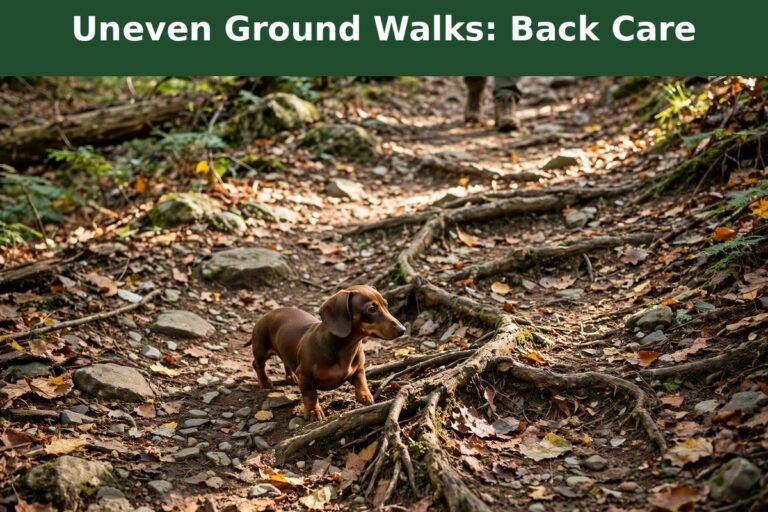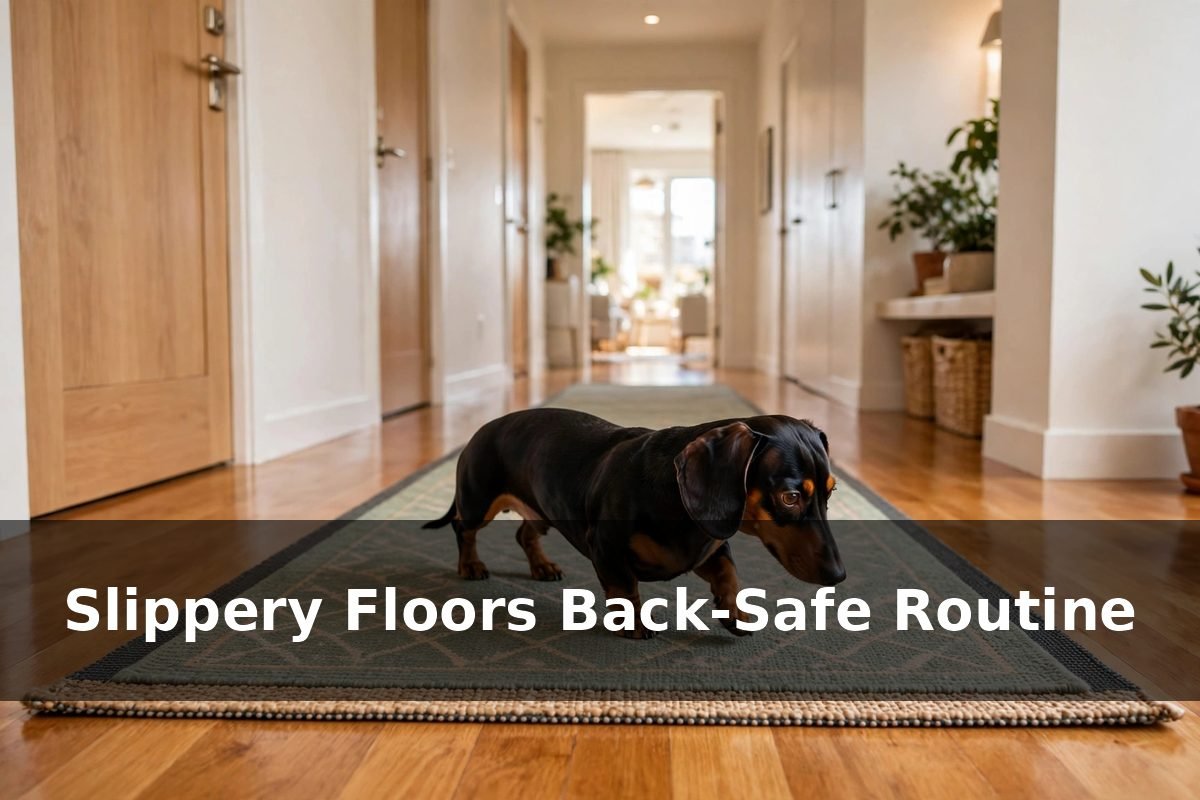
Dachshund Slippery Floors Routine: Back-Safe Home Guide
Quick Answer
- Dachshund slippery floors routine starts with rugs on the main routes: bed to door, bed to water bowl, and bed to food bowl.
- Keep rugs flat and fixed in place, with non-slip backing or a grip pad underneath, so they never slide under the dog.
- Trim nails regularly and keep paws clean and dry, because long nails and wet paws slide further on tile and wood.
- Slow the dog down at corners and doorways, where most slips happen, and never rush the dog across a bare floor.
- Contact a veterinarian if the dog yelps after a slip, refuses to move, or shows weakness in the back legs.
Contents
- 1. Why Tile and Wood Floors Are Hard on a Dachshund’s Back
- 2. Mapping Safe Routes Through the Home
- 3. Rugs, Mats, and Corners That Stay Put
- 4. Paws, Nails, and Grip
- 5. A Slow-Movement Daily Routine
- Room-by-Room Rug Plan for Tile and Wood Floors
- Common Mistakes
- When to Call Your Vet
- Pin This: Slippery Floors Back-Safe Routine
- Frequently Asked Questions
- Conclusion
1. Why Tile and Wood Floors Are Hard on a Dachshund’s Back
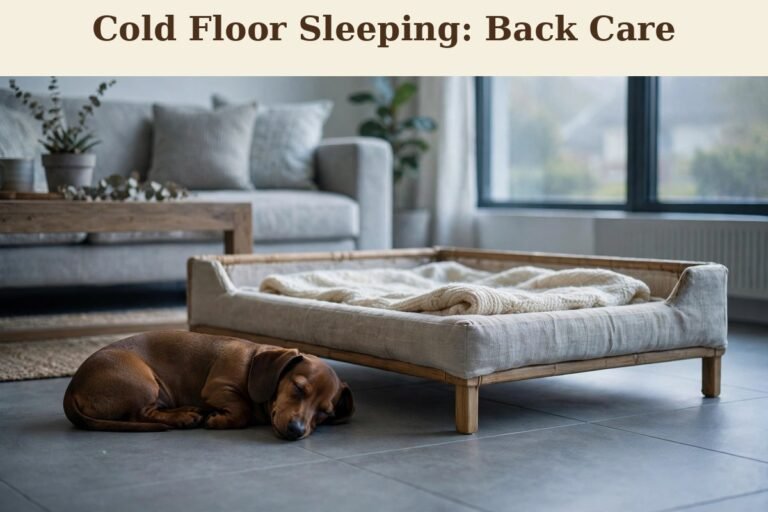
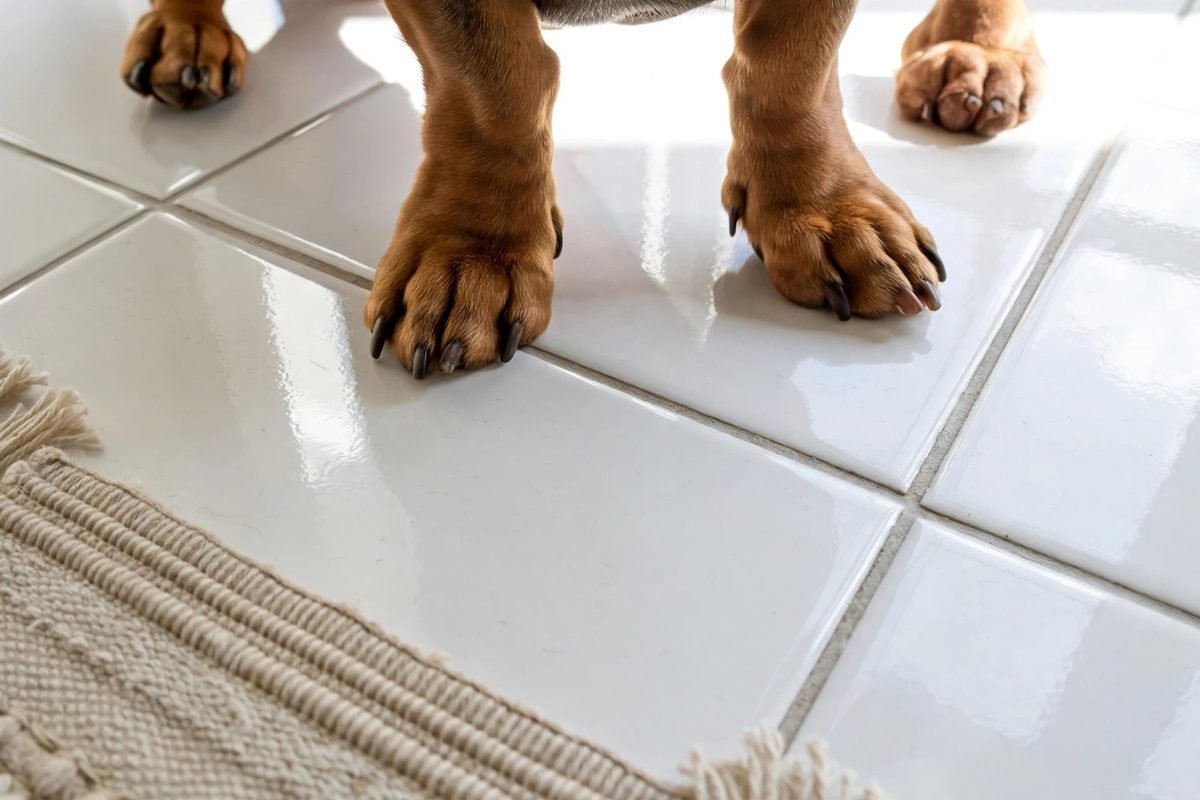
A Dachshund has short legs, a long back, and small paws, and a slippery floor asks all three to work harder than they should. On a rug, the paws grip and the legs push the body forward in a straight line. On polished tile or smooth wood, the paws slide, the legs splay out to the sides, and the back twists to keep the body upright. The dog does not fall every time, but the muscles along the spine tense with every step to stop a fall, and that constant tension leaves the back tired and sore by the end of the day. A Dachshund slippery floors routine is a daily habit, not a product choice, and it works by changing how the dog moves through the home every day.
The worst moments are the sudden ones: the dash to the door when the doorbell rings, the scramble to the food bowl at mealtimes, the turn at the corner of a hallway, and the first steps after a sleep, when the dog is still stiff. In each of those moments the dog moves fast on a surface with no grip, and the legs slide in different directions while the back tries to hold the body together. A home full of bare floors means dozens of small slips every day, and that daily load adds up over weeks and months.
Young dogs slip too, and the habit starts early. Disc degeneration in short-legged breeds can begin in the first year of life, so a puppy that scrambles across tile every day is already asking a lot of a young spine. Older dogs slip more, because stiff joints and weaker muscles give them less grip and less recovery when a paw slides. The answer is the same at every age: give the dog grip where it walks most, slow the dog down where it turns and rushes, and keep the paws in the best shape for gripping. The non-slip rug and mat guide for apartments covers which rugs and mats to choose, and this article covers the daily routine that makes them work.
2. Mapping Safe Routes Through the Home
Start by watching the dog for one day and noting where it walks most. Almost every home has the same three routes: from the bed to the front door, from the bed to the water bowl, and from the bed to the food bowl. Those three routes are where the rugs belong first, because they are where the dog walks when it is half asleep, excited, or in a hurry. A rug on a route the dog rarely uses is a decoration; a rug on the bed-to-door route is back care.
Walk the routes yourself, on the dog’s level, and look for the danger spots. Corners are the first danger, because the dog turns while moving and the back paws slide outwards. Doorways are the second, because the floor often changes there, from wood to tile, and the dog’s paws meet a new surface mid-stride. The third danger is the stretch of bare floor between two rugs, where the dog speeds up on the rug and then hits the bare floor at full pace. Each danger spot needs a rug of its own, or a change in the route so the dog never crosses it at speed.
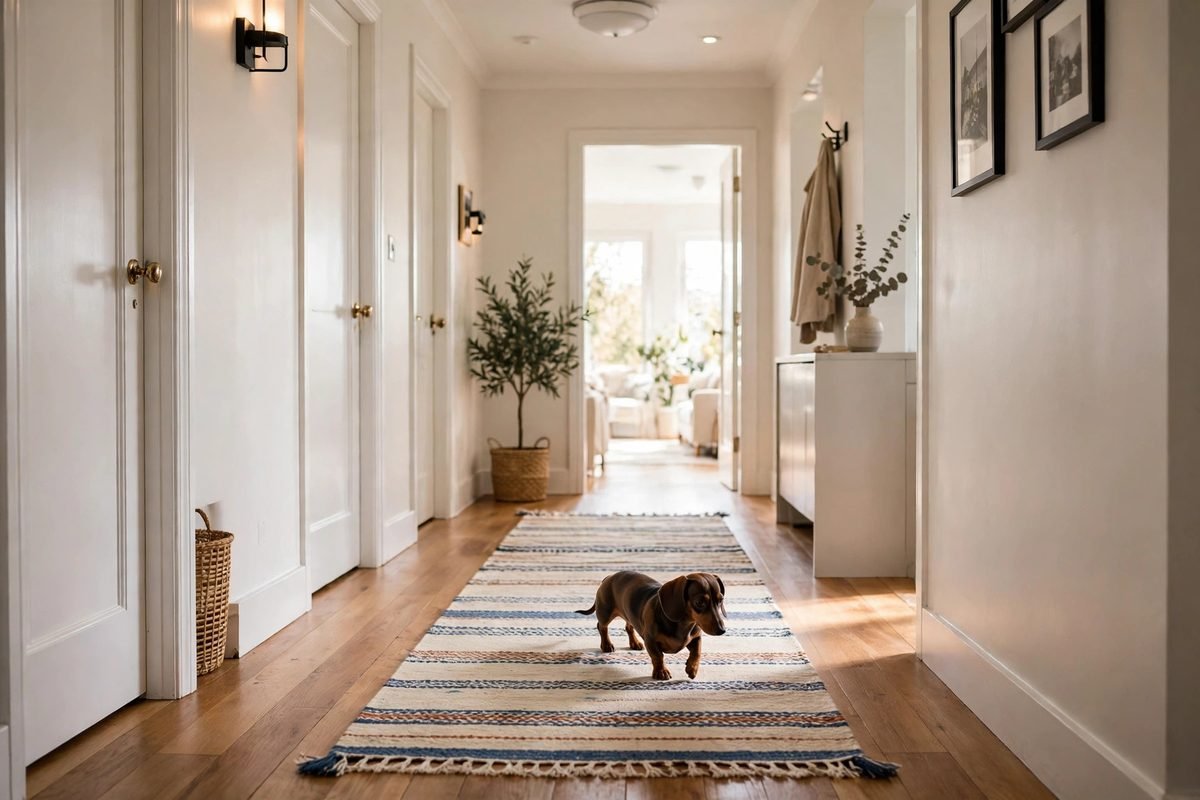
Think about the route, not just the room. A hallway with a runner down its whole length is better than a single rug in the middle, because the dog never has to step off the runner to reach the door. A kitchen with mats at the doorway, the water bowl, and the food bowl is better than one large rug that the dog walks around. The goal is a continuous path of grip from the bed to every place the dog needs to go, with no bare stretch in between. If the home cannot be covered fully, cover the three main routes first and add the rest over time.
3. Rugs, Mats, and Corners That Stay Put
A rug that slides is worse than no rug at all, because the dog trusts it and then it moves under the paws. Every rug on a slippery floor needs non-slip backing, or a grip pad underneath cut to the same size as the rug. Check the backing every month, because grip pads wear out, collect dust, and lose their hold, especially in kitchens and hallways. A rug that has started to slide should be fixed or replaced at once, not left for another week.
Keep rugs flat. A curled corner or a folded edge is a trip hazard, and a Dachshund that catches a paw on a curled corner can twist its back in the stumble. Heavy rugs lie flatter than light ones, and a rug with a thick edge is easier for the dog to feel under its paws. In doorways, use a low, flat mat that the door can pass over without catching, and keep the mat wide enough that the dog walks on it, not around it.
Corners deserve their own solution. A small square mat placed diagonally across a corner gives the dog grip exactly where it turns, and a runner that bends around the corner does the same job for a hallway. In the kitchen, a mat in front of the sink and the cooker covers the spots where water and grease make the floor slickest. At the front door, a mat inside and a mat outside catch wet paws before they reach the tile. Each mat is small and cheap on its own, and together they cover the moments when slips happen most.
4. Paws, Nails, and Grip
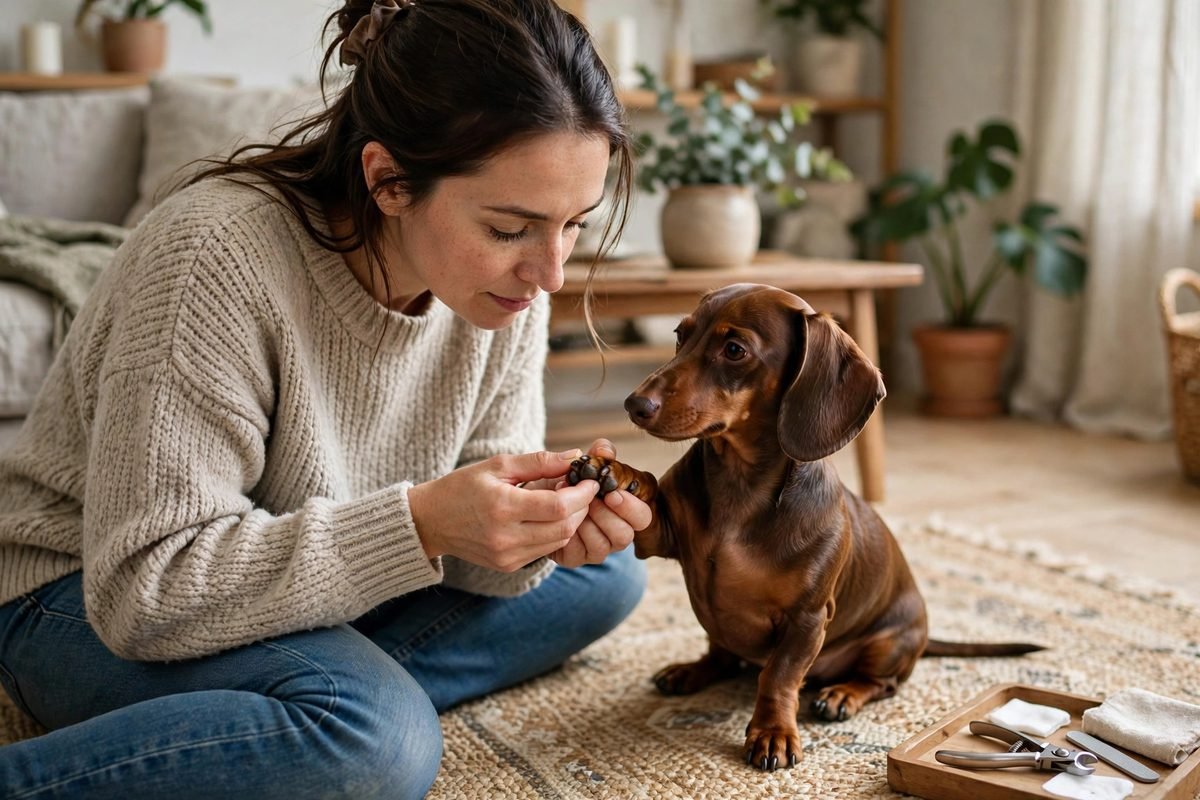
Nails are the first part of grip. A Dachshund with long nails walks on the tips of its nails instead of its paw pads, and nails slide on tile and wood where pads would grip. Trim the nails regularly, a little at a time, so the dog stays comfortable with the routine. A nail that clicks on the floor when the dog walks is too long, and a nail that has been trimmed back to a neat length lets the pad meet the floor properly. If trimming at home is difficult, a groomer or the clinic can do it, and the routine is worth keeping.
The fur between the paw pads matters too. Long fur between the pads covers the pad and slides like a sock on a polished floor, so the pads cannot grip at all. Trim the fur between the pads carefully, with blunt-ended scissors, so the pads are clear and can meet the floor. Clean paws after every walk, and dry them well, because wet paws on tile are the slickest of all.
Watch the paws on the floor. A dog that walks with its legs splayed, its back low, or its steps short and careful is telling the owner that the floor is too slippery, even if it has not fallen. A dog that refuses to cross a bare stretch of floor is not being stubborn; it has learned that the stretch is dangerous. Both are signs to add a rug, not to coax the dog across. The back-safe routine after a slip or fall at home covers what to do when a slip has already happened, and the daily routine here is what stops the next one.
5. A Slow-Movement Daily Routine
Speed is the other half of slipping. A dog that walks slowly rarely falls, and a dog that runs across tile often does. The daily routine should slow the dog down at the moments when it rushes most. At the door, ask the dog to wait for a moment before the door opens, so it walks out calmly instead of dashing. At mealtimes, put the food bowl down on a rug and let the dog walk to it slowly, instead of calling the dog from across a bare floor. At playtime, keep games on the rug, not on the bare floor, so the dog never builds up speed on a slippery surface.
Mornings need the slowest start. A dog that has slept for hours is stiff, and stiff legs slide more easily than loose ones. Let the dog wander on a rug for a few minutes after waking, before asking it to cross the home to the door. Keep the first toilet trip short and calm, and carry the dog across any bare stretch that cannot be avoided in the morning. A slow morning means a steadier back for the rest of the day.
Evenings need the same care. A tired dog at the end of the day moves less carefully, and the last toilet trip before bed is often the rush of the day. Keep the evening routine the same as the morning: a rug path to the door, a slow walk, and a calm return to the bed. The routine works because it is the same every day, and the dog learns the slow paths by habit.
Room-by-Room Rug Plan for Tile and Wood Floors
| Room | Where the Rug Goes | What It Covers |
|---|---|---|
| Hallway | Runner down the whole length, bending around corners | The bed-to-door route; turns at corners |
| Kitchen | Mats at the doorway, water bowl, food bowl, and sink | Wet and greasy spots; mealtime rush |
| Living room | Large rug under the main walking path; mat at the sofa base | Play and rest movement; sofa landings |
| Bedroom | Rug beside the bed, from the bed to the door | Stiff morning steps; night toilet trips |
| Front door | Mat inside and outside the door | Wet paws; the dash in and out |
Common Mistakes
- Putting a rug in the middle of a room while the bed-to-door route stays bare.
- Using rugs without grip pads, so they slide under the dog’s paws.
- Leaving a gap of bare floor between two rugs, where the dog speeds up and slips.
- Letting nails grow long, so the dog walks on nail tips instead of paw pads.
- Calling the dog across a bare floor at mealtimes, so it dashes and scrambles.
- Playing fetch on tile or wood, where the dog builds up speed with no grip.
- Ignoring a dog that refuses to cross a bare stretch, instead of adding a rug.
- Washing rugs so rarely that dust and fur destroy their grip.
When to Call Your Vet
Contact a veterinarian if the dog yelps after a slip, refuses to move, walks with a hunched back, or shows weakness in the back legs. Contact a veterinarian urgently if the dog cannot move its back legs, loses bladder control, or is in severe pain. A veterinarian can examine the dog and advise whether the floor routine needs to change, and the Animal Medical Center guide to intervertebral disc disease in dogs explains the signs that need prompt attention. The Cornell guide to intervertebral disc disease notes that the condition ranges from mild pain to paralysis, which is why early contact matters. The Cornell guide to chondrodystrophy and intervertebral disc disease explains the breed background behind that caution. This article gives general information only and is not a diagnosis.
Pin This: Slippery Floors Back-Safe Routine
- Put rugs on the bed-to-door, bed-to-water, and bed-to-food routes.
- Fix every rug with grip pads and keep corners flat.
- Trim nails and the fur between the pads regularly.
- Slow the dog down at corners, doorways, and mealtimes.
- Keep play on the rug, never on bare tile or wood.
- Call a veterinarian if a slip leaves the dog in pain.
Frequently Asked Questions
Why do Dachshunds slip so much on tile and wood floors?
Short legs, a long back, and small paws give a Dachshund less grip than a larger dog, and smooth floors offer nothing for the pads to hold. The legs splay, the back twists to stay upright, and the muscles along the spine tense with every step.
Where should rugs go first in the home?
On the three main routes: bed to front door, bed to water bowl, and bed to food bowl. Add mats at corners, doorways, and the front door next, so the dog never has to cross a bare stretch at speed.
Do long nails really make slipping worse?
Yes. Long nails lift the paw pads off the floor, so the dog walks on nail tips that slide on tile and wood. Trimmed nails let the pads meet the floor and grip, and the fur between the pads should be trimmed too.
How can a dog be slowed down on slippery floors?
Ask the dog to wait at the door before it opens, put the food bowl on a rug, and keep play on the rug. A slow walk on a rug route beats a dash across bare floor every time, especially in the morning when the dog is stiff.
When should a vet be called after a slip?
Call if the dog yelps, refuses to move, walks hunched, or shows weakness in the back legs. Call urgently if the dog cannot move its back legs, loses bladder control, or is in severe pain.
Conclusion
Slippery floors are a daily routine problem, and the fix is a daily routine: rugs on the routes the dog walks most, grip pads that hold them still, trimmed nails and clean paws, and a slow pace at the moments when the dog rushes. The next step is to walk the bed-to-door route tonight and lay the first runner, so tomorrow starts on grip instead of bare floor.