

Dachshund Cooling Mat for Hot Weather: Stay Cool at Home
Quick Answer
- A cooling mat gives a Dachshund a cooler surface to lie on in hot weather, using gel, water, or breathable fabric to draw heat away from the body.
- Choose a mat large enough for the dog to stretch out fully, with a non-slip base, and place it in shade, away from direct sun through a window.
- A cooling mat supports comfort on hot days, but it does not replace fresh water, shade, shorter walks, and a cool indoor temperature.
- Clean the mat regularly, check for leaks, tears, or chewing damage, and watch for signs of overheating that need prompt veterinary attention.
Contents
- 1. Why Hot Weather Is Hard for a Dachshund
- 2. Cooling Mat Types: Gel, Water, and Fabric
- 3. Size, Thickness, and Non-Slip Safety
- 4. Placement, Water, and Hot-Day Routines
- 5. Cleaning, Storage, and When a Mat Is Not Enough
- Cooling Mat Comparison Checklist
- Common Mistakes
- When to Call Your Vet
- Pin This: Cooling Mat Checklist
- Frequently Asked Questions
- Conclusion
Hot weather changes how a Dachshund rests. A dog that normally sleeps curled on a bed may stretch out on a cool tile floor, pant after a short walk, or move from room to room looking for a cooler spot. That restlessness is the dog trying to lose heat. A cooling mat gives that search a clear answer: a defined, cool surface in a shaded spot, ready whenever the dog needs it.
This guide explains how to choose a cooling mat for a Dachshund in an apartment. It covers mat types, size, placement, cleaning, and hot-day routines, with clear limits on what a mat can do. A cooling mat is a comfort aid. It does not prevent heatstroke, and it does not replace water, shade, and veterinary advice on hot days. Used well, it makes summer resting calmer and more comfortable.
1. Why Hot Weather Is Hard for a Dachshund
Dogs cool themselves mainly by panting and by losing heat through paw pads and areas with thinner fur, such as the belly. They do not sweat like people, so a hot apartment, a sunny balcony, or a long walk in midday heat can raise body temperature quickly. A Dachshund’s low body also sits close to hot pavements and sun-warmed floors, which adds heat from below as well as from the air.
Overheating signs often start quietly: heavier panting, restlessness, seeking cool floors, drooling, or a reluctance to walk. Those signs deserve attention, not a wait-and-see approach, especially in older dogs, overweight dogs, and dogs with breathing or back problems. A cooling mat helps a dog rest more comfortably, but it cannot cool a dog that is already dangerously overheated, and it must never delay veterinary help when warning signs appear.
Summer routines matter as much as any product. Shorter walks in the cooler morning and evening, fresh water at all times, shade indoors and outdoors, and a cool resting spot all work together. The guide to Dachshund hydration and water routines explains fresh water habits, bowl placement, and warm-day plans, and a cooling mat belongs in that same hot-day routine.
Exercise in heat needs care too. A dog that exercises hard in hot weather, then lies on a cooling mat, may still be overheated from the walk itself. The guide to how much exercise a Dachshund needs explains short, regular sessions, and in summer those sessions should be shorter, slower, and timed for cooler hours. A mat supports recovery after a sensible walk; it does not make a hot midday walk safe.

2. Cooling Mat Types: Gel, Water, and Fabric
Gel cooling mats are the most common type. They contain a gel that feels cool to the touch and absorbs body heat without needing refrigeration, though chilling one in a cool room can increase the effect. Gel mats are easy to use: place the mat flat, let the dog lie on it, and wipe it clean afterward. Their limits are weight, puncture risk from chewing or sharp nails, and a cooling effect that fades as the gel warms to body temperature.
Water-filled mats use water, sometimes with a cooling insert, to spread heat and give a cool surface. They can feel very cool at first, and they are often heavier and more stable than gel mats. Their limits are leaks, the need to fill and empty them carefully, and the risk of damp bedding if a seam fails. Check seams and valves regularly, and never use a water mat with a damaged seal.
Breathable fabric mats, often made from mesh or moisture-wicking fabric over a raised frame, cool by airflow rather than by gel or water. They suit dogs that chew gel mats, and they are light and easy to wash. Their cooling effect is milder than a gel mat, because it depends on air movement, but it lasts longer without warming up. A fabric mat in a breezy, shaded spot can be surprisingly effective for everyday summer resting.
Some mats combine approaches, such as a gel pad inside a washable fabric cover. A cover protects the gel from nails and chewing, makes cleaning easier, and can be replaced if it wears out. Whatever type is chosen, check that all materials are safe if chewed, that no small parts can break off, and that the mat does not contain anything toxic if punctured. If that information is not clear, choose a different mat.
3. Size, Thickness, and Non-Slip Safety
Size should allow the dog to stretch out fully, not just curl up. A Dachshund cooling off will often lie on its side with legs extended, which needs more length than a curled sleeping position. Measure the dog lying stretched out, from nose to tail base, and choose a mat at least that long. A mat too small for stretching will be used only partly, and the dog will still seek a cool floor for the rest of its body.
Thickness affects comfort and stability. A very thin mat may feel cool but offer little cushioning on a hard floor, while a very thick mat can feel unstable underfoot for a short-legged dog. A medium thickness, with a firm but comfortable surface, suits most apartment floors. Test the mat on the actual floor where it will be used, and watch whether the dog steps onto it confidently or hesitates at the edge.
Non-slip safety is essential, especially on smooth apartment floors. A mat that slides when the dog steps on it will frighten the dog and may cause a slip. Choose a mat with a non-slip base, or place it on a non-slip rug or mat underneath. Check the base after washing, because some non-slip surfaces lose grip over time. Replace a mat whose base no longer holds on the floor.
Weight and portability matter in a small apartment. A heavy gel mat is stable, but hard to move between rooms or to wash in a small sink. A lighter fabric mat moves easily but may slide more. Choose the balance that fits the home: a stable mat in the main resting spot, and a lighter mat for a second spot, such as a balcony shade area, if one is needed.
4. Placement, Water, and Hot-Day Routines
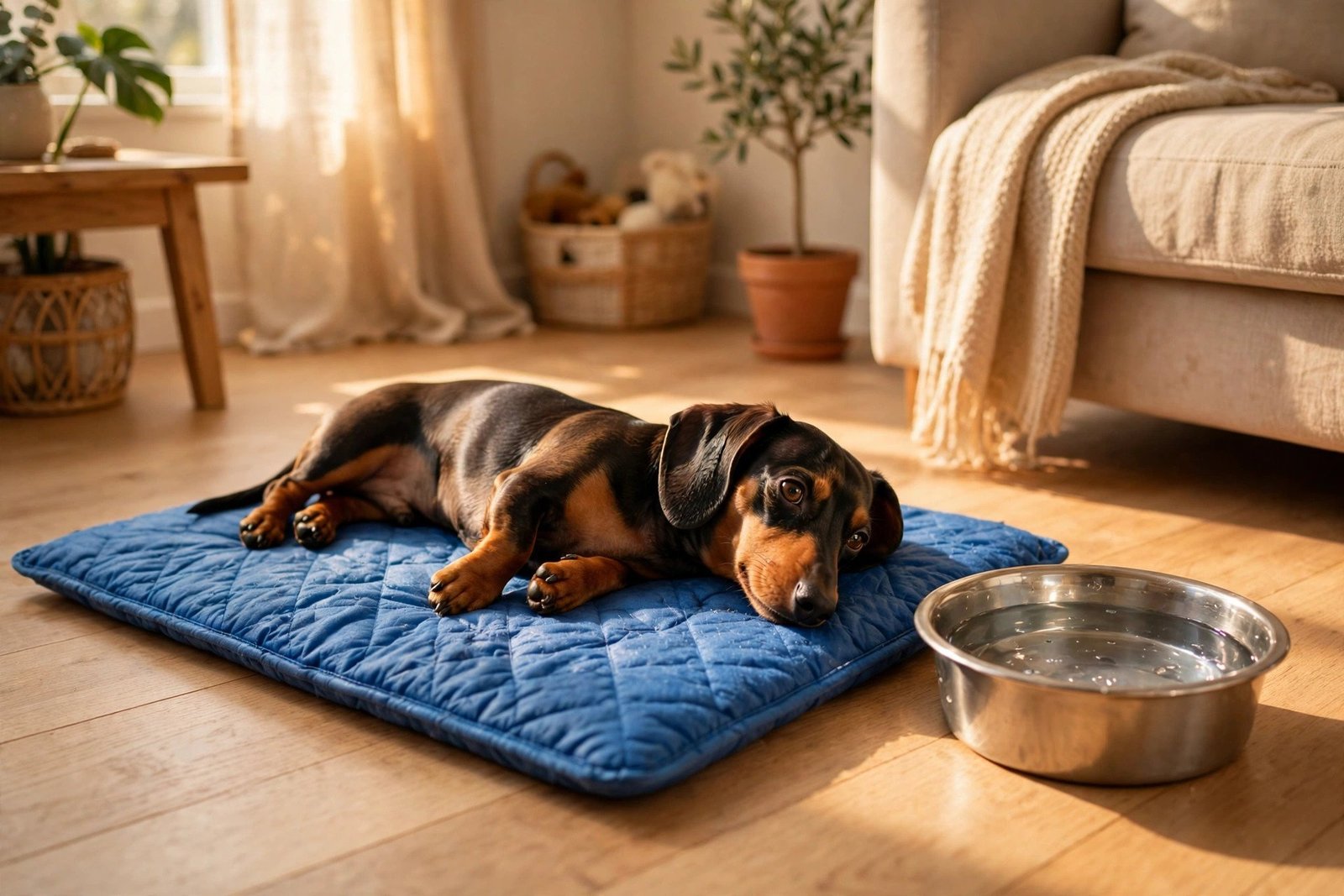
Place the mat in shade, away from direct sun through a window, because a mat in sunlight will warm up and lose its cooling effect. A shaded living room corner, a hallway away from a sunny window, or a shaded balcony spot all work, provided the balcony is fully safe and supervised. Keep the mat away from radiators, heaters, and hot appliances, and check the mat surface with a hand before the dog uses it on a very hot day.
Water should always be near the resting spot in hot weather, in a fresh, full bowl on a non-slip mat. A cooling mat does not replace drinking water, and a dog that lies on a mat without water nearby may still become dehydrated. Refill water more often in summer, keep the bowl out of direct sun, and check it at least twice a day. A second water bowl in another room helps on very hot days.
Build a simple hot-day routine. Walk in the cooler morning and evening, keep midday walks very short or skip them for indoor play, and allow a calm rest on the cooling mat after any walk. Avoid hot pavements, which can burn paws, by testing the ground with a hand before a walk. After a walk, offer water, allow rest in shade, and watch for heavy panting that does not settle quickly.
Cooling mats work best as part of a cool home routine. Closing curtains on sunny windows, using a fan for airflow, and keeping the apartment ventilated all help the mat stay cool longer. A fan should not blow directly onto the dog for long periods, and the dog should always be able to move off the mat to another spot if it prefers. Choice matters: a mat the dog can leave freely will be used more calmly than one the dog feels confined to.
5. Cleaning, Storage, and When a Mat Is Not Enough
Clean the mat regularly, following the instructions for its type. Gel mats usually need only a wipe with a damp cloth and mild detergent, then full drying. Fabric mats and covers can often be machine washed, but check the label first. Water mats need careful emptying, rinsing, and drying to prevent mold inside seams. A dirty mat loses cooling effect, develops odor, and can irritate skin.
Check the mat for damage every week in summer, and more often if the dog chews. Look for punctures, leaks, torn seams, worn non-slip bases, and loose covers. A gel mat with a puncture should be removed immediately, because gel leakage and chewing risk make it unsafe. A fabric mat with a torn seam should be repaired or replaced before it unravels further.
Store mats flat in a cool, dry spot when not in use, rather than folded sharply, which can crack gel mats or damage seams. Keep a mat accessible through summer, not buried behind winter items, so it can be used on the first hot day, not found halfway through a heatwave. At the end of summer, clean and dry the mat fully before storing it.
Know when a mat is not enough. If the dog pants heavily for a long time after rest, drools excessively, vomits, seems weak or wobbly, or collapses, move the dog to shade, offer small amounts of water if it can drink safely, cool it gradually with damp towels, and seek veterinary help immediately. Do not use ice-cold water or ice baths unless a veterinarian advises it, and do not delay help while trying a mat. A mat is for comfort on normal hot days, not for emergencies.

Cooling Mat Comparison Checklist
| Type | Best for | Limit to watch |
|---|---|---|
| Gel mat | Strong cooling, easy daily use | Puncture risk, warms over time |
| Water mat | Very cool surface, stable weight | Leaks, seam and valve checks |
| Fabric mesh mat | Chewing dogs, easy washing | Milder cooling, needs airflow |
| Gel mat with cover | Protection plus easy cleaning | Cover wear, fit must stay snug |
Common Mistakes
- Placing the mat in direct sun, so it warms up and stops cooling.
- Choosing a mat too small for the dog to stretch out fully.
- Using a cooling mat as a replacement for water, shade, or shorter walks.
- Ignoring punctures, leaks, or worn non-slip bases.
- Walking in midday heat and expecting a mat to undo overheating.
- Storing a damp mat folded, so mold or seam damage develops.
When to Call Your Vet
Contact a veterinarian immediately if the dog shows heavy panting that does not settle, excessive drooling, vomiting, weakness, wobbliness, collapse, or any sudden change after heat exposure. This article gives general information only and does not diagnose any condition. A veterinarian can examine the dog and advise on cooling, fluids, and recovery. Do not delay help for heat illness, and do not rely on a cooling mat alone in an emergency.
Pin This: Cooling Mat Checklist
- Choose a mat large enough to stretch out on fully.
- Place it in shade, away from sun and heaters.
- Keep fresh water nearby at all times in heat.
- Walk in cooler hours and test pavements by hand.
- Clean the mat regularly and check for damage weekly.
- Store it flat, clean, and dry between seasons.
- Seek vet help promptly for overheating signs.
Frequently Asked Questions
Do cooling mats need to be refrigerated?
Most gel mats work without refrigeration, using pressure-activated gel. Chilling one in a cool room can increase the effect, but check the instructions, because freezing can damage some mats.
How long does a cooling mat stay cool?
It depends on the type, the room temperature, and the dog’s body heat. Gel mats typically cool for a period, then warm up and need a break to recharge. Fabric mats cool more mildly but for longer.
Can a puppy use a cooling mat?
Yes, with supervision, provided the mat is safe if chewed and the puppy can move off it freely. Watch puppies closely, because they may chew gel mats or lie on them when they are already cool enough.
Should a cooling mat be used outdoors?
Yes, in shade, on a safe balcony or garden spot, with water nearby and supervision. Avoid direct sun, hot ground, and unsupervised outdoor use.
What if the dog will not lie on the mat?
Place it in a favorite resting spot, add a familiar blanket on top for a few days, and reward calm use. Do not force the dog onto the mat, and check that the surface, size, and stability suit the dog.
Conclusion
A Dachshund cooling mat for hot weather is a simple summer tool when it is sized for stretching, placed in shade, paired with fresh water and cooler-hour walks, and kept clean and damage-free. That routine gives the dog a cooler resting spot on hot days, and calmer resting supports the hydration and exercise habits that matter most in summer.






3 Comments