
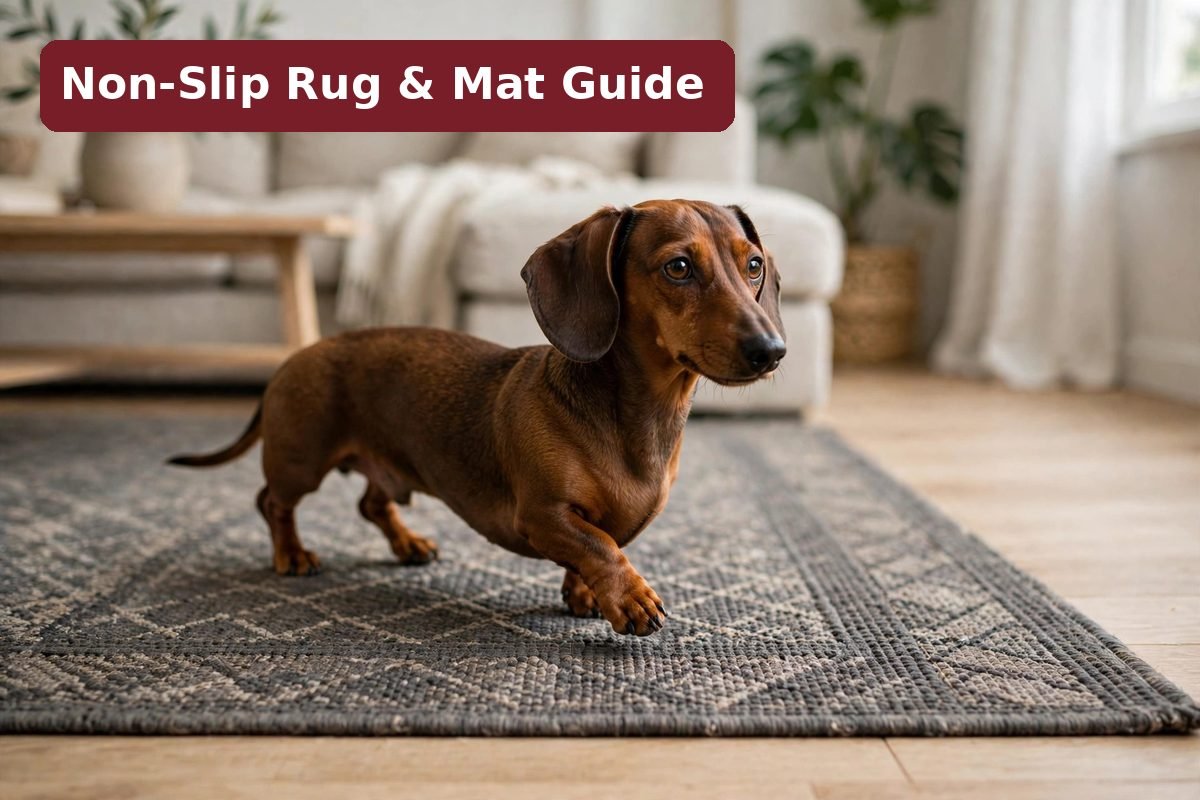
Dachshund Non-Slip Rug and Mat Guide for Apartments
Quick Answer
- Non-slip rugs and mats give a Dachshund grip on smooth apartment floors, where slipping can twist a leg or strain the long back.
- Choose low-pile rugs with a rubber or latex backing, sized to cover the dog’s main paths, and add a rug pad underneath for extra grip.
- Place rugs at the bed, the sofa, the food and water bowls, and along hallways, so the dog rarely has to cross bare floor.
- Wash or vacuum rugs weekly, replace them when the backing wears smooth, and contact a veterinarian if the dog slips, limps, or shows back pain.
Contents
- 1. Why Smooth Floors Are a Risk for Dachshunds
- 2. Rug and Mat Types: Low-Pile, Runner, and Rubber-Backed
- 3. Choosing Size, Pile, and Backing
- 4. Placing Rugs on the Dog’s Daily Paths
- 5. Cleaning, Care, and Replacing Worn Rugs
- Non-Slip Rug and Mat Comparison Checklist
- Common Mistakes
- When to Call Your Vet
- Pin This: Non-Slip Rug and Mat Checklist
- Frequently Asked Questions
- Conclusion
Apartment floors are made for people, not for dogs. Polished wood, laminate, and tile look clean and modern, but a Dachshund’s small paws find little grip on them, and a dog that runs to the door, turns sharply, or jumps from a sofa can slide, splay, and fall. For a long-backed breed, one bad slip can mean a strained leg or a back injury that takes weeks to heal.
This guide explains how to choose non-slip rugs and mats for an apartment, where to place them, and how to keep them working. It is general information about home products, not veterinary advice. A dog that slips often, limps, or shows back pain needs a veterinarian, not a new rug, and a rug is one part of a safer home, not a fix for an injury.
1. Why Smooth Floors Are a Risk for Dachshunds
Dachshunds have short legs, a long body, and a low centre of gravity, which makes turning and stopping on smooth floors harder than for taller dogs. When a dog runs across a wooden floor and tries to turn, its paws slide instead of gripping, the legs splay, and the spine twists. That twist, repeated daily, adds strain to the discs between the vertebrae, which are already the breed’s weak point.
Wet floors make the risk worse. Rain on paws, water from a bowl, or a damp mop leaves patches that a dog cannot see, and a dog that slips on a wet patch may fall hard onto its side or back. Older dogs and puppies are at greater risk, because older dogs have weaker muscles and puppies have not yet learned to move carefully on smooth surfaces.
Rugs break the slide. A rug gives paws something to grip, slows the dog down before a turn, and cushions a fall if one still happens. Cornell’s information on chondrodystrophy and disc disease explains why this breed’s discs are vulnerable, so reducing slips at home is a practical part of back care. The guide to non-slip paw grips for slippery floors covers another way to add grip, and rugs cover the floor itself, which helps every step the dog takes indoors.

2. Rug and Mat Types: Low-Pile, Runner, and Rubber-Backed
Low-pile rugs are the best choice for most apartments. A short, tight pile gives grip without catching nails, and it is easy to vacuum and wash. A flat-weave or a short-loop rug stays flat on the floor, does not curl at the edges, and lets a small dog walk across it without tripping. Avoid deep shag rugs, which trap dirt, catch nails, and can trip a short-legged dog.
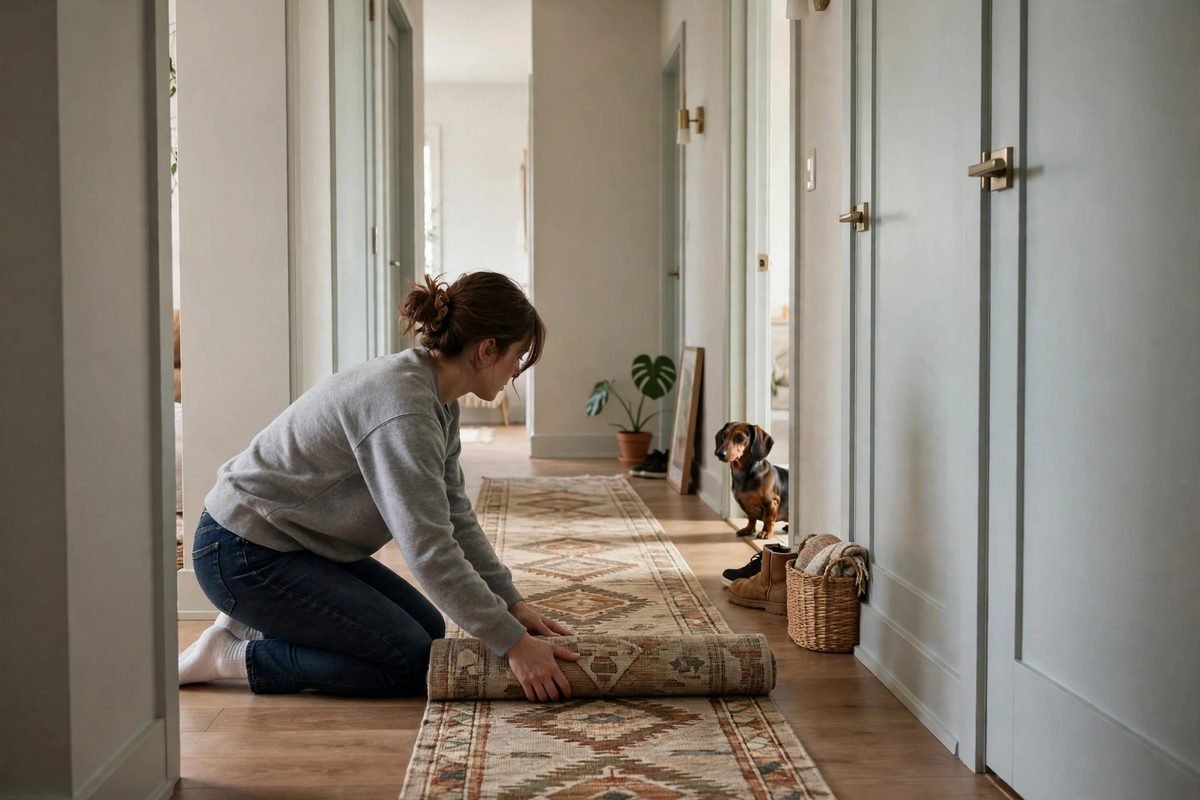
Hallway runners cover long, straight paths where dogs run and turn. A runner along the hallway from the front door to the living room gives the dog grip on its most-used route, and a runner beside the bed gives grip on the first steps of the morning, when muscles are stiff. Choose a runner with a non-slip backing or add a rug pad underneath, because a runner that slides is worse than no runner at all.
Rubber-backed mats suit small, high-risk spots: under the food and water bowls, beside the sofa where the dog jumps down, and at the top and bottom of any ramp. A mat with a raised edge holds spilled water, and a thick mat cushions landings. Mats are easy to lift, shake out, and wash, which makes them useful in kitchens and near doors, where dirt and water collect fastest.
3. Choosing Size, Pile, and Backing
Choose rugs that cover the dog’s paths, not just the centre of the room. A small rug in the middle of a large wooden floor leaves bare floor on every side, so the dog still slips on the way to the rug. Measure the routes the dog uses most, from bed to door, from sofa to kitchen, and from the front door to the living room, and choose rugs that cover those routes with grip all the way.
Choose a low pile, no more than a centimetre high, with a tight weave that nails cannot catch in. A low pile is easier to clean, dries faster after a wash, and does not trip a dog that drags its paws. Check the edges: a rug with a bound or stitched edge lies flat, while a rug with a loose or curling edge is a trip hazard for a small dog and a person.
Check the backing before buying. A rubber or latex backing grips the floor and stops the rug sliding, while a rug without backing needs a separate rug pad underneath. A rug pad adds cushioning and grip, and it protects the floor from the rug’s backing, but it must be cut to fit the rug, or it will bunch and trip the dog. Washable rugs suit homes with dogs, because they can go in the washing machine after accidents, muddy paws, or spills.

4. Placing Rugs on the Dog’s Daily Paths
Place rugs where the dog starts, stops, and turns. A rug beside the bed gives grip on the first steps of the day, a rug in front of the sofa cushions the landing when the dog steps down, and a rug under the food and water bowls stops slips on wet patches. A rug at the front door catches mud and gives grip when the dog rushes in from a walk.
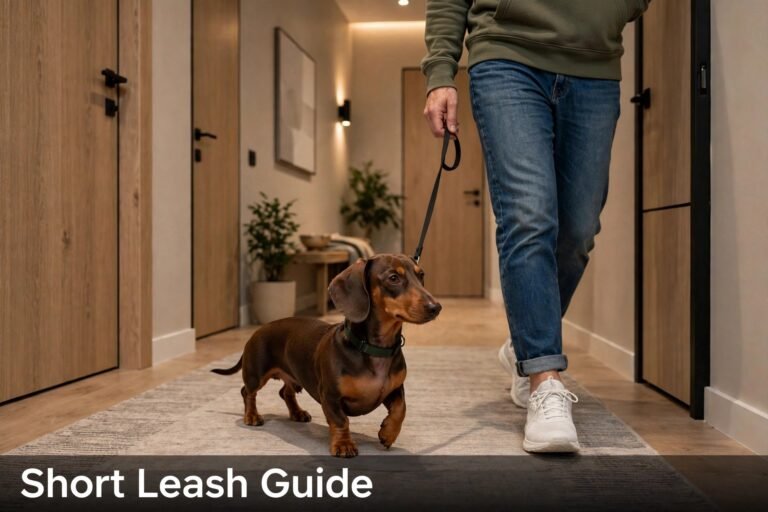
Place runners along hallways and in front of stairs, where the dog builds speed and must turn or stop. Leave no bare gap at a doorway, because a dog that runs from rug to bare floor and back again slips at the change of surface. Overlap rug edges slightly, or butt them tightly together, so there is no bare strip in the middle of a path.
Keep rugs flat and secure. Tape the corners of light rugs, use a rug pad underneath, and check weekly that no edge has curled or bunched. The guide to apartment home layout for a Dachshund’s back explains how furniture, ramps, and floor coverings work together, and rugs are the floor part of that layout. A rug that moves under the dog’s feet is a hazard, so a rug that cannot be fixed in place should be replaced with a heavier one.

5. Cleaning, Care, and Replacing Worn Rugs
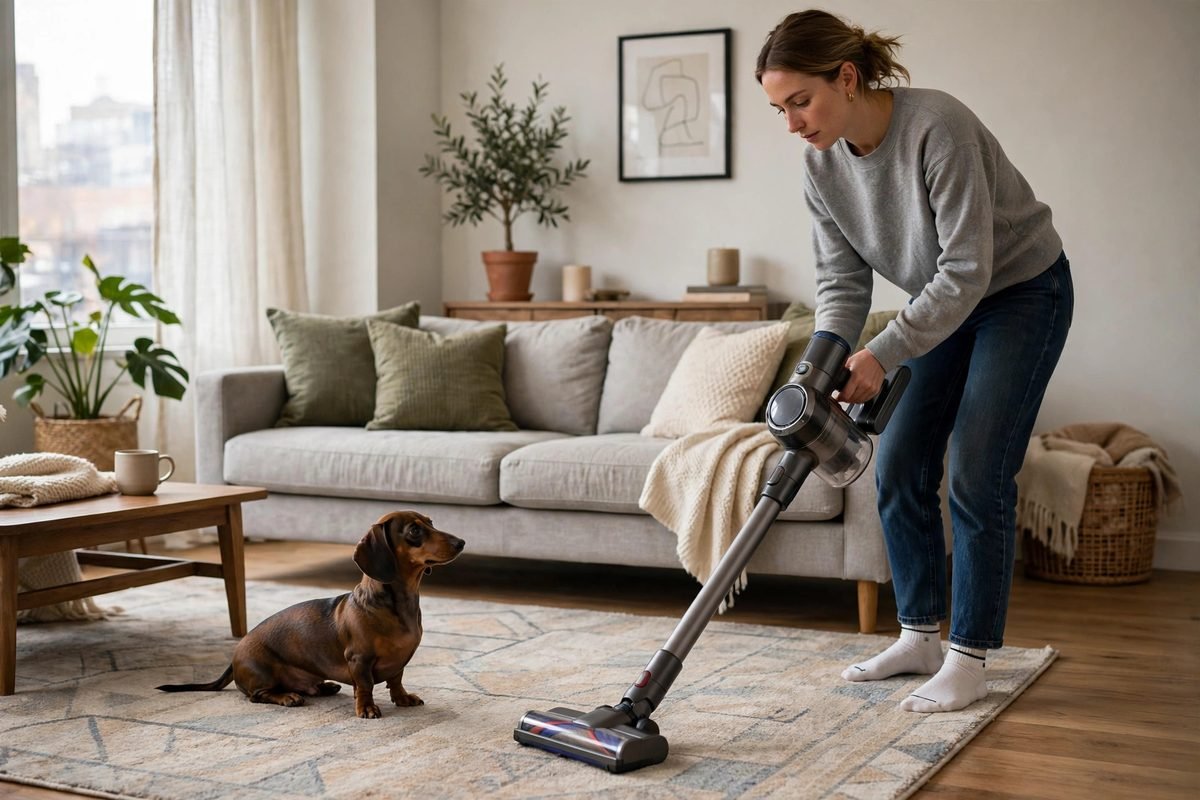
Vacuum rugs at least twice a week, and more often in shedding season or after muddy walks. A rug full of hair and dirt loses grip, because paws slide on the debris instead of the fibres. Shake small mats outside daily, and wash washable rugs in the machine on a gentle cycle, then dry them fully before putting them back, because a damp rug slips and smells.
Clean accidents at once. Blot, do not rub, then wash with a pet-safe cleaner and rinse well, so no cleaning residue remains for the dog to lick or walk on. A rug that smells after cleaning needs a deeper wash or replacing, because a dog that smells its own scent on a rug will return to the same spot. Keep a spare mat ready, so a rug in the wash does not leave a bare, slippery gap in the dog’s path.
Replace rugs when the backing wears smooth, the pile flattens, or the edges curl and will not lie flat. A rug that has lost its grip is decoration, not safety, and a curled edge is a trip hazard. Check the backing every month by lifting a corner and feeling for smoothness or cracking, and replace rug pads at the same time, because a worn pad lets the rug slide even when the rug itself looks fine.
Non-Slip Rug and Mat Comparison Checklist
| Rug or mat type | Best for | Limit to watch |
|---|---|---|
| Low-pile rubber-backed rug | Living rooms, daily paths, grip | Needs a pad on very smooth floors |
| Hallway runner | Long routes, door to living room | Must not slide or bunch in the middle |
| Rubber-backed mat | Bowls, sofa landing, ramps | Small area, needs frequent washing |
| Washable rug with pad | Accidents, muddy paws, easy care | Pad must fit, or it bunches and trips |
Common Mistakes
- Buying a rug that is too small to cover the dog’s paths.
- Choosing deep shag pile that catches nails and trips the dog.
- Skipping the rug pad, so the rug slides on smooth floors.
- Leaving bare gaps at doorways between rugs.
- Using a rug with curled or bunched edges.
- Forgetting to vacuum, so dirt and hair kill the grip.
- Keeping a worn rug whose backing no longer grips.
When to Call Your Vet
Contact a veterinarian if a Dachshund slips often, limps, refuses to walk on smooth floors, or shows sudden back pain, weakness, or wobbliness, and seek urgent help for collapse, heavy bleeding, or loss of bladder control. Contact a veterinarian also if the dog’s paws are sore, cracked, or bleeding from slipping, or if it has fallen hard and seems stiff or unwilling to move. This article gives general information only and does not diagnose any condition. A veterinarian can examine the dog, check for back or joint injury, and advise on home safety for dogs with disc disease, arthritis, or weak legs. Do not delay veterinary help for a dog that has fallen or is clearly in pain.
Pin This: Non-Slip Rug and Mat Checklist
- Choose low-pile rugs with rubber backing.
- Cover the dog’s main paths, not just the room centre.
- Add runners in hallways and at the front door.
- Place mats at bowls, sofa, and ramps.
- Use rug pads and fix curled edges.
- Vacuum twice a week and wash regularly.
- Replace rugs when the backing wears smooth.
Frequently Asked Questions
Do rugs really help a Dachshund’s back?
Yes. Rugs give paws grip, so the dog does not slide, splay, or twist its spine when turning or stopping. Less slipping means less strain on the discs, which are the breed’s weak point, and a rug also cushions a fall if one still happens.
What pile height is best?
Low pile, no more than a centimetre high, with a tight weave. Low pile gives grip without catching nails, is easy to vacuum, and does not trip a short-legged dog. Deep shag rugs trap dirt, catch nails, and can cause trips.
Do I need a rug pad under every rug?
Yes, unless the rug has a good rubber or latex backing that grips the floor on its own. A pad adds grip and cushioning, but it must be cut to fit the rug, or it will bunch underneath and trip the dog.
Where should rugs go first?
Beside the bed, in front of the sofa, under the food and water bowls, at the front door, and along the hallway. These are the places where the dog starts, stops, turns, and lands, so they are the places where grip matters most.
How often should I replace a non-slip rug?
Replace it when the backing feels smooth or cracked, the pile is flattened, or the edges curl and will not lie flat. Check the backing monthly by lifting a corner, and replace the rug pad at the same time, because a worn pad lets the rug slide.
Conclusion
Non-slip rugs and mats turn a slippery apartment into a safe home for a Dachshund: low pile for grip, rubber backing for hold, and rugs on every path the dog uses daily. Cover the routes, keep the rugs flat and clean, and replace them when the grip wears out.



2 Comments