Dachshund Non-Slip Bath Mat Guide for Safe, Calm Baths
Quick Answer
- A non-slip bath mat is a textured mat that sits in the bath or shower tray, so a Dachshund stands on grip instead of smooth, wet porcelain.
- Choose a mat that covers the whole standing area, grips the bath with suction cups, drains water through holes, and lies flat with no curled edges.
- Place the mat before the water, press the suction cups down firmly, test it with a hand, and lift the dog in gently, keeping the back level.
- Keep baths short, calm, and warm, with a handheld shower or a jug, and dry the dog thoroughly before letting it walk on a smooth floor.
- Contact a veterinarian if the dog slips, falls, or shows back pain, stiffness, limping, or reluctance to move after a bath.
Contents
- 1. Why Baths Are Slippery for a Dachshund
- 2. Choosing a Safe Non-Slip Bath Mat
- 3. Setting Up the Bath Before the Dog Gets In
- 4. Bathing Calmly on a Steady Mat
- 5. Drying, Cleaning the Mat, and Watching the Back
- Bath Mat Comparison Checklist
- Common Mistakes
- When to Call Your Vet
- Pin This: Non-Slip Bath Mat Checklist
- Frequently Asked Questions
- Conclusion
Many Dachshunds dislike baths, and the reason is often simple: the bath is slippery. A small dog steps onto smooth, wet porcelain, the paws slide, the legs splay, and the dog panics, scrambles, and tries to climb out. That scramble is hard on a long back, because a slipping dog twists, braces, and lands hard, and a dog that falls in a bath can hurt a leg, a paw, or its spine. A non-slip bath mat changes the surface under the paws, from smooth and slick to textured and steady, and that one change can turn a stressful bath into a calm one.
A bath mat is a low-cost, simple product, and it is different from a rug or a mat used on a living room floor. A bath mat is made to sit in water, grip a wet bath, drain quickly, and dry between uses, while a floor rug would soak, slip, and grow smells in a bath. This article explains why baths are slippery for a Dachshund, how to choose a bath mat, how to set up the bath, how to bathe calmly on a steady mat, and how to clean the mat and watch the dog afterwards. It is general information only, not a diagnosis, and a dog that slips, falls, or shows pain after a bath needs a veterinarian, not a new mat.
1. Why Baths Are Slippery for a Dachshund
A bath or shower tray is designed to be smooth, so water runs away and the surface is easy to clean. That smooth surface is the problem for a dog. A Dachshund has small paws, short legs, and a long body, and when the paws slide on wet porcelain, the legs splay out, the body twists, and the dog loses its balance. A dog that cannot stand steadily will scramble, and scrambling on a hard, wet surface is a risk for a pulled muscle, a twisted leg, or a strain on the back.
The shape of a Dachshund adds to the risk. A long back means the front and hind legs are far apart, and a slip at one end can twist the spine in the middle. A dog that tries to climb out of a bath, with the front paws on the edge and the hind paws slipping below, puts a sharp strain on the back and shoulders. The Animal Medical Center explains intervertebral disc disease in dogs, and disc problems are a known risk for this long-backed breed, with disc degeneration in short-legged breeds able to begin in the first year of life, so a slip in the bath is a back risk as well as a bathing problem.

2. Choosing a Safe Non-Slip Bath Mat
Start with the size. A bath mat should cover the whole area where the dog stands, from one end of the bath to the other, or the full floor of a shower tray, so the dog never has to step off the mat onto smooth porcelain. Measure the bath or tray before buying, and choose a mat that fits the length and width, with no gaps at the edges. A mat that is too small leaves a slippery strip at one end, and a dog that steps onto that strip will slip. A mat that is too large will curl up at the edges, and curled edges are a tripping hazard.
Look at the texture on top. A mat with a raised, textured surface, with small bumps, ridges, or a pebble pattern, gives the paws grip without being rough on the pads. A mat that is too smooth will not grip, and a mat that is too rough can irritate a small paw, especially if the dog stands on it for several minutes. Run a hand over the mat, and choose a texture that feels grippy but not sharp. Check that the mat has drainage holes, so water runs through and does not pool on top, because a mat that holds a puddle is a mat that slips.
Choose a material that is safe in water and easy to clean. A rubber or silicone bath mat, made for use in a bath or shower, is the usual choice, because it grips when wet, dries between uses, and can be washed. Avoid a mat made for a living room floor, a mat with a fabric top that soaks up water, and a mat with a strong chemical smell when new. Wash a new mat in warm soapy water, rinse it well, and let it dry fully before the first use. The guide to bathing without straining the back covers the same calm lifting and posture ideas for bath time, and the guide to a non-slip rug and mat guide for apartments explains how grip helps a Dachshund on smooth floors around the home.
3. Setting Up the Bath Before the Dog Gets In
Set up the bath before the dog comes into the room. Place the mat in the empty bath or tray, press the suction cups down firmly, one by one, and check that the mat lies flat, with no bubbles, no curled edges, and no gaps. Run a hand over the mat, and try to slide it in several places. If any part lifts or moves, lift the mat, clean the bath surface and the suction cups, and press it down again. A mat that is fixed properly will not move under a firm hand push.
Prepare everything within easy reach, so the owner never has to leave the dog alone in the bath. Put the shampoo, a jug, a handheld shower head, and towels on a stool or a shelf next to the bath, and place a non-slip mat on the bathroom floor where the dog will stand after the bath. Keep the bathroom warm, close the door, and keep the room calm, with no loud noise and no other pets in the room. A calm room makes a calm bath, and a calm bath makes a steady dog.

4. Bathing Calmly on a Steady Mat
Lift the dog into the bath gently, with one hand under the chest and one under the hindquarters, keeping the back level. Do not let the dog jump into the bath, and do not lift it by the front legs or the scruff, because both put strain on a long back. Lower the dog onto the mat, let it find its footing, and wait a moment while it stands still. A dog that stands steadily on the mat, with all four paws down, is ready to be washed, while a dog that scrambles or tries to climb out needs a pause, a calm word, and a moment to settle.
Keep the dog still with a calm voice and a gentle hand, not by holding it down. A hand resting lightly on the back, a calm word, and a slow pace help the dog stay still, while a tight grip or a raised voice makes the dog struggle. Rinse thoroughly, because shampoo left in the coat can irritate the skin, and rinse the paws and belly carefully, where dirt and shampoo collect. Keep the bath short, usually five to ten minutes, and end before the dog gets tired, cold, or stressed.
5. Drying, Cleaning the Mat, and Watching the Back
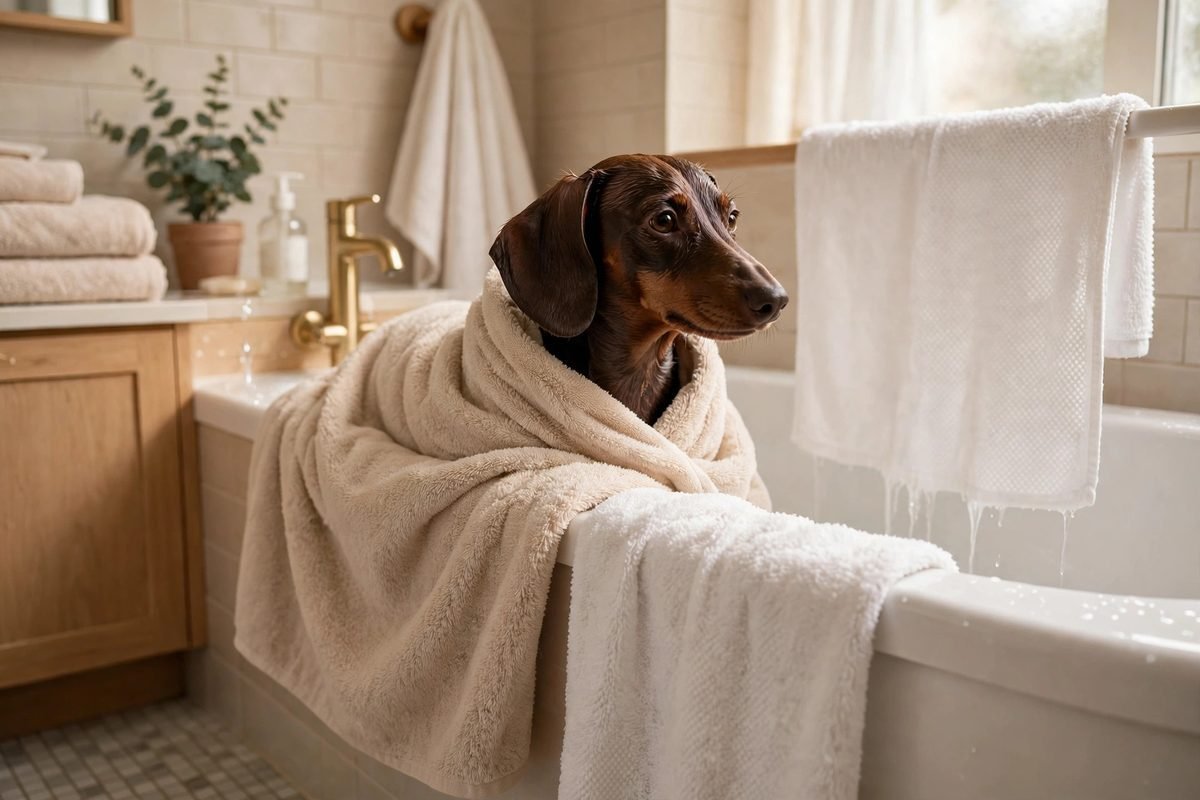
Dry the dog thoroughly after the bath. Use a soft towel, pat the coat dry instead of rubbing hard, and dry between the toes, under the ears, and around the belly, where water hides. A second dry towel helps, and a low, warm hairdryer on a cool setting can be used only if the dog is calm with it, held at a distance, and never on a hot setting. A dog that is left damp in a cool room can get cold and stiff, so keep the dog warm, dry, and indoors until the coat is dry.
Clean the bath mat after every bath. Lift the mat out, rinse it under warm water, wash it with warm soapy water and a brush, paying attention to the suction cups and the drainage holes, then rinse well and hang it up to dry. A mat left in a wet bath grows mould and bacteria, smells stale, and loses its grip, because dirty suction cups do not stick. Hang the mat over the bath edge or on a hook, with air flowing around it, and do not store it rolled up while damp.
Watch how the dog moves after a bath, every time. A dog that walks normally, shakes, and settles to rest has had a good bath. A dog that walks stiffly, refuses a ramp, yelps when lifted, or lies flat and will not move needs rest and a veterinarian, not another bath. Cornell’s information on chondrodystrophy and disc disease explains why this breed’s discs are vulnerable, and early signs are easy to miss if no one is watching. Keep a short note of bath time, mat use, and how the dog moved afterwards, and share it with a veterinarian if anything changes.
Bath Mat Comparison Checklist
| Mat type | Best for | Limit to watch |
|---|---|---|
| Rubber mat, suction cups | Baths, strong grip, easy to wash | Cups lose grip if dirty or worn |
| Silicone mat, drainage holes | Showers, quick draining, light | Must cover full standing area |
| Textured pebble mat | Grip for small paws, comfort | Check texture is not too rough |
| Floor mat after bath | Standing after bath, drying | Not for inside the bath, use on floor |
Common Mistakes
- Using a living room rug or a fabric mat in the bath.
- Choosing a mat that is too small for the standing area.
- Forgetting to press the suction cups down firmly.
- Filling the bath too deep for a small dog.
- Letting the dog jump in and out of the bath.
- Leaving the mat in a wet bath between uses.
- Spraying water directly on the face and ears.
- Ignoring stiffness or pain after a slip in the bath.
When to Call Your Vet
Contact a veterinarian if a Dachshund slips, falls, or shows back pain, stiffness, limping, weakness in the legs, reluctance to move, or yelping when lifted after a bath, and seek urgent help for sudden collapse, loss of bladder control, or severe pain. Contact a veterinarian also if the dog has a sore paw, a cut, a skin rash, or an ear problem after bathing, or if it vomits or refuses food after a bath. This article gives general information only and does not diagnose any condition. A veterinarian can examine the dog, check for disc disease, muscle strain, or skin and ear problems, and advise whether bathing and a particular mat suit that individual dog. Do not delay veterinary help for a dog that is clearly in pain or cannot move normally.
Pin This: Non-Slip Bath Mat Checklist
- Choose a mat that covers the full standing area.
- Check suction cups and press them down firmly.
- Use shallow, warm water, not a deep bath.
- Lift the dog in and out, keeping the back level.
- Wet and rinse with a jug or low shower.
- Dry the dog thoroughly in a warm room.
- Clean the mat after every bath and hang to dry.
Frequently Asked Questions
Is a bath mat really needed for a Dachshund?
Yes, because a bath is smooth and wet, and a small, long-backed dog can slip, splay, and twist on it. A textured mat with suction cups gives the paws grip, so the dog stands steadily with a level back. A dog that stands steadily stays calmer and is easier to wash safely.
What size bath mat should I buy?
Measure the bath or shower tray first, and choose a mat that covers the whole standing area, with no slippery gaps at the edges. A mat that is too small leaves a strip of smooth porcelain, and a mat that is too large curls up at the edges. Check the fit before the first bath.
Can I use a normal rug in the bath instead?
No. A living room rug soaks up water, slips on a wet bath, and grows smells and bacteria. Use a rubber or silicone bath mat made for a bath or shower, with suction cups, a textured top, and drainage holes, and wash it after every bath.
How do I stop my dog from slipping after the bath?
Lift the dog out onto a towel on a non-slip floor mat, dry the paws first, and keep the dog in a warm room until dry. Do not let a wet dog jump out of the bath onto a smooth floor, because a wet paw on a smooth floor will slip.
How often should I clean the bath mat?
Clean it after every bath, with warm soapy water and a brush, paying attention to the suction cups and drainage holes, then rinse well and hang it up to dry. A mat left in a wet bath loses grip and grows mould, so never store it damp or rolled up.
Conclusion
A non-slip bath mat makes bath time steady: a mat that covers the standing area, grips with suction cups, drains well, and is cleaned after every bath, with gentle lifting and a calm, short wash. Give a Dachshund that steady footing, and bath time stays safer for the paws, the coat, and the long back.