
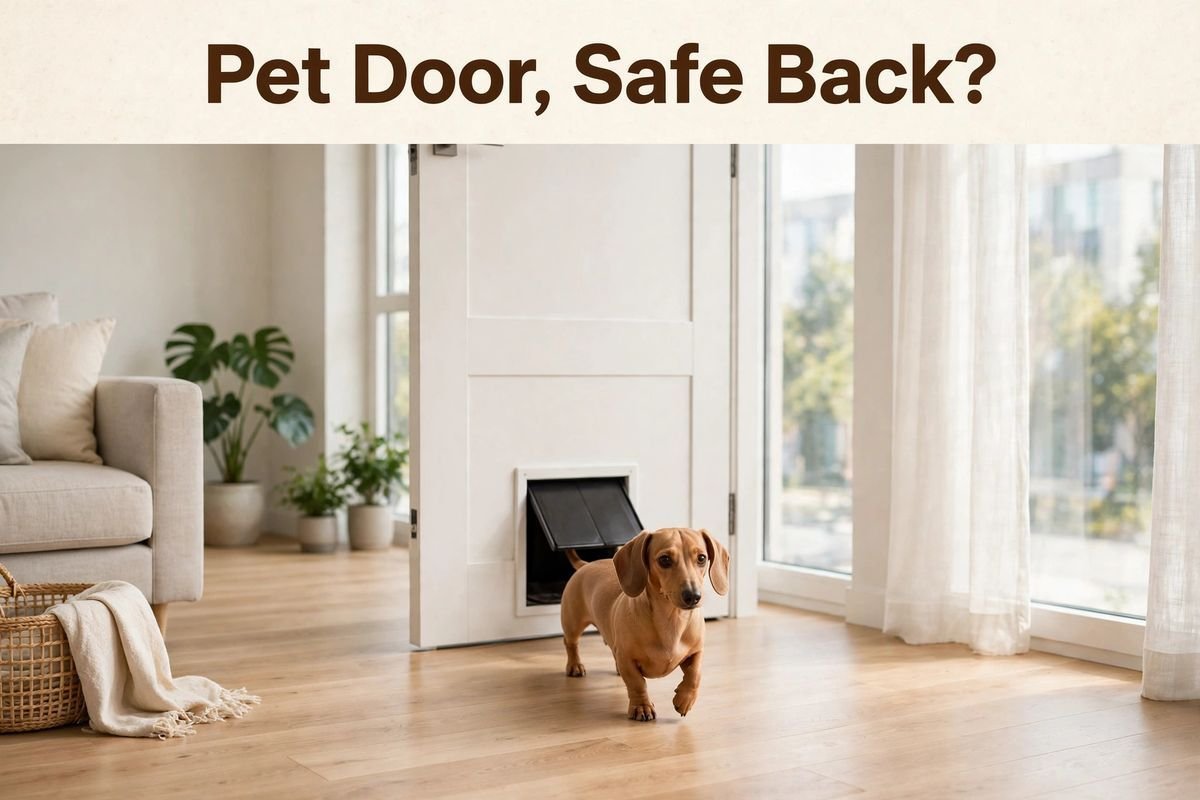
Dachshund Pet Door Guide for Apartments: Back-Safe?
Quick Answer
- A pet door can work in an apartment only when the flap is low, wide, and easy to push, with a step-over height close to the floor so a Dachshund never has to jump or climb through it.
- Choose a flap sized for a miniature Dachshund, with a light magnetic seal and a smooth frame, and place it on a balcony door or an interior door, never on a route that forces the dog up or down steps.
- Train the dog to walk through slowly with treats and a calm voice, and lock the flap at night or when the dog is unsupervised.
- Contact a veterinarian if the dog hesitates, crouches, or shows back pain when using the door, because the door may not suit that dog.
Contents
- 1. Is a Pet Door Back-Safe for a Dachshund?
- 2. Flap Types: Flexible, Rigid, and Electronic
- 3. Choosing Size, Step-Over Height, and Seal
- 4. Fitting a Pet Door in an Apartment
- 5. Training a Dachshund to Use the Door Calmly
- Pet Door Comparison Checklist
- Common Mistakes
- When to Call Your Vet
- Pin This: Pet Door Checklist
- Frequently Asked Questions
- Conclusion
A pet door sounds like freedom for a small dog in an apartment: the dog can step out to the balcony, reach a toilet area, or move between rooms without waiting for a person to open the door. For a Dachshund, though, the wrong pet door can be a daily strain on the long back, because a flap that is too high, too stiff, or too narrow forces the dog to jump, duck, twist, or push hard with its head and shoulders every time it passes through.
This guide explains how to judge whether a pet door is back-safe for a Dachshund, which flap types suit apartments, how to measure for size and step-over height, and how to train the dog to use it calmly. It is general information about home products, not veterinary advice. A dog with back pain, weak legs, or a recent injury needs a veterinarian before any change to its routine, and a pet door is never a substitute for supervision, walks, or veterinary care.
1. Is a Pet Door Back-Safe for a Dachshund?
A pet door is back-safe when the dog can walk through it at a normal walking pace, with its head and back level, without jumping, climbing, crouching, or twisting. The key measurement is the step-over height, the distance from the floor to the bottom edge of the flap. For a miniature Dachshund, that height should be as close to the floor as possible, ideally no more than a few centimetres, so the dog steps through rather than hops over a sill. A high sill turns every trip through the door into a small jump, and repeated jumping adds load to the spine and the discs between the vertebrae.
The flap itself matters just as much. A heavy flap with a strong magnet forces the dog to push hard with its nose and shoulders, and a dog that shoves its way through with its head down can strain its neck and upper back. A light, flexible flap that swings open with a gentle nudge lets the dog pass through without force, and a clear or partly clear flap lets the dog see what is on the other side, so it does not rush or hesitate at the threshold.
Dachshunds are prone to disc disease because of their long spine and the shape of their vertebrae, and Cornell’s information on chondrodystrophy and disc disease explains why this breed’s discs are vulnerable. A veterinarian can advise whether a pet door suits a particular dog, especially an older dog, a dog that has had back trouble, or a dog that is overweight, and that advice should come before the door is fitted.
2. Flap Types: Flexible, Rigid, and Electronic
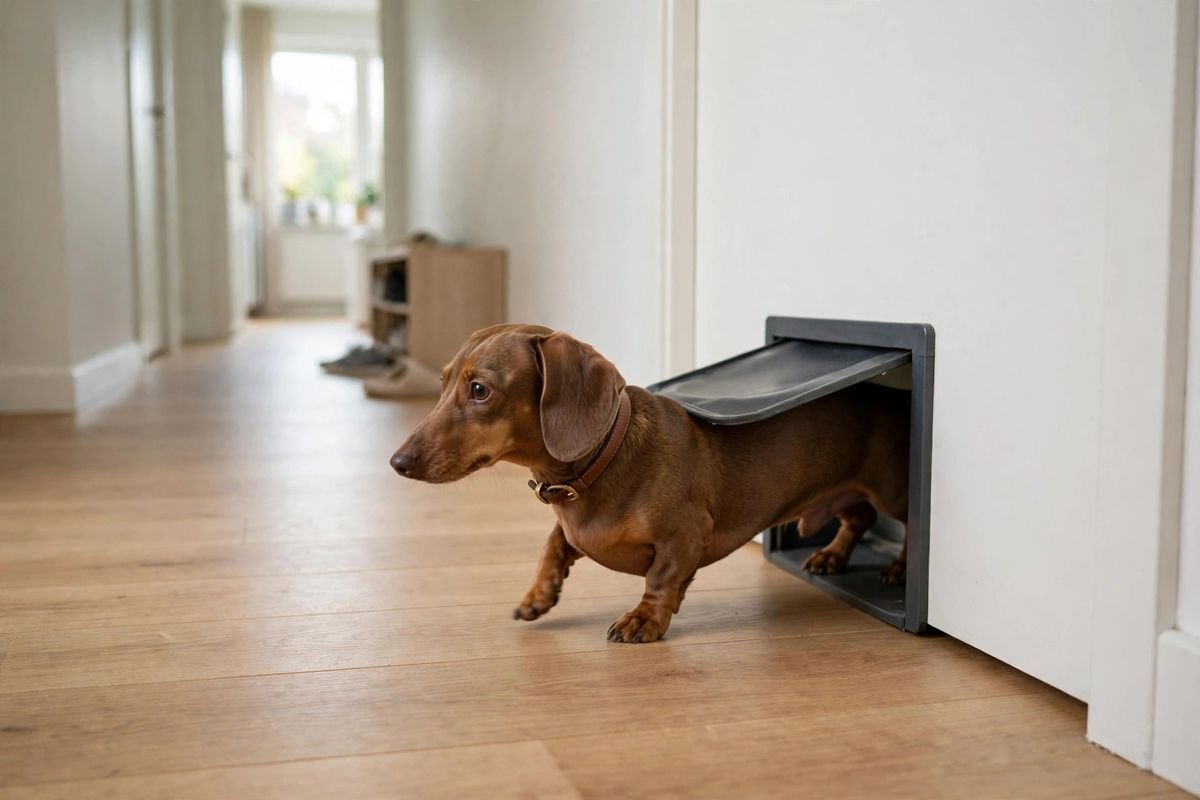
Flexible vinyl flaps are the simplest and often the best choice for a Dachshund. A single soft flap swings easily, seals lightly with a small magnet, and gives way when the dog pushes through, so the dog does not need to force its way. A double flap, with one flap on each side, seals better against draughts and noise, but it doubles the resistance, and a small dog may find two flaps harder to push than one.
Rigid flaps, made of hard plastic or a framed panel, suit larger dogs and exterior doors, but they are often too heavy for a miniature Dachshund. A rigid flap that swings back can catch a small dog, and a flap with a strong spring can hit the dog’s back as it passes through. If a rigid flap is the only option, check that it swings freely, that it has no sharp edges, and that the dog can push it open with its nose alone, without putting its weight behind the push. A flap that a person can open with one finger is about right for a small dog.
Electronic flaps open only for a dog wearing a microchip or a collar tag, which stops other animals entering and keeps the door locked when the dog is not near it. That security suits ground-floor apartments and balconies where stray animals or draughts are a concern, but electronic flaps cost more, need batteries or power, and can be slower to open, so a dog that rushes through may bump into a flap that has not yet lifted. Test the opening speed before fitting, and keep a manual lock for nights and holidays.
3. Choosing Size, Step-Over Height, and Seal
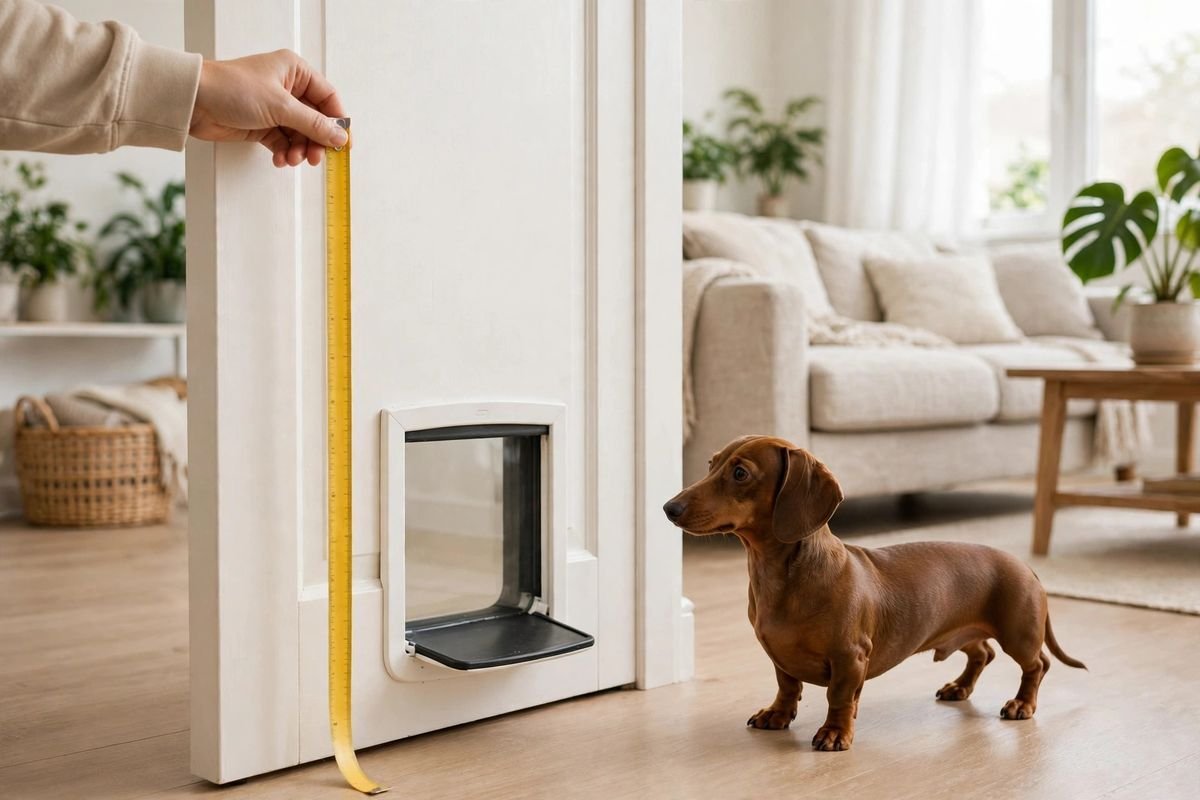
Measure the dog before choosing a flap. Measure the shoulder height from the floor to the top of the shoulders, the width across the chest, and the length from chest to tail base, then add a few centimetres of clearance on each side. A flap that is too narrow forces the dog to squeeze through sideways, twisting its spine, while a flap that is too tall lets in draughts and noise without helping the dog. For most miniature Dachshunds, a flap about 15 centimetres wide and 20 centimetres tall is a good starting point, but the dog’s own measurements matter more than any standard size.
Step-over height is the measurement that decides whether the door is back-safe. The bottom of the flap should sit as close to the floor as the door allows, and any raised sill should be covered with a small, gentle ramp or a flat threshold strip so the dog steps up a slope rather than hopping over a lip. The guide to apartment home layout for a Dachshund’s back explains how ramps, furniture, and floor coverings work together, and the pet door is one part of that layout, not a separate piece.
Check the seal and the lock. A light magnetic strip around the flap keeps out draughts without adding much resistance, while a heavy magnetic seal can be too strong for a small dog. The door should have a slide-in panel or a locking cover for nights, holidays, and times when the dog should stay inside, and that cover should be easy for a person to fit and remove.
4. Fitting a Pet Door in an Apartment
Most apartments do not allow cutting into a front door or an exterior wall, so the practical options are an interior door, a balcony sliding door insert, or a window insert. An interior door is the simplest: a pet door can be fitted into a bedroom or living-room door, and the door can be replaced or repaired when moving out. A sliding-door insert fits into the track of a balcony door, so no cutting is needed, but it narrows the opening for people and must be sealed against draughts.
Check the tenancy rules before fitting anything. Many landlords allow a pet door in an interior door with written permission, while few allow changes to an exterior door, a fire door, or a shared hallway door. A fire door must never be cut, because that breaks its fire rating and can put the whole building at risk.
Fit the door at floor level and test it before the dog uses it. Push the flap open from both sides, check that it swings freely and does not stick, and run a hand around the frame for sharp edges. Place a non-slip mat on both sides of the door, so the dog has grip as it steps through, and keep the area clear of furniture, shoes, and cables that could trip the dog as it passes. A dog that must turn sharply as soon as it comes through the flap will twist its spine, so leave a clear space of at least a metre on each side.
5. Training a Dachshund to Use the Door Calmly
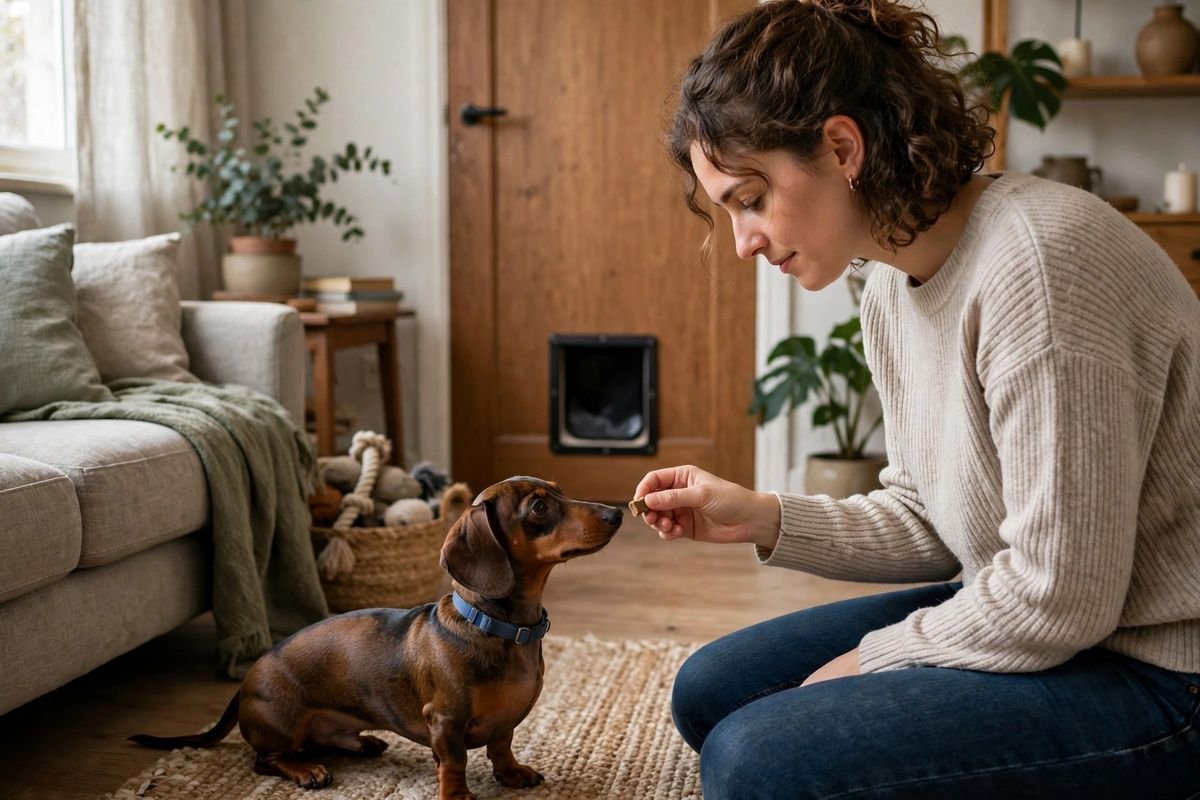
Start with the flap taped open, so the dog can walk through the empty frame without pushing anything. Place treats on the far side, call the dog through in a calm voice, and reward every slow, level pass with a treat and praise. Keep sessions short, five minutes at a time, and end while the dog is still happy, so the door stays a pleasant place. A dog that rushes through should be called back and asked to walk through again slowly, because speed and excitement are what cause slips and bumps at the threshold.
Lower the flap gradually, a little at a time over several days. Tape it half open, then a quarter open, then fully closed, rewarding the dog each time it pushes through gently. Hold the flap open with a hand at first, so the dog learns that the flap moves and will not trap it, and let the dog push it with its nose rather than its head or shoulders. The guide to stair gates for apartments covers another way to control where a Dachshund can go, and a gate can be a useful alternative while the dog is still learning the flap, or a permanent choice if the dog never takes to the door.
Lock the flap at night and when the dog is unsupervised, especially for a balcony door. A Dachshund left alone with an open flap can slip out onto a balcony in bad weather, eat something it should not, or get stuck, and a locked flap keeps the dog safely inside. Set a routine: flap open during the day when someone is home, locked at night and when the home is empty, and check the flap weekly for wear, sticking, or a magnet that has become too strong.
Pet Door Comparison Checklist
| Pet door type | Best for | Limit to watch |
|---|---|---|
| Single flexible vinyl flap | Miniature Dachshunds, interior doors | Less draught sealing in cold flats |
| Double flap | Cold or windy balconies | Double resistance for a small dog |
| Rigid flap | Exterior doors, larger dogs | Often too heavy, can swing back |
| Electronic microchip flap | Ground floors, keeping other animals out | Slower to open, needs power or batteries |
| Sliding-door insert | Balconies, no cutting needed | Narrows the doorway for people |
Common Mistakes
- Choosing a flap that is too narrow, so the dog squeezes through sideways.
- Leaving a high step-over sill that the dog must jump over.
- Picking a heavy flap with a strong magnet a small dog cannot push.
- Cutting a fire door or an exterior door without permission.
- Forcing a frightened dog through the flap instead of training slowly.
- Leaving the flap unlocked at night or when the dog is alone.
- Forgetting to check the flap for sticking, wear, or sharp edges.
When to Call Your Vet
Contact a veterinarian if a Dachshund hesitates, crouches, or cries when using a pet door, or if it shows sudden back pain, weakness, wobbliness, or a reluctance to walk, and seek urgent help for collapse, heavy bleeding, or loss of bladder control. Contact a veterinarian also if the dog has had back trouble before, is overweight, or is older, before fitting a pet door, so the door can be judged against that dog’s health. This article gives general information only and does not diagnose any condition. A veterinarian can examine the dog, check for disc disease or joint problems, and advise whether a pet door, a stair gate, or a ramp suits that dog best.
Pin This: Pet Door Checklist
- Measure shoulder height and chest width first.
- Keep the step-over height close to the floor.
- Choose a light, flexible flap with a gentle seal.
- Fit it in an interior door or a sliding-door insert.
- Train with the flap taped open, then lower it slowly.
- Lock the flap at night and when the dog is alone.
- Check weekly for sticking, wear, and sharp edges.
Frequently Asked Questions
Is a pet door safe for a Dachshund’s back?
It can be, when the flap is low, wide, and light, with a step-over height close to the floor, so the dog walks through level without jumping, climbing, or twisting. A veterinarian can advise for a dog with back trouble, and this article gives general information only.
What size flap does a miniature Dachshund need?
Measure the dog’s shoulder height and chest width, then add a few centimetres of clearance on each side. A flap about 15 centimetres wide and 20 centimetres tall suits many miniature Dachshunds, but the dog’s own measurements matter more than any standard size.
Can I fit a pet door in a rented apartment?
Often yes, in an interior door or with a sliding-door insert that needs no cutting, but check the tenancy rules and get written permission first. Never cut a fire door or an exterior door, and keep the original door safe so it can be put back when moving out.
How do I train a Dachshund to use a pet door?
Tape the flap open, lure the dog through with treats, and reward slow, level passes. Lower the flap a little at a time over several days, and go back a step if the dog freezes or refuses. Short, calm sessions work better than one long session, and forcing the dog can create a lasting fear of the door.
Should the pet door stay open at night?
No. Lock the flap at night and when the dog is unsupervised, especially for a balcony door, so the dog stays safely inside in bad weather and cannot get stuck or eat something it should not. Open it during the day when someone is home to supervise.
Conclusion
A pet door can give a Dachshund freedom in an apartment, but only when the flap is low, light, and wide enough for the dog to walk through level, without jumping or twisting. Measure the dog, choose a gentle flap, fit it where the rules allow, train slowly, and lock it when the dog is alone.



One Comment