Dachshund Refusing Food for a Day: Home Checks to Try
Quick Answer
- A Dachshund that refuses all food for one day needs calm home checks first: fresh water, mood, movement, mouth, belly, stool, and temperature, all noted down.
- Offer the usual food at the usual time, leave it down for fifteen minutes, then lift it away without fuss, and try again at the next meal.
- Do not switch foods, add rich treats, or hand-feed all day to tempt the dog, because that can upset the stomach and hide the real pattern.
- Keep the day quiet, with short level walks, no new food, and a simple written note of what the dog drank, passed, and did.
- Contact a veterinarian if the dog refuses food for more than a day, refuses water too, vomits, has diarrhea, seems in pain, or is a puppy, a senior, or already unwell.
Contents
- 1. What Refusing Food for a Day Really Means
- 2. The Calm First Checks: Water, Mood, and Movement
- 3. Check the Mouth, Belly, and Stool
- 4. A Quiet Day: What to Offer and What to Skip
- 5. Keeping Notes and Knowing When the Day Is Over
- Refusing Food Checklist: What to Check and When
- Common Mistakes
- When to Call Your Vet
- Pin This: Refusing Food for a Day Checklist
- Frequently Asked Questions
- Conclusion
1. What Refusing Food for a Day Really Means
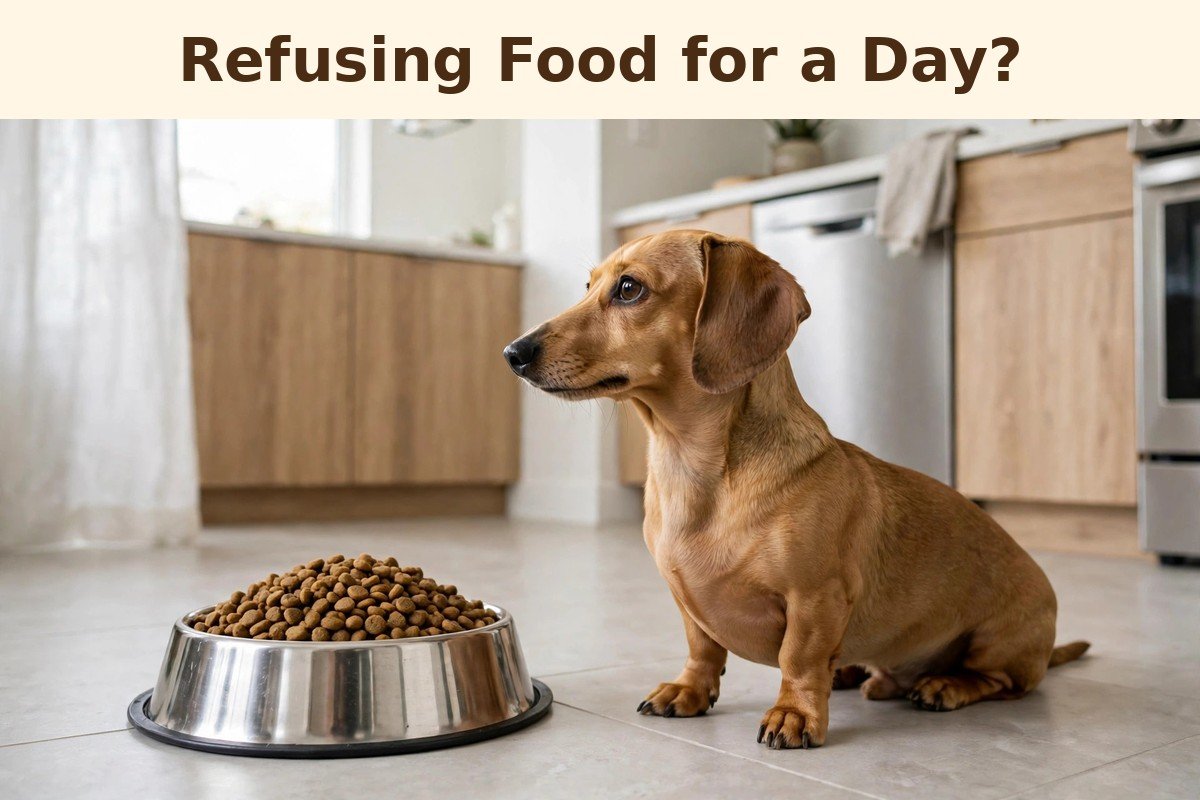
A Dachshund that turns away from its bowl is hard to watch, because most Dachshunds love food and a full bowl left untouched feels wrong at once. Yet refusing food for one day is not the same as refusing food for a week, and it is not the same as being picky. A picky dog sniffs the food, picks out the best bits, and eats something, even if it is not what the owner wanted it to eat. A dog that refuses food entirely eats nothing at all: not its kibble, not a treat, not a piece of plain cooked chicken held out by hand. That full refusal is the line this article is about, and it deserves a calm, careful response rather than a panicked one.
There are many ordinary reasons a Dachshund may skip food for a day. A hot day, a change in routine, a stressful visit, a mild stomach upset, tiredness after a long walk, or a new smell in the home can all put a dog off its food for a meal or two. Some dogs eat less when the weather turns warm, and some eat less after a vaccination or a car journey. In many of these cases the dog still drinks water, still wags its tail, still walks normally, and comes back to food at the next meal as if nothing happened. The job of the owner on that day is to notice which of those things are true, and to write them down, so the pattern is clear instead of guessed at.
Disc degeneration in Dachshunds can begin in the first year of life, so pain in the back or neck can also show up as a dog that will not eat, because bending down to the bowl hurts. The calm mealtime routine for a picky Dachshund is useful for a dog that eats some food but not all of it, while this article is for the dog that eats nothing at all.

2. The Calm First Checks: Water, Mood, and Movement
The first check is water, and it matters more than food. A dog can go a day without food and be fine, but a dog that will not drink needs help much sooner. Put down fresh, cool water in a clean bowl, in the usual place, and watch whether the dog drinks. Most dogs that refuse food will still drink, and a dog that drinks normally, toilets normally, and stays bright is far less worrying than a dog that turns away from water too. If the dog will not drink at all for several hours, or if it drinks and then vomits the water back up, note the time and contact a veterinarian the same day.
Next, check the mood. A Dachshund that refuses food but still follows its owner around the apartment, sniffs at the door, wags its tail, and settles in its usual sleeping spot is a different dog from one that hides under the bed, will not get up, or stares at the wall. Mood is not a medical test, but it is a useful early signal, because owners know their own dog’s normal mood better than anyone else. Note whether the dog greets the owner, whether it is interested in a walk, whether it plays at all, and whether it seeks company or avoids it. A small change in mood with a full refusal of food is worth writing down, because a veterinarian will ask about it.
3. Check the Mouth, Belly, and Stool
The mouth is a common and often missed reason a Dachshund refuses food. Lift the lip gently and look at the gums and teeth in good light. Healthy gums are pink and moist, and the teeth should be whole, without a broken tooth, a swollen gum, or a sore that the owner can see. A sore tooth, a cut on the tongue, a bit of food or a small object caught between the teeth, or sore gums can make every bite hurt, and a dog that has learned that eating hurts will simply stop trying. Look for drooling, pawing at the mouth, a bad smell from the mouth that is new, or bleeding from the gums. Do not reach into the mouth or try to pull anything out with fingers, because a frightened dog may bite, and a stuck object may need a veterinarian to remove it safely.
Offer a small, soft test if the mouth looks sore: a few pieces of the dog’s usual food soaked in warm water until soft, or a spoonful of plain wet food, offered by hand. A dog with a sore mouth may eat soft food while refusing hard kibble, and that difference is useful information for a veterinarian. If the dog refuses even soft food, or takes food into its mouth and drops it again, note that too, because dropping food is a different sign from ignoring food. Do not offer bones, hard treats, or anything chewy on this day, and do not offer human food from the table as a test, because a rich or fatty snack can upset the stomach and make the next check harder to read.
The guide to an upset stomach and vomiting at home explains what to watch for when the stomach is unsettled, and the same checks apply here, including what to note about the stool.

4. A Quiet Day: What to Offer and What to Skip
A quiet day is the kindest response to a dog that refuses food. Keep the apartment calm, keep visitors away, keep the television low, and let the dog rest in its own bed in a warm, quiet room. Short, level walks for toileting are enough, and there should be no long walk, no park visit, no rough play, and no training session that asks the dog to jump or run. A tired or stressed dog eats less, and a quiet day removes the noise so the owner can see whether appetite returns on its own. If the dog sleeps for much of the day, let it sleep. Rest is recovery, and a dog that wakes up bright and interested in food has answered the question by itself.
At each normal mealtime, offer the usual food, freshly served, and leave it down for fifteen minutes. Use the usual bowl in the usual place, and do not stand over the dog watching it, because some dogs will not eat while they are watched. Walk away, do something else, and come back after fifteen minutes. If the food is untouched, lift it away without comment and throw it away or cover it and put it in the fridge if it is wet food. Do not leave the bowl down all day, because food left out goes stale, attracts flies, and makes it impossible to know when, or whether, the dog ate. A clear mealtime with a clear end gives a clear answer at the next meal.
5. Keeping Notes and Knowing When the Day Is Over
A short written note turns a worrying day into useful information. On a piece of paper or in a phone note, write the time of each meal offered, whether the dog ate any of it, how much water the dog drank, when the dog last passed stool and what it looked like, whether the dog vomited, how the dog moved, and how the mood seemed. Keep the note short and factual: times and plain observations, not guesses about the cause. A note that says “8 a.m. offered food, ate nothing, drank water, walked normally, stool firm at 9 a.m.” is far more useful to a veterinarian than a memory of a worrying day. Take the note to the appointment, or read it out on the phone, and the veterinarian can work from facts instead of from worry.
The day ends at the next morning’s first meal. A healthy adult Dachshund that refuses food for one day and then eats normally the next morning, drinks well, and moves normally has usually had a passing upset, a hot day, or a stressful day, and the owner can simply return to the normal routine and keep watching for a few more days. Do not make up for the missed meals with a larger portion the next day. Serve the normal amount, at the normal time, and let the dog eat at its own pace. A double portion after a day without food can upset the stomach all over again, and the dog does not need to catch up.
The Cornell guide to chondrodystrophy and intervertebral disc disease explains the breed background that makes back pain one of the reasons a Dachshund may stop eating.

Refusing Food Checklist: What to Check and When
| When | What to Do | What to Watch For |
|---|---|---|
| First missed meal | Offer usual food for 15 minutes, then lift it away | Dog ignores food completely; note the time |
| Same hour | Fresh water in a clean bowl; check mood and movement | Drinking normally; walking normally; bright or flat |
| Within a few hours | Gently check mouth, gums, and belly with a light touch | Sore tooth; drooling; flinching; swollen belly |
| Through the day | Quiet rest; short level walks; no treats or new food | Vomiting; diarrhea; blood in stool; refusal of water |
| Next morning | Offer the usual food at the usual time | Eats normally, or still refuses and needs a vet call |
Common Mistakes
- Changing the food or brand at once, so the owner cannot tell whether the refusal or the new food caused the next problem.
- Offering treats, cheese, sausage, or table scraps all day to tempt the dog, and hiding the real pattern.
- Leaving the bowl down all day, so nobody knows when, or whether, the dog ate.
- Hand-feeding every bite, which can teach the dog to wait for hand-feeding instead of eating from the bowl.
- Skipping the water check, and missing the more urgent sign of a dog that will not drink.
- Forcing food into the dog’s mouth, which risks choking and frightens a dog that may already be in pain.
- Reaching into the mouth to pull out a stuck object, instead of letting a veterinarian remove it safely.
- Waiting several days before calling a veterinarian, especially with a puppy, a senior, or a dog that also vomits or refuses water.
When to Call Your Vet
Contact a veterinarian if a Dachshund refuses all food for more than a day, refuses water as well as food, vomits repeatedly, has diarrhea or blood in the stool, seems in pain when lifted or touched, walks stiffly or refuses to move, or has a swollen belly. Contact a veterinarian the same day for a puppy that refuses food for half a day, a senior that refuses food and water together, or any dog with a known health condition that stops eating. Contact a veterinarian urgently if the dog cannot stand or tries to vomit without bringing anything up. A veterinarian can examine the mouth, belly, and back and advise on the next step, and the Animal Medical Center guide to intervertebral disc disease in dogs explains the signs that need prompt attention. This article gives general information only and is not a diagnosis.
Pin This: Refusing Food for a Day Checklist
- Offer the usual food for 15 minutes, then lift it away.
- Check water first: a dog that will not drink needs help sooner.
- Check mood, movement, mouth, belly, and stool, and write it down.
- Keep the day quiet: no treats, no new food, short level walks.
- Try again at the next normal mealtime, with the same food.
- Call a veterinarian if food is still refused the next morning.
Frequently Asked Questions
Is it normal for a Dachshund to skip one meal?
Yes, skipping a single meal can happen after a hot day, a stressful event, or a mild stomach upset, and many healthy dogs eat normally at the next meal. Refusing all food for a full day is different, and it deserves a veterinarian call if it continues into the next day.
Should I offer a different food if my Dachshund refuses its usual food?
No, not on the first day. Changing food makes it impossible to tell whether the refusal or the new food caused the next problem, and a new food can upset a sensitive stomach. Offer the usual food until a veterinarian advises a change.
My Dachshund refuses food but still drinks water. Is that okay?
It is reassuring, because drinking normally is a good sign, but it does not mean the refusal can be ignored. Contact a veterinarian if the dog still refuses food the next morning, or sooner if vomiting, diarrhea, or pain appears.
Can back pain make a Dachshund refuse food?
Yes. A Dachshund with a sore back or neck may refuse food because bending down to the bowl hurts, or because pain itself puts the dog off eating. A dog that refuses food and walks stiffly should be checked by a veterinarian promptly.
When should I worry about a puppy that refuses food?
Sooner than with an adult dog. Puppies have small energy reserves and can become weak quickly, so a puppy that refuses food for half a day, or that refuses food and water together, should be seen by a veterinarian the same day.
Conclusion
A Dachshund that refuses food for a day deserves a calm day, not a frantic one: the usual food at the usual times, fresh water, gentle checks of mood, movement, mouth, belly, and stool, a short written note, and a veterinarian call if the refusal lasts past the next morning.