
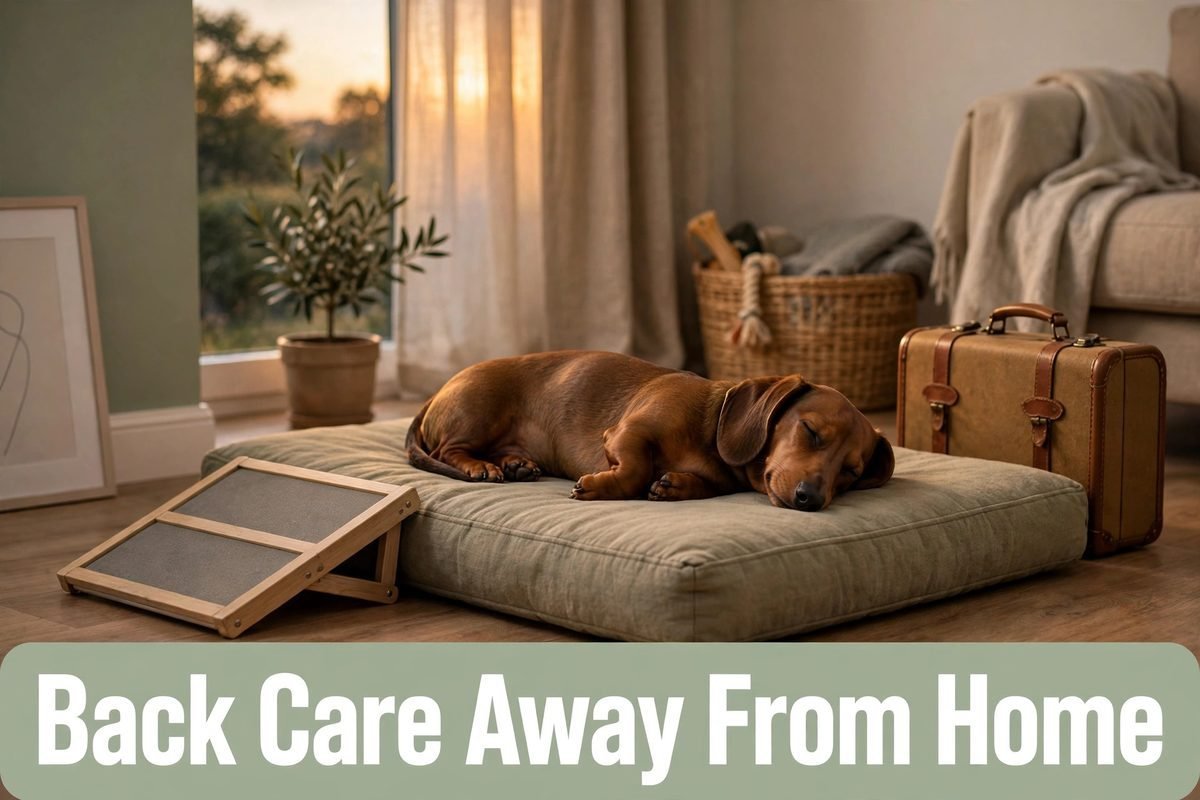
Dachshund Back Care at Someone Else’s Home: Holiday Guide
Quick Answer
- A Dachshund staying at someone else’s home needs the same back-safe routine as at home: a ramp for the sofa and bed, its own flat bed, non-slip surfaces, and calm lifting every time.
- Pack before the visit: the ramp, the bed, the harness, the food, a non-slip mat, and a note of the normal routine, so nothing back-safe is left behind.
- Agree the house rules with the host before arriving: no stairs, no jumping on and off furniture, no slippery floors, and a quiet corner where the dog can rest.
- Keep the days calm, with short, level walks, regular toilet trips, and plenty of rest, and watch how the dog moves in the new setting.
- Contact a veterinarian if the dog shows back pain, stiffness, weakness in the legs, or reluctance to move during or after the stay.
Contents
- 1. Why a New Home Is Harder on a Dachshund’s Back
- 2. Packing the Back-Safe Kit Before You Go
- 3. Agreeing the House Rules With Your Host
- 4. The First Day: Settling In Without Strain
- 5. Keeping the Routine Calm for the Whole Stay
- Staying Away Checklist: Home vs Someone Else’s Home
- Common Mistakes
- When to Call Your Vet
- Pin This: Staying at Someone Else’s Home Checklist
- Frequently Asked Questions
- Conclusion
1. Why a New Home Is Harder on a Dachshund’s Back
A Dachshund’s home is not just a place to sleep; it is a landscape the dog knows by heart. At home, the dog knows where the ramp is, which floor is slippery, how high the sofa is, and where the bed sits. In someone else’s home, all of that knowledge disappears at once. The sofa is a different height, the stairs have a different number of steps, the floor might be smooth tile instead of carpet, and the bed might be high off the ground with no ramp in sight. A dog that has to work all of that out in the first hour of a visit is a dog that is likely to jump, scramble, and slip, and those are the movements that put the most strain on a long back.
Excitement makes the problem worse. A visit usually means new people, new smells, and often other pets or children, and an excited Dachshund will run, jump up at people, and try to climb onto unfamiliar furniture. A calm dog moves carefully; an excited dog does not, and in a house with no ramp and no familiar bed, nothing slows it down. Disc degeneration in short-legged breeds can begin in the first year of life, so the habits that protect the back need to travel with the dog.
The stay itself adds a second problem: the routine changes. Meal times shift, walk times shift, and the bed is in a different room, and a dog that is unsure of the routine paces and tries to follow people from room to room. The answer is to bring the routine with the dog, in the form of the same bed, the same ramp, and the same calm habits. The guide to moving home with a Dachshund covers the same idea for a permanent move, and a holiday stay is a short version of the same challenge.
2. Packing the Back-Safe Kit Before You Go
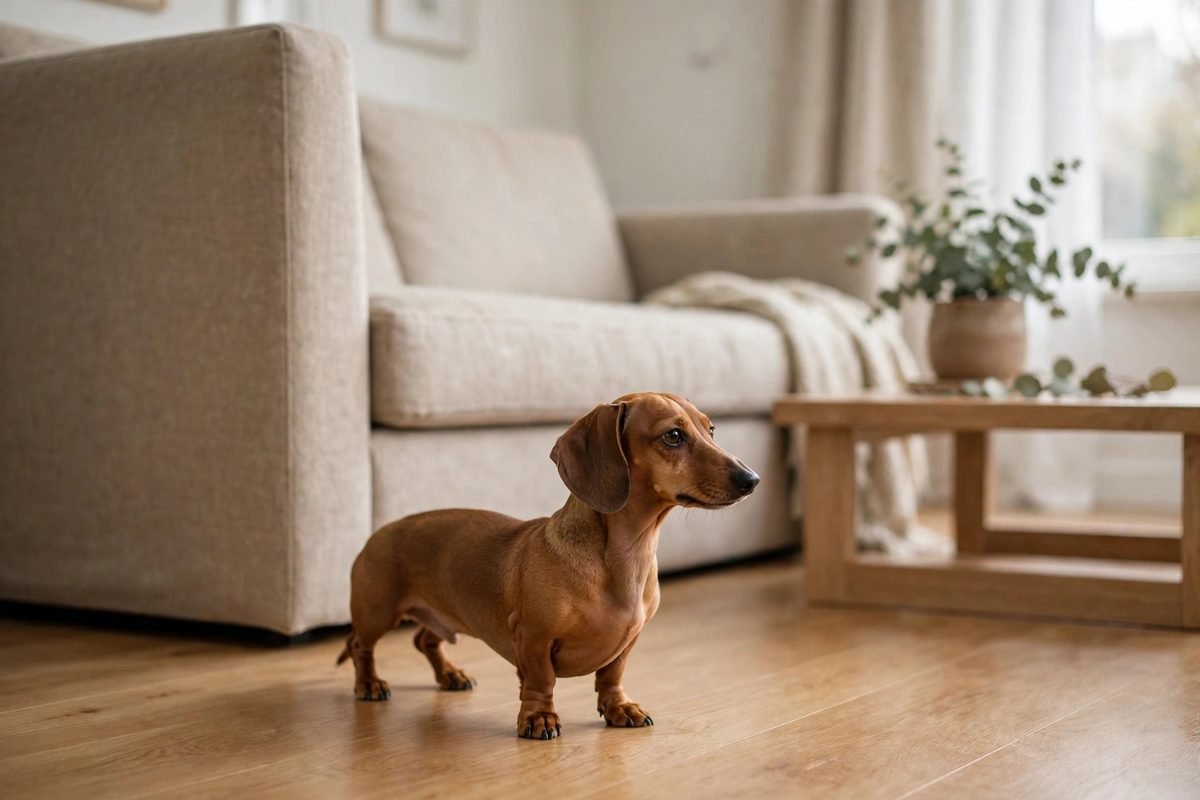
Packing for a Dachshund is packing for a back, and the most important item in the bag is the ramp. If the dog uses a ramp at home for the sofa or the bed, that ramp needs to travel, because a host’s sofa is no lower than the one at home. A folding ramp packs into a car easily, and it should be set up in the host’s living room before the dog is let into the room.
Pack a small first-aid note as well: the name and number of the dog’s veterinarian, and the address of a veterinary practice near the host’s home, found before the trip. A holiday is the worst time to search for a vet in a hurry, and a note in the bag costs nothing. Check the car before leaving: the dog should travel in its usual carrier or on its usual car bed, with a non-slip base, and the journey should include breaks every couple of hours for water, a toilet trip, and a slow walk on flat ground. Arriving calm, rather than arriving stiff from a long drive, makes the first day in the new house much easier, and the dog that arrives relaxed is the dog that settles fastest.
3. Agreeing the House Rules With Your Host
The house rules conversation should happen before the visit, not after the dog has already jumped off the host’s high bed. It does not need to be a long talk, and it does not need to sound like a list of demands. A short, friendly message works well: the dog has a long back, so it uses a ramp for the sofa and bed, it should not use stairs, and it needs a quiet corner to rest in. Most hosts are glad to know, because nobody wants a guest’s dog to get hurt in their house, and most of the rules are easy to keep once the host understands why they matter. The key points are simple: the dog is lifted, not allowed to jump, and the ramp is used every time.
Talk about the times the dog will be left alone, too. A Dachshund left alone in a strange house may pace, scratch at doors, and try to climb onto furniture, and all of that is hard on the back. Agree that the dog will be left in its own bed in a safe room, with a chew or a puzzle feeder and the door closed. The guide to back care when a Dachshund is left alone for long hours explains the same setup for home.
4. The First Day: Settling In Without Strain
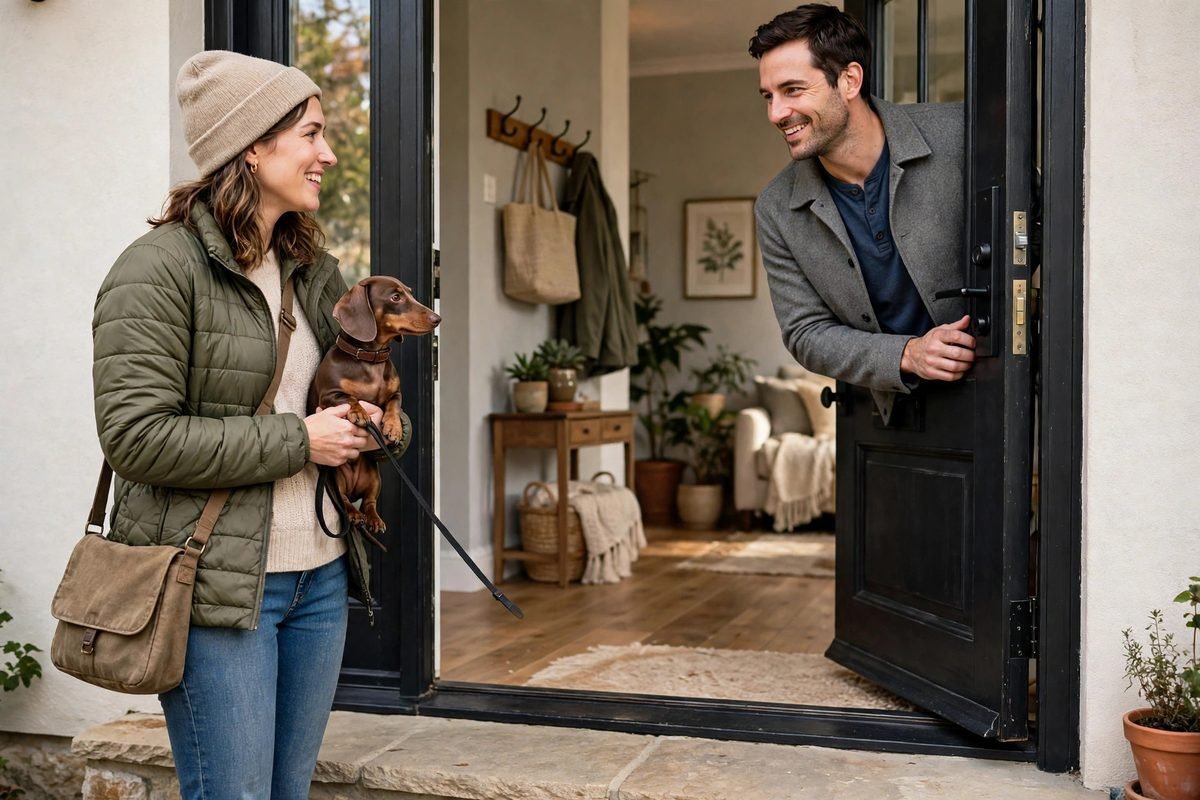
The first day sets the pattern for the whole stay, so it should be the calmest day of all. Arrive, walk the dog slowly around the garden or the street on a lead, let it toilet, and then bring it into the house on the lead, with the ramp already in place and the bed already set up in its corner. Let the dog sniff the bed, the ramp, and the room, and offer a treat for settling on the bed. Keep the greetings short: one person at a time, sitting down, letting the dog come to them, rather than a crowd of people bending over the dog and lifting it up for cuddles. A dog that is lifted by strangers, passed from person to person, or picked up by the front legs is a dog whose back is being handled by people who do not know the routine, and that is a risk that is easy to avoid by keeping the first greetings low and calm.
Watch how the dog moves on the first evening. A dog that walks normally, stretches, and settles on its bed has had a good first day. A dog that is stiff getting up, slow to move, or reluctant to use the ramp may be tired, may have slipped on a smooth floor, or may simply be unsure of the new house. Give the dog a quiet evening, a gentle check of the back with a light touch, and an early night in its own bed. If the dog seems sore, keep the next day even calmer, with shorter walks and more rest, and watch whether the stiffness eases. The first day is not a day for outings, long walks, or games with the host’s children; it is a day for settling in, and the rest of the stay will be easier for it.
5. Keeping the Routine Calm for the Whole Stay
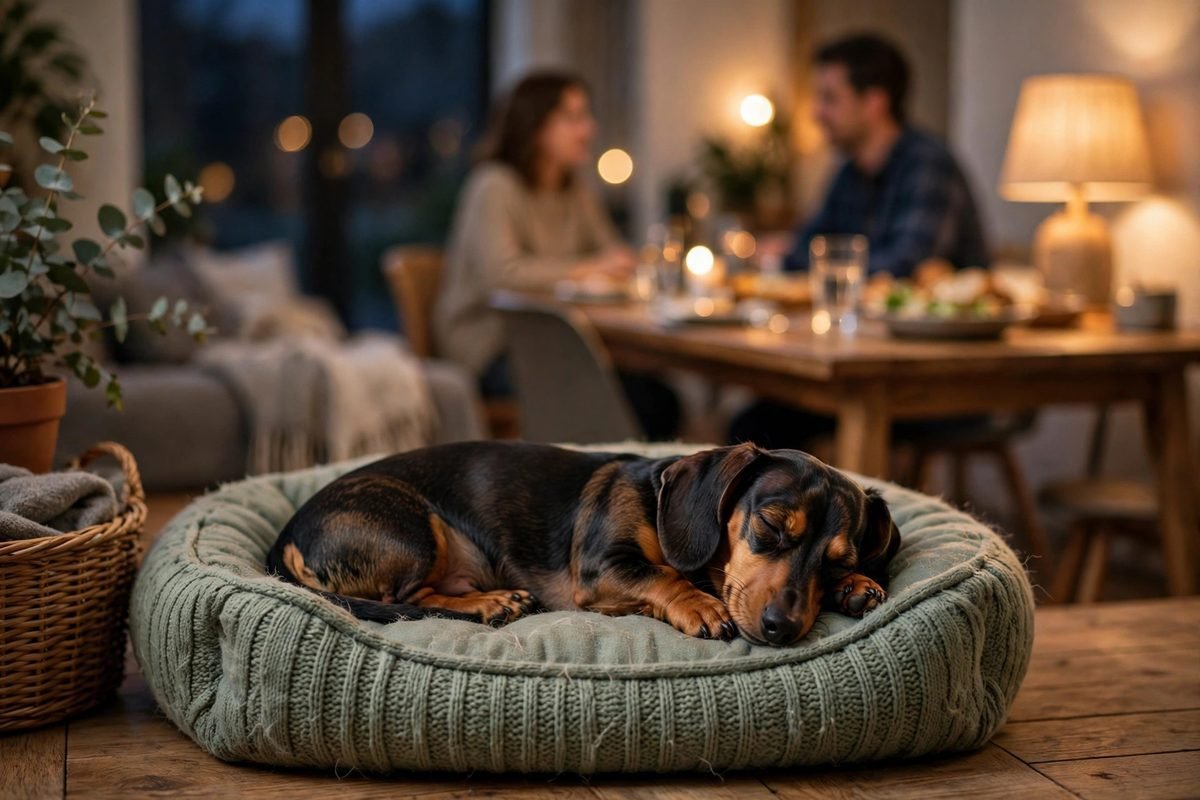
Once the dog has settled, the job is to keep the routine steady for the rest of the stay. Feed at the same times, walk at the same times, and keep the bed and the ramp in the same places, so the dog can find them without thinking. Keep the walks short and level, and keep the play calm: a gentle game on the floor, a puzzle feeder, or a slow wander around the garden, rather than a chase game with the host’s children or a run up and down the stairs. If the host’s house has a garden, check it first for gaps in the fence, steep steps, and slippery decking, and keep the dog on a lead in the garden until the owner knows it is safe. A garden that is safe for a person is not always safe for a short-legged dog.
On the last day, pack the kit the same way it was packed at home, and give the dog a calm morning before the journey. A short, level walk, a toilet trip, food at the normal time, and a rest in the bed before the car ride will make the journey home easier. When the dog gets home, keep the first day back calm as well, with short walks and the usual routine, and watch how the dog moves for a day or two after the stay. A dog that comes home stiff or sore may have had a slip or a jump that nobody noticed, and a quiet day at home, with the familiar ramp and bed, is the best way to let it settle. If the stiffness lasts more than a day, or the dog shows pain, contact a veterinarian.
Staying Away Checklist: Home vs Someone Else’s Home
| Back-Safe Need | At Home | At Someone Else’s Home |
|---|---|---|
| Ramp for sofa and bed | Already in place | Pack it; set it up before the dog enters the room |
| Own flat bed | In its usual spot | Pack it; put it in a quiet corner |
| Non-slip floors | Mats already down | Pack mats for smooth tile or wood |
| Stairs | Gated or avoided | Ask the host; use a gate or closed door |
| Toilet routine | Known garden or spot | Agree a spot; walk there on a lead |
| Left alone | Safe room at home | Safe room with bed, chew, and closed door |
| Local vet | Known practice | Note the address before the trip |
The table shows the real work of a stay: nothing in it is new, and everything in it is the home routine, packed into a bag and set up again in a different house.
Common Mistakes
- Leaving the ramp at home, and then letting the dog jump on and off the host’s sofa and bed for the whole stay.
- Not telling the host about the back, so well-meaning strangers lift the dog by its front legs or pass it around for cuddles.
- Letting the dog roam a strange house unsupervised, with stairs, slippery floors, and high furniture to explore.
- Packing a busy holiday with long walks, outings, and late nights, and giving the dog no proper rest.
- Forgetting the dog’s own bed, so the dog sleeps on a high bed, a pile of cushions, or a cold, hard floor.
- Leaving the dog alone in a strange room with the door open, where it can pace, scratch, and try to climb furniture.
- Skipping the check for a local veterinary practice, and then searching in a hurry when the dog needs help.
- Treating the first day as a normal day, with long walks and big greetings, instead of a calm settling-in day.
When to Call Your Vet
Contact a veterinarian if a Dachshund shows back pain, stiffness that lasts more than a day, weakness in the back legs, a reluctance to move, or yelping when lifted or touched along the back during or after a stay away from home. Contact a veterinarian urgently if the dog cannot move its back legs, loses bladder control, or is in severe pain. A veterinarian can examine the dog, and the Animal Medical Center guide to intervertebral disc disease in dogs explains the signs that need prompt attention. This article gives general information only and is not a diagnosis.
Pin This: Staying at Someone Else’s Home Checklist
- Pack the ramp, the bed, the harness, food, and non-slip mats.
- Tell the host the house rules before you arrive.
- Set up the ramp and bed before the dog enters the room.
- Keep the first day calm, with short, level walks.
- Rest the dog in its own bed, in a safe room, when you go out.
- Note the local veterinary practice before the trip.
- Call a veterinarian if stiffness or pain lasts more than a day.
Frequently Asked Questions
Should I take my Dachshund’s ramp on holiday?
Yes. The ramp is the single most important item to pack, because the host’s sofa and bed are no lower than the ones at home, and the dog will try to climb them with or without a ramp. Set it up before the dog enters the room, so the dog never has to jump.
Can my Dachshund sleep on the host’s bed?
Only if the dog can get up and down safely, which usually means a ramp and a bed that is not too high. In most host homes, the dog’s own low, flat bed on the floor, in a quiet corner, is the safer choice, and it avoids the jump down in the morning.
What if the host’s house has stairs?
Ask the host before the visit whether the stairs can be closed off with a door or a stair gate, and keep the dog on the ground floor. If the bedroom is upstairs, sleep downstairs with the dog, or keep the dog in a safe room downstairs.
How do I stop my Dachshund jumping up at the host’s children?
Keep the dog on a lead for the first greetings, and ask the children to sit down and let the dog come to them, with a treat held low. A dog that jumps up at people puts its back through a sudden stretch, and excited children make the jumping worse.
What if my Dachshund seems stiff after a stay away from home?
Keep the first day back at home calm, with short, level walks, the usual bed and ramp, and plenty of rest, and watch how the dog moves. If the stiffness eases within a day, the dog was probably just tired. If it lasts more than a day, contact a veterinarian. The Cornell guide to chondrodystrophy and intervertebral disc disease explains why the long-backed shape needs this care on every trip.
Conclusion
A stay at someone else’s home works well when the home routine travels with the dog: the ramp, the bed, the harness, the food, the same meal times, the same short walks, and the same calm habits. Tell the host the house rules before you arrive, set the room up before the dog walks in, and keep the first day calm.






One Comment