

Dachshund Moving Home Guide: Protect the Back on Move Day
Quick Answer
- Give your Dachshund a quiet room away from boxes, movers, and open doors, with its bed, water, and a familiar blanket.
- Carry with both hands, chest and hindquarters supported, and use a carrier and ramp for car travel and new stairs.
- Set up the ramp, floor bed, and food area in the new home before letting your dog explore, and ask a veterinarian about any pain or movement change after the move.
Contents: 1. Why Moving Day Is Risky for Backs | 2. The Quiet Room Plan | 3. Carrying and Car Travel | 4. First Hours in the New Home | 5. The First Week: Routine Over Exploring | Step-by-Step Move Plan | Common Mistakes | When to Call Your Vet | FAQs | Pin This
Moving home is stressful for dogs, and stress plus chaos is a poor combination for a long back. Doors stand open, boxes become climbing frames, strangers carry furniture through hallways, and a dog that is normally calm may dash, jump, or slip in the confusion. A back-safe move is not about buying anything new. It is about planning the day so your Dachshund spends most of it in one calm place, moves only when carried or guided, and arrives in a new home that is already set up for safe movement.
Start planning a week before move day, not on the morning itself. Pack your dog’s essentials last, set up the new home’s safe spots first, and keep the same feeding, walking, and rest times as far as possible. Dogs cope better with change when the daily pattern stays familiar, even if the rooms around them are new.
1. Why Moving Day Is Risky for Backs
On move day, the usual safeguards disappear. Ramps are packed, gates are removed, furniture is moved, and floors are covered with boxes and wrapping. A dog that normally uses a ramp may jump from a half-empty sofa, a dog that normally waits at stairs may run them while a door is propped open, and a dog startled by a mover may bolt and slip on a smooth floor. None of these moments is planned, which is exactly why they need a plan in advance.
General background explains why extra care is worthwhile. The Animal Medical Center explains intervertebral disc disease in dogs and how disc problems can affect movement. Cornell describes chondrodystrophy and intervertebral disc disease in breeds such as the Dachshund. Moving does not cause disc disease, and this guide does not claim that it does. The point is practical: a chaotic day increases the chances of jumps, slips, and awkward lifts, so removing that chaos is sensible back care.
2. The Quiet Room Plan
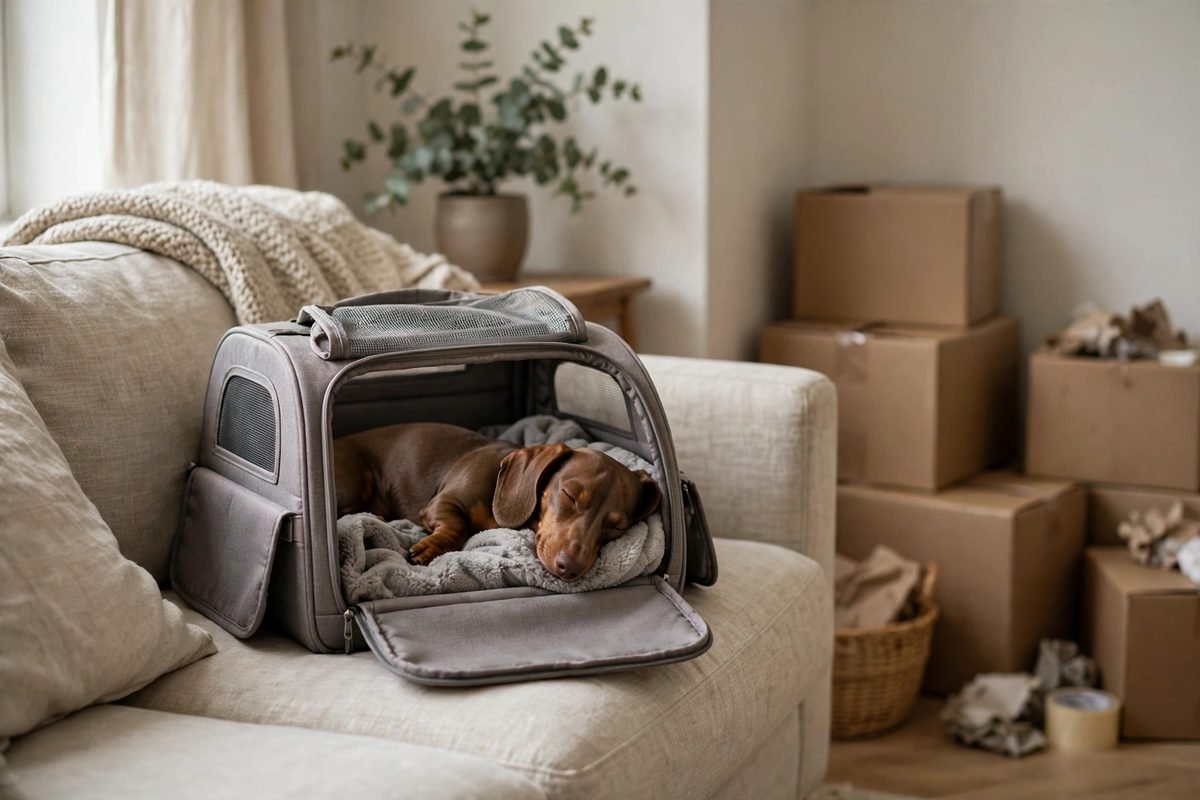
Choose one room in the old home that will be emptied last, and make it your dog’s room for move day. Put its bed, water bowl, a familiar blanket, and a few quiet toys inside, and close the door with a clear note for movers: dog inside, do not open. This single step prevents most move-day accidents, because your dog is not underfoot, cannot slip out of an open front door, and cannot climb half-packed furniture. Let the dog out only for toilet breaks on a lead, carried over stairs where needed, and returned to the quiet room afterwards.
Prepare the same quiet room in the new home before your dog arrives, if you can access it in advance. Even a partly set-up room with a bed, water, and a closed door gives your dog a safe landing place while the rest of the home is unpacked. If you cannot access the new home early, bring the quiet-room kit with you in the car, not in the moving van, and set it up first on arrival, before boxes come in. Keep one familiar person with the dog during the busiest hours, so it is not left alone in a strange room.
3. Carrying and Car Travel
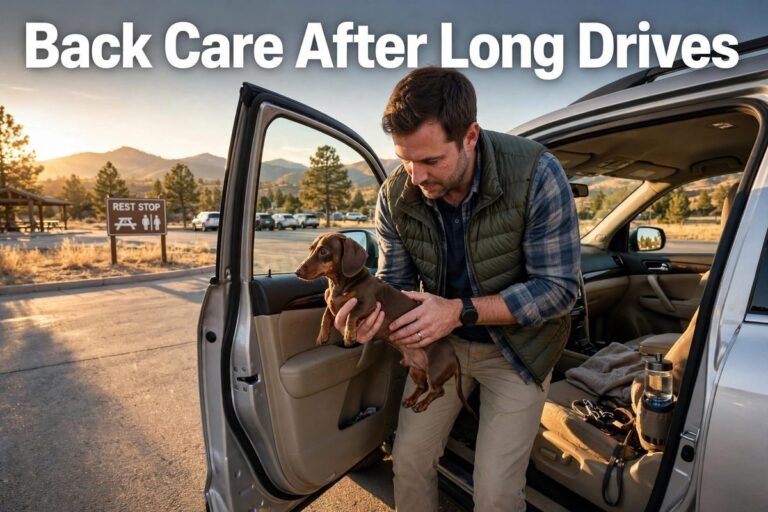
Move day involves more lifting than usual: into the car, out of the car, up new stairs, and over thresholds. Use the same two-hand lift every time: one hand under the chest, one supporting the hindquarters, back level, in one smooth motion. The guide to carrying a Dachshund up and down apartment stairs safely covers stair carrying in detail, and the same principles apply to new stairs you have not practised before. Take stairs slowly, keep a hand free for a rail where possible, and never carry a dog while also carrying a box.
For car travel, use a secure carrier that your dog already knows, placed where it cannot slide, with a familiar blanket inside. A carrier prevents a dog from moving around the car, jumping out when a door opens, or being thrown by a sudden stop. Drive calmly, avoid long detours on move day, and stop for a short toilet break on longer journeys, lifting your dog in and out of the car rather than letting it jump. Keep water available at stops, and never leave a dog alone in a parked car.

4. First Hours in the New Home
On arrival, set up the essentials before exploring: ramp at the main sofa if one will be used, floor bed in a quiet corner, food and water in a fixed spot, and gates at any stairs your dog should not use alone. Let your dog into the quiet room first, allow it to sniff and settle, and only then open one more room at a time. A whole new home at once is overstimulating, and an overstimulated dog runs, jumps, and explores without caution. Slow introductions are kinder and safer.
Walk your dog around the new home on a lead for the first tours, including the route to the garden or toilet area, the stairs, and the sleeping area. Note hazards as you go: slippery floors, gaps behind furniture, balconies, and open stairways. The guide to apartment home layout for a Dachshund’s back can help you check room-by-room setup once the first boxes are in. Add non-slip rugs on smooth floors where your dog walks most, and keep the ramp route clear of unpacked boxes from the first evening.
5. The First Week: Routine Over Exploring
The first week is about routine, not full exploration. Keep feeding times, walk times, and rest times as close to the old routine as possible, and keep walks short and familiar while your dog learns the new area. Short, calm walks reduce the chance of overexcitement on new pavements and stairs, and they give you time to learn the safest toilet route. Gradually extend walks and open new rooms over several days, rather than all at once.
Watch movement during the first week, in a general way, without turning every walk into a test. Note whether your dog uses the ramp, hesitates at new stairs, or seems more restless at night, and keep the quiet room available as a retreat for the whole week. If unpacking is still chaotic after a few days, keep the dog’s core rooms calm and closed off, and let it explore new rooms only when they are clear. A slower first week leads to a calmer, safer home in the long run.

Move-Day Checklist
| When | Task |
|---|---|
| Week before | Pack dog kit last; practise carrier and quiet room |
| Move morning | Set up quiet room; close door with a note for movers |
| Travel | Carrier in the car, two-hand lifts, short calm drive |
| Arrival | Quiet room first, then ramp, bed, food, and gates |
| First week | Same routine, short walks, rooms opened gradually |
Step-by-Step: Move Week Plan
- One week before: pack a dog kit with bed, blanket, food, water bowl, lead, and carrier.
- Day before: confirm the quiet room in the old home and, if possible, in the new home.
- Move morning: settle the dog in the quiet room before movers arrive.
- Travel: carry with both hands, use the carrier, and drive calmly.
- Arrival: set up the quiet room, ramp, bed, and gates before unpacking boxes.
- First week: keep the old routine, open rooms gradually, and add non-slip rugs.
Common Mistakes
The most common mistake is letting the dog roam free on move day “to get used to it,” which puts it underfoot, near open doors, and on half-packed furniture. A quiet room is kinder and safer. A second mistake is packing the ramp, bed, and carrier in the moving van, leaving nothing familiar on arrival. A third mistake is carrying a dog and a box at the same time, which makes a safe two-hand lift impossible. A fourth mistake is opening the whole new home at once, which overstimulates the dog and encourages running and jumping before safe routes are set.
When to Call Your Vet
Contact a veterinarian if, after the move, your dog shows pain, stiffness, reluctance to walk or climb, repeated yelping, or a change in appetite, toileting, or behaviour that does not settle within a day or two. A veterinarian can examine your dog and advise on next steps, and it helps to mention the move, any fall or slip, and how the dog travelled. Seek veterinary care promptly for sudden weakness, severe pain, or an inability to stand or walk. Do not try to diagnose the cause at home, and do not delay care because the move is busy; a quiet room and a veterinary call can happen on the same day.
Should a Dachshund stay with a friend on move day?
That can work well, if the friend’s home is calm and the dog knows it. A familiar, quiet house may be calmer than a half-packed home, but only if travel there and back is also calm and safe.
What should go in the dog kit?
Bed, familiar blanket, food, water bowl, lead, carrier, any items your veterinarian has advised, and a note of feeding times. Keep the kit in the car, not in the moving van.
How do I handle new stairs?
Decide the rule before arrival: carry, gate, or guided use, and apply it from the first hour. Do not let your dog learn the new stairs by running them during unpacking.
What if a Dachshund will not settle in the new home?
Keep the quiet room available, maintain the old routine, and introduce rooms slowly. If restlessness, loss of appetite, or movement changes persist, contact a veterinarian for advice.
When can unpacking return to normal?
Once the dog’s core rooms are set up, the ramp route is clear, and the dog is eating, sleeping, and walking normally, usually within the first week. Keep gates and safe routes in place even after boxes are gone.
Pin This: Moving Home Checklist
- Quiet room, closed door, note for movers.
- Dog kit in the car, never in the van.
- Two-hand lifts and a secure carrier.
- New home: ramp, bed, food, gates first.
- Same routine, rooms opened gradually.





2 Comments