
Dachshund Demand Barking: A Calm Attention Routine
Quick Answer
- Demand barking is barking used to ask for something: attention, a toy, a game, food, or a door opened.
- It grows when barking works. If barking reliably brings attention or the toy, the dog will bark again next time.
- The fix is a clear trade: barking earns nothing, while calm waiting, sitting, or settling earns what the dog wants.
- Keep rules the same for everyone in the home, and pair the trade with set play times so the dog is not left guessing.
Contents
- 1. What Demand Barking Looks Like
- 2. Why Barking Keeps Working
- 3. The Calm Trade: Barking Earns Nothing, Calm Earns Rewards
- 4. Set Play, Attention, and Toy Times
- 5. Handling Setbacks, Guests, and Busy Days
- Demand Barking Response Checklist
- Common Mistakes
- When to Call Your Vet
- Pin This: Demand Barking Checklist
- Frequently Asked Questions
- Conclusion
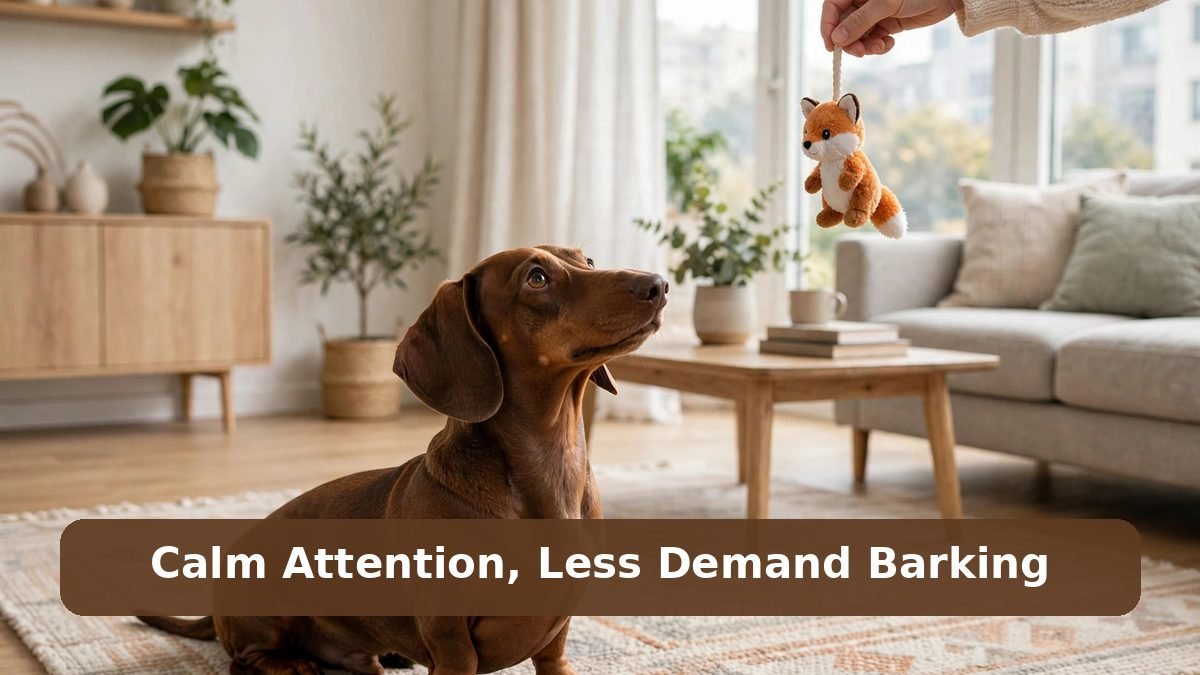
A Dachshund standing beside a toy, staring at its owner, and barking in short, sharp bursts is usually not confused. It is asking, in the clearest way it knows, for something to happen. The toy should be thrown, the hand should reach down for a stroke, the door should open, or the treat should appear. This is demand barking, and it is one of the most common barking patterns in apartment life because it is so easy to reward by accident. A quick glance, a laugh, a word, or a thrown toy can all be enough to teach the dog that barking works.
Demand barking responds well to a simple plan: calm behavior earns attention and games, while barking pauses them.
1. What Demand Barking Looks Like
Demand barking has a recognizable pattern. It usually happens when the owner is nearby and able to respond, and it is aimed directly at a person or an object. The dog may bark while looking at the owner, then look at the toy, the food bowl, or the door. It may nudge a hand, paw at a leg, drop a toy at the owner’s feet, and bark again if nothing happens. The barking often stops the moment the wanted thing is given, which is a strong clue that the bark was a request rather than an alarm.
Context helps separate demand barking from other types. Alert barking happens at sounds or visitors the dog cannot control, and it often continues even when the owner is in another room. Demand barking, by contrast, usually fades when the owner leaves the room or when the wanted item is out of reach, because the audience for the request is gone. It also tends to cluster around predictable moments: meal preparation, the start of a play session, the moment an owner sits down to work, or the time a favorite toy comes into view.
Watch the body as well as the sound. A demand-barking dog often looks eager: ears up, tail moving, and leaning toward the person or toy. A frightened or pained dog looks different, with a tucked tail or lowered body. If barking comes with those signs, or any sudden change in movement or appetite, ask a veterinarian about it.
Keep a short log for three or four days: time, what the dog seemed to want, what happened next, and how long barking lasted. Most households find one or two requests account for most episodes.

2. Why Barking Keeps Working
Barking keeps working because it is often rewarded quickly, even when nobody intends to reward it. Attention is a reward for a social dog, and attention includes eye contact, talking, touching, laughing, and even scolding in an animated voice. From the dog’s point of view, a loud “No, stop it” followed by a look and a gesture is still a response, and it may be enough to keep the behavior going. The same applies to giving in after a long bout of barking: the dog learns that persistence pays, even if the owner held out for several minutes first.
Inconsistent rules make the problem stronger. If barking earns a toy in the evening but not in the morning, or earns attention from one household member but not another, the dog has good reason to keep trying. An inconsistent reward is harder to give up than a reward that never arrives, because the dog cannot be sure that this time will not be the time it works. That is why a household agreement matters more than any single training session. Everyone who interacts with the dog needs to follow the same response.
Boredom and unmet needs also feed demand barking. A dog that has had little play, little sniffing time, and little mental activity during the day has more reason to demand interaction in the evening. Demand barking is not solved by ignoring the dog all day. It is solved by meeting needs on a schedule, so that requests become less urgent, and by teaching the dog that calm behavior is the reliable way to ask for more.
Timing matters. A reward given just after barking stops can still be linked to barking if the dog has not settled. The plan below therefore waits for a clear calm behavior, such as sitting quietly, before giving the wanted thing.
3. The Calm Trade: Barking Earns Nothing, Calm Earns Rewards
The core method is a trade, applied the same way every time. When the dog barks to demand something, the owner becomes calm and boring: no eye contact, no talking, no touching, and no movement toward the wanted item. Arms stay relaxed, the body turns slightly away, and the owner waits. This is not a punishment and it is not a standoff. It is simply the removal of the response the barking was designed to produce. The moment the dog pauses and offers a calm behavior, such as sitting, lying down, or standing quietly for a few seconds, the owner responds warmly and gives the wanted thing, or a small step toward it.
Start with easy wins. Choose a low-excitement request first, such as a stroke or a calm toy, rather than the most exciting game the dog knows. Wait for a pause in barking, then ask for a sit if the dog already knows it, or simply wait for a quiet moment, and reward that moment at once. Early on, reward very short calm pauses, even two or three seconds, because the dog needs to discover quickly that calm works. As the dog succeeds, lengthen the calm pause gradually before giving the reward, from a few seconds to ten, then thirty.
Use the same steps for a toy request. If the dog barks and drops a toy at your feet, do not pick it up while barking continues. Wait, stay boring, and pick it up only when the dog is quiet and settled. Then play a short, calm game and end it before excitement climbs again. Ending a game while the dog is still calm teaches that calm play lasts longer than frantic play, and it gives the owner control over the next round. The guide to teaching quiet in 7 days uses the same calm-pause idea, and it pairs well with this trade.
Expect a short period when barking gets louder before it gets better. When a behavior that used to work stops working, a dog often tries harder for a while. This is normal, and it is not a sign that the plan has failed. Stay calm, stay consistent, and do not give in during that louder phase, because giving in then teaches that louder barking works. If the barking becomes distressed, prolonged, or paired with signs of pain or anxiety, stop training and ask a veterinarian for guidance before continuing.

4. Set Play, Attention, and Toy Times
A dog that knows when play and attention are coming has less reason to demand them at other times. Build a simple daily schedule with two or three short play sessions, a couple of calm attention times, and rest periods in between. A morning play session before work, a midday game or enrichment activity, and an evening session after a walk cover most days. Keep sessions short, around five to ten minutes, and end them calmly with a settle on a mat or bed.
Toy access also needs a plan. Leaving every exciting toy out all day can keep excitement high and give the dog many chances to demand a game. Instead, rotate toys: keep two or three out, store the rest, and swap them every few days. Offer a toy during a scheduled play time, and put it away calmly when the session ends. The dog still gets plenty of play, but play becomes an event the owner starts, rather than a demand the dog makes at any hour.
Attention times work the same way. Sit with the dog for a few calm minutes, offer gentle strokes when the dog is settled, and then return to your own activity without drama. If the dog barks for more attention after that time ends, return to the calm trade: no eye contact or talking while barking continues, and attention again only when the dog settles. Over days, the dog learns that attention is plentiful but not available on demand through barking.
Enrichment fills the gaps between scheduled times. A snuffle mat, a food puzzle, or a safe chew gives the dog something to do without needing the owner. Place it away from the owner’s desk, so the dog learns to settle independently.
5. Handling Setbacks, Guests, and Busy Days
Guests are a common setback for demand barking, because visitors often respond to barking with attention, laughter, or a treat. Before guests arrive, explain the simple rule: please ignore barking, and greet or stroke the dog only when it is calm and settled. Give guests an easy alternative, such as tossing a treat onto the dog’s mat when the dog is quiet, so they can be friendly without rewarding barking. If the dog becomes too excited, move it to a quiet room with an enrichment item until it settles, then try the greeting again.
Busy days need a lighter version of the plan, not a day off from it. When work, calls, or chores fill the day, keep the rule the same but shorten the sessions. A two-minute play break, a quick settle reward, and a food puzzle can hold the routine together until a normal day returns. What matters is that barking still earns nothing, even on a busy day, because a single exception after a long bout can undo several days of progress.
Watch for new demand targets as old ones improve. A dog that stops barking for toys may start barking for food or a door. Apply the same trade to each new request, and review the log weekly.
Household consistency deserves a final check. The routine for barking when you leave the room uses the same rule: one response, from everyone, every time. If one person still rewards barking, progress will be slow. Agree the rule in plain words and review it after two weeks.

Demand Barking Response Checklist
| Situation | What to do | What to avoid |
|---|---|---|
| Dog barks for a toy | Stay calm and boring, wait for quiet, then start a short game | Picking up the toy while barking continues |
| Dog barks for attention | No eye contact or talking during barking, attention when settled | Scolding in an excited voice, which is still attention |
| Dog barks for food or a door | Wait for a sit or quiet pause before giving it | Giving in after a long bout to get peace |
| Guests arrive | Ask guests to greet only a calm dog, use the mat | Letting guests stroke or feed a barking dog |
| Busy day | Short play breaks and enrichment, same rule | Dropping the rule because the day is busy |
Common Mistakes
- Giving in after a long bout of barking, which teaches persistence.
- Rewarding barking with eye contact, talking, or laughing, even while saying no.
- Letting one household member reward barking while others ignore it.
- Rewarding too soon after barking, before the dog has truly settled.
- Ignoring the dog all day and expecting calm behavior with no scheduled play.
- Starting with the most exciting request instead of an easy, low-excitement win.
When to Call Your Vet
Contact a veterinarian if demand barking appears suddenly, becomes much more intense than usual, or comes with signs such as pain, limping, a hunched back, appetite changes, restlessness, or any sudden change in behavior. A veterinarian can check whether pain or discomfort is making the dog more demanding or harder to settle, and can discuss whether anxiety plays a role. This article gives general information only and is not a diagnosis. A veterinarian can also refer to a qualified behavior professional if barking is paired with distress, destructive behavior, or behavior that does not improve with consistent training over several weeks.
Pin This: Demand Barking Checklist
- Barking earns nothing: no eye contact, talking, or toy while barking continues.
- Calm earns the reward: wait for a quiet sit or settle, then respond warmly.
- Start with easy requests and reward short calm pauses first.
- Set two or three short play times and rotate toys.
- Give calm attention times and enrichment between sessions.
- Ask guests to greet only a calm, settled dog.
- Keep one rule for everyone, every day, even on busy days.
Frequently Asked Questions
How long should I wait for calm before rewarding?
At first, reward a pause of just two or three seconds. Lengthen the pause gradually as the dog succeeds, so calm behavior becomes a habit rather than a single lucky moment.
Is ignoring barking the same as ignoring the dog?
No. Ignoring barking means withholding a response to that behavior for a short time. The dog still gets scheduled play, attention, walks, and enrichment throughout the day.
What if my Dachshund barks louder when I stop responding?
A short increase is common when a previously rewarded behavior stops working. Stay calm and consistent, and do not give in during that phase. If barking becomes distressed or prolonged, pause and seek professional guidance.
Should children follow the same rule?
Yes, as far as is practical. Children can learn the simple version: no attention while barking, and a stroke or game when the dog is calm. An adult should supervise early sessions.
When is professional help the right step?
Seek a qualified trainer or veterinary behavior professional if barking worsens despite consistent practice, if it is paired with anxiety or pain signs, or if progress stalls for several weeks.
Conclusion
Demand barking fades when calm behavior becomes the reliable way to ask. Make barking boring, make calm rewarding, and give the dog a predictable day of play, attention, and rest. Start with one easy request today, and keep the rule the same for everyone.




2 Comments