Dachshund Barking at Washing Machine: Calm Routine
Quick Answer
- Dachshund barking at washing machine noise usually means the dog is startled by the sudden hum, spin, and thud of a cycle starting, and barks to warn the household about a sound it cannot see.
- The dishwasher adds a second problem, with hissing water, clanking plates, and a long wash cycle that keeps the noise going for an hour or more.
- Teach a calm spot away from the kitchen first, then pair the appliance sounds with treats at a low level, so the noise starts to predict something pleasant.
- Never shout over the barking or switch the machine off every time the dog barks, because both reactions teach the dog that barking controls the noise.
- Most Dachshunds settle noticeably within two to three weeks of short daily sessions, with shorter barking bursts and quicker returns to rest.
Contents
- 1. Dachshund Barking at Washing Machine Noise Explained
- 2. Why the Dishwasher Is a Different Problem
- 3. The Calm Spot Plan: Distance, Sound, and Reward
- 4. Real Cycles: Wash Day, Dishes, and Spin Time
- 5. Keeping Wash Day Quiet for Good
- Washing Machine and Dishwasher Quiet Plan
- Common Mistakes
- When to Call Your Vet
- Pin This: A Quieter Wash Day
- Frequently Asked Questions
- Conclusion
1. Dachshund Barking at Washing Machine Noise Explained
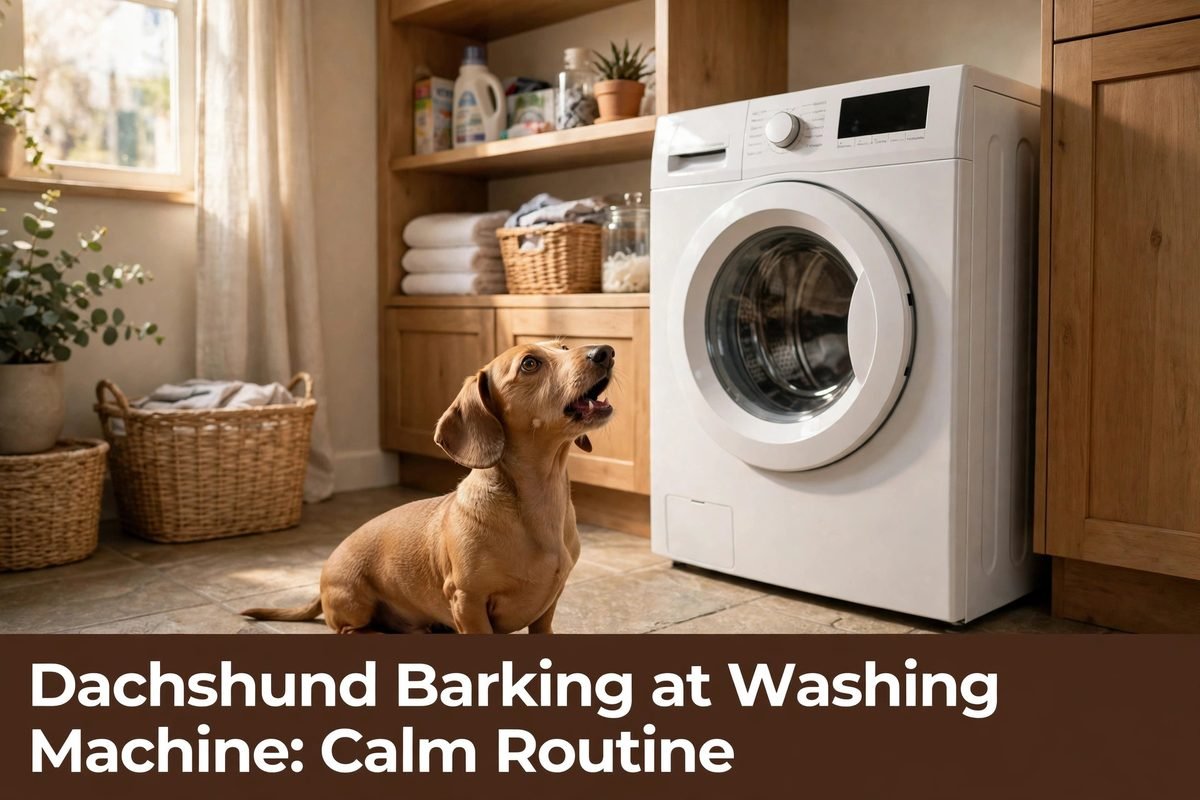
Dachshund barking at washing machine noise starts with surprise. The machine sits quiet for hours, then fills with water, hums, and begins to turn. A spin cycle adds a rising whine and a thud as the load shifts, and the whole kitchen floor can vibrate. The dog cannot see what is making the sound, and it cannot predict when the next change will come, so barking becomes its way of warning the household about something strange behind a closed door.
Hearing plays a large part in the reaction. A Dachshund hears far more than a person does, so a hum that sounds mild in the living room can sound loud and close to the dog. The spin cycle is the worst part for many dogs, because the sound rises quickly and the vibration travels through the floor into the dog’s paws. A dog that is resting near the kitchen feels the change through its body as well as its ears, and that double signal makes the barking harder to stop.
Routine also shapes the problem. Wash day often follows the same pattern: the owner loads the machine, presses a button, and walks away. The dog learns that the button press predicts an hour of noise, so it starts barking at the loading stage, before the machine even starts. The barking then continues through the cycle, because the dog never learns that the noise ends safely on its own. Changing that prediction is the heart of the fix, so that the sound of a machine starting leads to a calm spot and a treat instead of a barking fit.
2. Why the Dishwasher Is a Different Problem
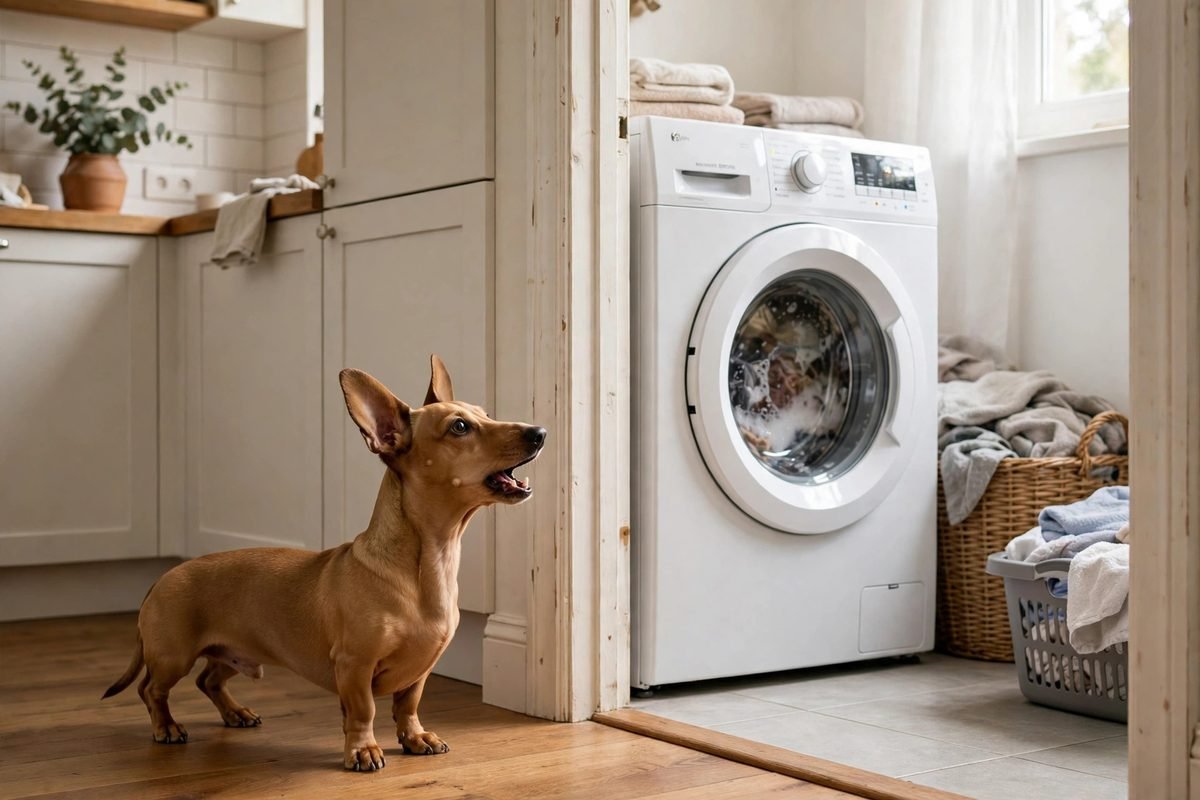
The dishwasher is a different problem from the washing machine, even though both live in the kitchen and both make noise. A washing machine runs in clear stages, with a fill, a wash, and a spin, while a dishwasher hisses, sprays, and clanks for a long stretch with no clear pattern. Plates and cutlery rattle when the spray arms turn, and the sound changes every few minutes, so the dog never quite settles into the rhythm. A long, unpredictable noise is harder for a dog to ignore than a short, familiar one.
The dishwasher also changes the kitchen itself. Steam escapes when the door opens, the smell of detergent fills the room, and the owner bends down to load and unload plates many times. The dog watches the owner move around the open door and hears the clatter of every plate, so the whole scene feels busy and uncertain. A dog that is calm with the washing machine may still bark at the dishwasher, because the two appliances sound different, smell different, and last for different lengths of time.
Training must cover both machines separately. A dog that has learned to ignore the washing machine has not learned to ignore the dishwasher, and the two sounds need their own short sessions. Start with the machine the dog reacts to less strongly, build calm there first, and then move on to the harder one. In many homes that means starting with the washing machine, which has clearer stages, and adding the dishwasher once the dog can rest through a full wash cycle.
3. The Calm Spot Plan: Distance, Sound, and Reward
The calm spot plan starts away from the kitchen, in a quiet room where the dog already likes to rest. Choose a bed or mat with a clear view of the owner but far enough from the appliances that the sound is soft. Teach the dog to go to the spot and settle there with a small treat, ten times a day for two or three days, with no machines running at all. The spot must become a favourite resting place before any noise is added, so the dog wants to be there when the training starts.
Next, add the sound at the lowest level possible. Run the washing machine on a short, gentle cycle with the kitchen door closed, and sit with the dog on its spot. Reward every quiet moment with a small treat, and keep the session to three or four minutes. If the dog barks, the sound is too close or too loud, so move the spot further away or close another door and try again. The guide to barking at the vacuum and household appliances uses the same distance-first idea for noisy machines around the home.
The third step is to shorten the distance slowly. Over a week, move the spot one step closer to the kitchen every two days, always rewarding quiet resting. Then leave the kitchen door open a crack, then fully open, while the machine runs. A dog that can rest quietly with the door open has learned that the noise is ordinary, and the owner can then start loading the dishwasher in the same calm way. Keep every session short, end on a quiet moment, and never rush the move closer, because one frightening session can undo a week of steady progress.
4. Real Cycles: Wash Day, Dishes, and Spin Time
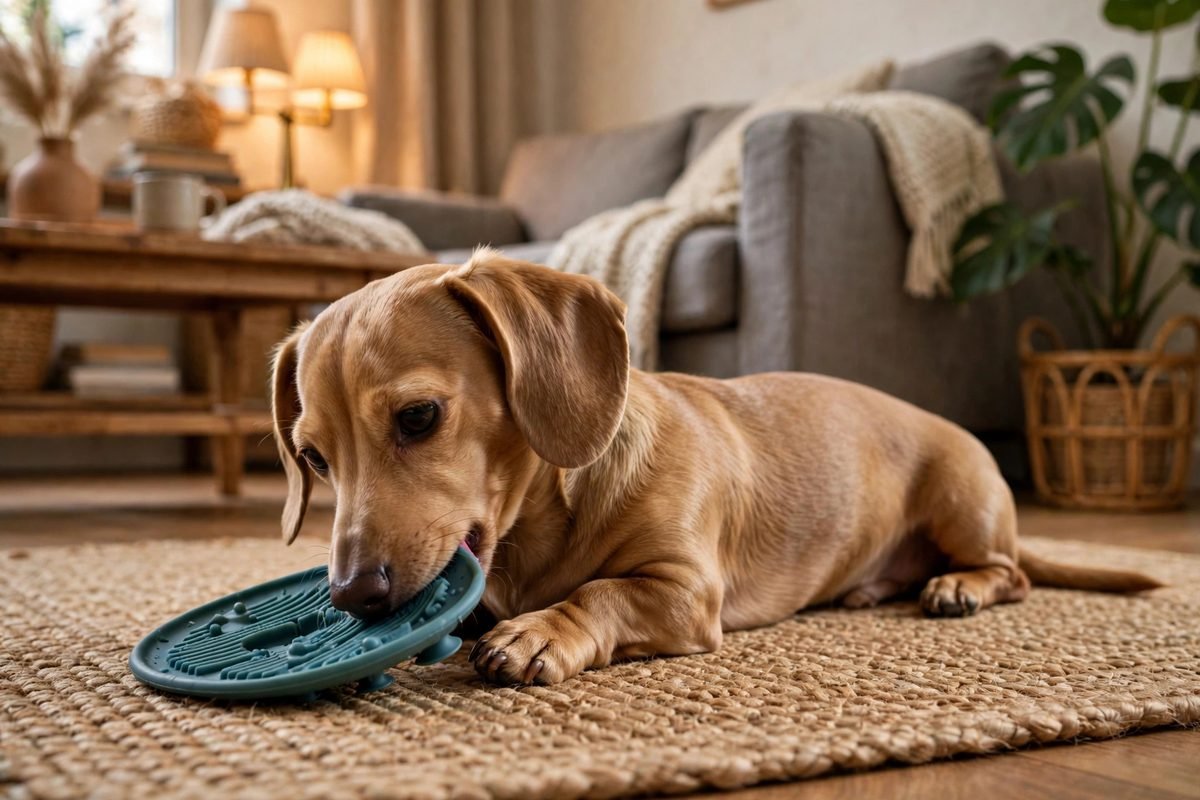
Real wash day needs a plan for the spin cycle, because that is when most dogs bark hardest. Before the spin starts, send the dog to its spot with a long-lasting chew, such as a filled lick mat, so the dog is already busy and settled when the whine rises. A chewing dog has far less energy for barking, and the chew gives the dog something pleasant to do while the machine works. Stay nearby for the first few real cycles, so the dog can see that the owner is calm and nothing strange is happening.
Dishwasher time needs its own routine. Load the dishwasher while the dog is on its spot with a chew, and keep the loading slow and quiet, placing each plate down gently instead of dropping it in. Run the dishwasher at a time when the dog is already tired, such as after a walk, so resting feels natural. If the dog barks at the clanking, do not open the dishwasher to check it or shout across the kitchen, because that tells the dog the noise is worth worrying about. Wait for a pause in the barking, then reward the quiet.
Loading and unloading deserve care too. A Dachshund that is underfoot while the owner bends over a machine can be stepped on or lifted suddenly, and gentle handling matters for a long-backed breed, since disc degeneration in short-legged breeds can begin in the first year of life. Keep the dog on its spot while the door is open, and use a treat to guide it there before bending down. The guide to barking at the robot vacuum covers the same keep-the-dog-settled idea for a machine that moves around the floor.
5. Keeping Wash Day Quiet for Good
Wash day stays quiet when the routine stays the same. Every wash and every dishwasher load should follow the same sequence: spot, chew, machine on, quiet rest, and a treat when the cycle ends. If the owner sometimes lets the dog bark through a cycle and sometimes tries to stop it, the dog will keep barking, because it works half the time. Every person in the household should use the same spot, the same words, and the same chew, so the dog gets one clear message from everyone.
Keep practicing even after the barking improves. A short refresher once a week, with the dog on its spot through a full cycle, keeps the routine fresh. If the barking returns after a holiday, a new machine, or a move to a different flat, go back to a closed door and a greater distance for a few days and rebuild slowly. Setbacks are normal, and a few calm sessions usually bring the quiet back.
Watch the dog’s body as well as its voice. A dog that lies on its spot with a loose body and soft ears is calm, while a dog that lies stiffly with its ears forward is still worried even if it is quiet. The worried dog needs more distance, a longer chew, and slower practice, not a longer session. Over time, the machines become ordinary background sounds, and the dog barely lifts its head when a cycle starts.

Washing Machine and Dishwasher Quiet Plan
| Step | What to Do | What Good Looks Like |
|---|---|---|
| Days 1 to 3 | Teach the calm spot with no machines running | Dog settles on the spot when asked |
| Days 4 to 7 | Short gentle wash with the kitchen door closed; reward quiet | Dog rests through a short cycle |
| Week 2 | Move the spot closer; open the kitchen door a crack | Dog stays calm with the door open |
| Week 2 to 3 | Add the dishwasher; load slowly with a chew on the spot | Dog chews calmly through the clanking |
| Spin cycle | Give a lick mat before the spin starts | Dog chews through the whine and thud |
| Every week | One full cycle with the dog on its spot | Quiet routine stays fresh and reliable |
The plan works best when the spot comes before the sound, the sound comes at a low level first, and the distance only shortens after quiet. Keep the order the same every time, and the dog will learn the order too.
Common Mistakes
- Shouting over the barking, which adds more noise and excitement to the kitchen.
- Switching the machine off every time the dog barks, which teaches the dog that barking stops the noise.
- Training the washing machine and forgetting the dishwasher, so the second machine still sets off the barking.
- Starting with the spin cycle at full volume instead of a short gentle wash.
- Letting the dog stand right beside the machine while it runs, with no calm spot to go to.
- Dropping plates loudly into the dishwasher while the dog is already nervous.
- Skipping the chew on wash day, so the dog has nothing pleasant to do during the noise.
- Stopping practice completely once the barking improves, so the routine fades within a few weeks.
When to Call Your Vet
Contact a veterinarian if the barking comes with shaking, hiding for hours, loss of appetite, or a refusal to enter the kitchen for more than a few days. Contact a veterinarian promptly if the dog seems in pain, yelps when touched, or shows sudden changes in behavior, such as barking far more than usual or becoming withdrawn. A veterinarian can check whether anxiety, pain, or a health problem is driving the behavior, and can advise on the next steps. This article gives general information only and is not a diagnosis.
Pin This: A Quieter Wash Day
- Teach a calm spot away from the kitchen before any machine runs.
- Start with a short gentle wash and the kitchen door closed.
- Move the spot closer slowly, rewarding every quiet rest.
- Give a lick mat before the spin cycle starts.
- Load the dishwasher slowly, with the dog settled on its spot.
- Never switch the machine off because the dog barked.
Frequently Asked Questions
Why does my Dachshund bark at the washing machine but not the dishwasher?
The two machines sound very different. A washing machine has clear stages and a rising spin whine, while a dishwasher hisses and clanks without a clear pattern. A dog may find one sound startling and the other easy to ignore, so train each machine separately, starting with the one the dog reacts to less strongly.
How do I start if my Dachshund barks the moment the machine starts?
Start with the kitchen door closed and the dog on a calm spot in another room, with a chew to keep it busy. Reward quiet, move the spot further away if the dog barks, and only shorten the distance after several calm sessions.
Should I let my Dachshund watch the washing machine?
No, watching usually makes the barking worse, because the dog stares at the turning drum and the moving load. A calm spot with a view of the owner, but not of the machine, works better, because the dog can rest instead of guarding the appliance.
What if the spin cycle always sets my Dachshund off?
Give a long-lasting chew just before the spin starts, and stay near the dog for the first few cycles. If the dog still barks, run a shorter cycle or a slower spin setting for a week, then build back up to a full spin once the dog can rest through the gentler version.
Will my Dachshund ever ignore the dishwasher completely?
Most Dachshunds learn to rest through the dishwasher with only a glance up when it starts, rather than barking through the whole cycle. A single alert bark is normal, and the goal is a short bark followed by quiet resting, not total silence. If the barking is getting worse after a month of practice, go back to a closed door and rebuild slowly.
Conclusion
A washing machine and a dishwasher are two noisy strangers in the kitchen, and the fix is one calm routine for both. Teach the spot, start the sound low and far away, move closer slowly, and give the dog a chew for the hardest moments. As a next step, set up the calm spot today, teach the dog to love it with ten treats, and run a short gentle wash tomorrow with the kitchen door closed.