
Back-Safe Fetch for Dachshunds: Ball Play at Home Guide
Quick Answer
- Back-safe fetch for Dachshunds means rolling a ball along the floor, never throwing it high, so the dog trots to it instead of jumping, twisting, or landing hard.
- Play on a flat, non-slip surface with a soft, low-bounce ball that is too large to swallow and easy for a short-legged dog to carry.
- Keep each session short, about five to ten minutes, with calm pauses between throws, and stop while the dog is still moving well.
- Watch for a tucked belly, an arched back, short steps, or a sudden refusal to chase, and end play at once if any of those signs appear.
- Contact a veterinarian if soreness, stiffness, or a change in movement lasts more than a day after play.
Contents
- 1. What Back-Safe Fetch Looks Like at Home
- 2. Choosing a Ball and a Play Spot That Protect the Back
- 3. The Rolling-Ball Routine, Step by Step
- 4. Reading the Dog During Play and Knowing When to Stop
- 5. Cooling Down and Making Fetch a Calm Daily Habit
- Back-Safe Fetch Checklist: Before, During, and After Play
- Common Mistakes
- When to Call Your Vet
- Pin This: Back-Safe Fetch at Home
- Frequently Asked Questions
- Conclusion
1. What Back-Safe Fetch Looks Like at Home
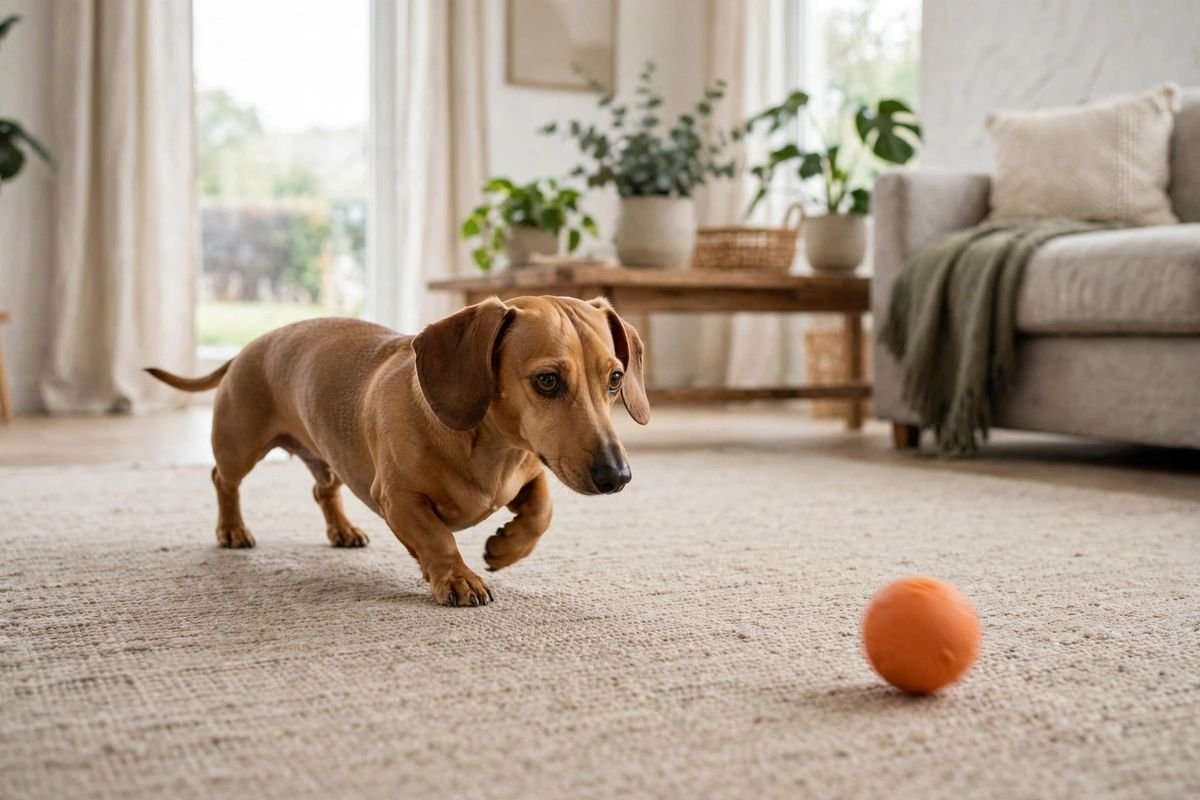
Back-safe fetch for Dachshunds starts with a simple change: the ball stays on the floor. A rolling ball moves at ground level, so the dog can trot after it, pick it up, and bring it back without leaving the ground. A thrown ball asks for something very different. It arcs through the air, and a keen dog leaps to catch it, twists in mid-air to follow it, and lands on its front legs with the long spine taking the jolt. Vets commonly advise at-risk dogs to avoid jumping from furniture and sudden, high-impact movement, and the same caution fits a game of fetch played at full height in a living room.
A Dachshund has a long back and short legs, and that shape changes how the body handles sudden movement. Disc degeneration in short-legged breeds can begin in the first year of life, so a play habit that loads the spine with jumps and sharp turns is worth shaping early, while the dog is still young and keen. The goal is not to take fetch away. Fetch is a favorite game for many Dachshunds, and it gives a dog in an apartment a way to move, sniff, and use its nose and legs in a small space. The goal is to keep the fun part, the chase and the carry, and to take out the parts that load the back: the leap, the twist, and the hard landing.
The living room sets the limits. A small apartment floor is not a field, and that is an advantage: short rolls, a clear path, and a soft surface keep the game under control. The back-friendly play ideas for Dachshunds at home show how other indoor games use the same low, slow pattern, and fetch fits neatly beside them. When the rules are set before the ball comes out, fetch becomes a daily routine the owner can repeat without worry.
2. Choosing a Ball and a Play Spot That Protect the Back
The ball matters more than most owners expect. A hard tennis ball bounces high and rolls fast, and a fast ball makes a dog run hard, brake hard, and turn hard. A soft rubber ball with a low bounce stays closer to the floor and moves at a speed a short-legged dog can match with a trot. Choose a ball that is large enough to sit safely in the mouth without slipping to the back of the throat, and light enough that carrying it does not pull the head down and arch the neck. A ball with a slightly rough surface is easier to pick up from a smooth floor, so the dog does not have to scrape at it with its teeth or twist its neck to grip it.
The play spot matters just as much. A slippery tile or polished wood floor makes a trotting dog slide, and a slide that ends in a sudden stop loads the spine. A rug, a yoga mat, or a non-slip runner laid along the fetch path gives the paws grip and softens each step. Clear the path before play starts: move shoes, cords, and low furniture out of the way, and close the door to any room with stairs. A straight run of about ten to fifteen feet is enough for an apartment game, and a straight run is better than a wide open room, because it keeps the dog moving forward instead of cutting sharp corners.
3. The Rolling-Ball Routine, Step by Step
A steady routine keeps fetch safe, because the dog learns what to expect and the owner can spot a change early. Start with a short warm-up: a few minutes of calm walking around the apartment, a slow wander to the water bowl, and a gentle stretch of the legs as the dog moves. A cold dog that goes straight into a sprint is more likely to pull up stiff, so the warm-up is part of the game, not a delay before it.
Follow these steps for each game:
- Set the ball on the floor and let the dog sniff it, so the dog knows the game has started and can settle before the first roll.
- Roll the ball gently along the floor, about six to ten feet, in a straight line away from the dog, with the hand low and the arm moving forward, not up.
- Let the dog trot after the ball at its own pace, and wait at the far end while the dog picks it up and turns.
- Call the dog back in a calm voice, and praise the return quietly, without asking for a fast run back.
- Pause for a few seconds between rolls, with the ball held still, so the dog can breathe and reset before the next chase.
- Repeat for five to ten minutes, then end the game while the dog is still moving well, with a calm word and a small treat.
Keep the rolls short and low. A roll that travels the full length of the room invites a sprint, and a sprint invites a hard stop at the wall. A short roll keeps the dog trotting, and a trotting dog can stop in a step or two without skidding. If the ball rolls under furniture, let it stay there and start a fresh roll, rather than asking the dog to duck under a low couch or twist sideways to reach it. The safe digging routine at home uses the same idea of a short, controlled burst of activity followed by a calm pause, and fetch works best when it follows that rhythm.

4. Reading the Dog During Play and Knowing When to Stop
A Dachshund rarely stops a game it loves, so the owner has to watch for the signs the dog will not show on its own. The earliest sign is a change in the trot: the stride shortens, the back legs move a little less freely, or the dog starts to bunny-hop with both back legs together. The back may arch slightly, the belly may tuck up, or the tail may drop lower than usual. A dog that was trotting smoothly and then starts to hesitate before the next roll is already tired, even if it still looks keen.
Other signs are easier to miss in the excitement of the game. A dog that pants hard after two or three rolls, stands with its weight shifted forward, or lies down flat and stays down is asking for a break. A dog that yelps when it picks up the ball, flinches when the back is touched, or refuses to chase the next roll has already reached its limit, and the game should end at once, without one more throw. Do not test the dog with another roll to see if it will go again. Put the ball away, let the dog rest, and watch how it moves over the next hour.
5. Cooling Down and Making Fetch a Calm Daily Habit
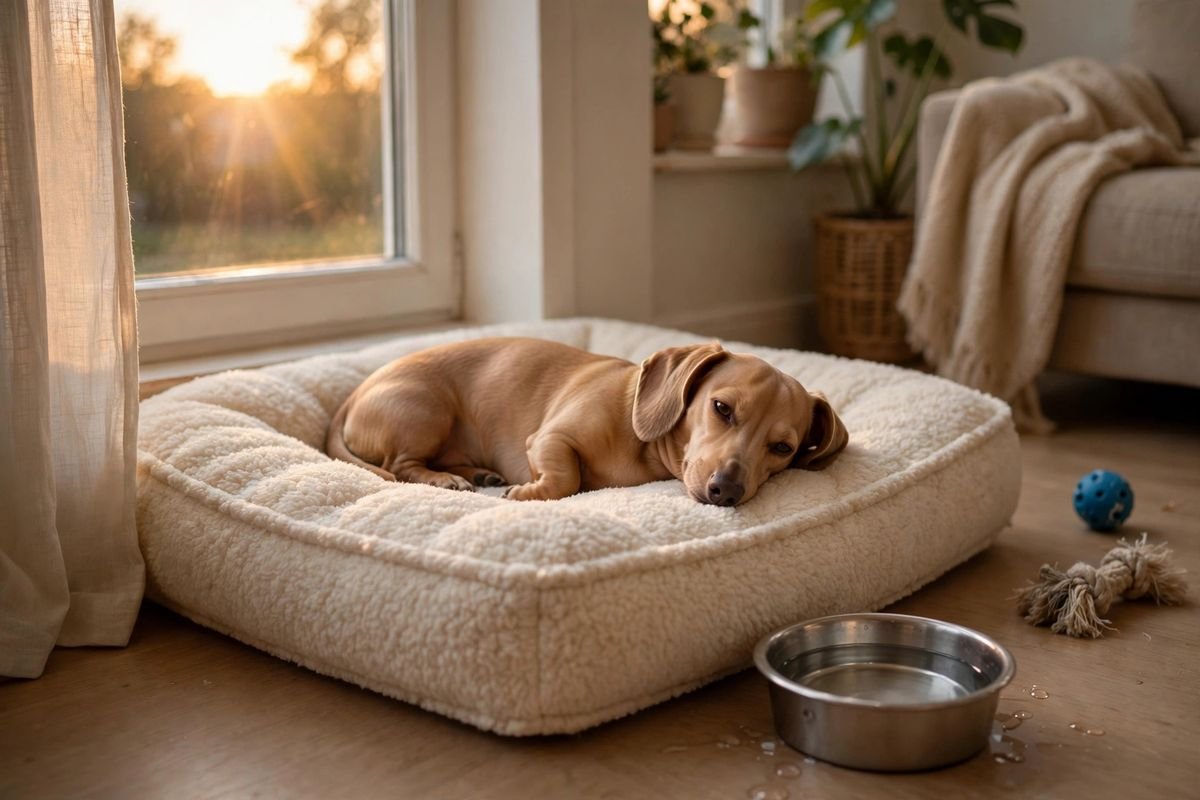
The minutes after fetch matter as much as the game itself. A dog that runs hard and then flops onto a cold floor can stiffen up as the muscles cool, so guide the dog to a warm, soft spot to rest. A slow walk around the apartment, a drink of water, and a few minutes of calm sniffing let the breathing settle and the legs loosen before the dog lies down. Do not ask the dog to climb stairs, jump onto the couch, or go straight out for a walk right after fetch. Give the body time to cool down at its own pace.
Make fetch a daily habit at the same time and in the same spot. Dogs settle into routines, and a routine game is a calmer game than a surprise one. A short morning game and a short evening game, each five to ten minutes, give a Dachshund regular movement without the long, tiring session that leaves the back sore. On days when the dog seems stiff in the morning, skip fetch and use a slower game instead, such as sniffing for treats hidden on the floor, which keeps the dog moving without any running at all.
Back-Safe Fetch Checklist: Before, During, and After Play
| When | What to Do | What to Watch For |
|---|---|---|
| Before play | Check the ball for wear; lay a non-slip path; clear the floor | Ball intact; path clear; floor has grip |
| Warm-up | A few minutes of calm walking indoors | Dog moves freely; no stiffness or hesitation |
| During play | Roll low and short; pause between rolls; five to ten minutes only | Steady trot; level back; no bunny-hopping |
| Stopping | End while the dog still moves well; put the ball away | Dog settles calmly; no panting that lasts |
| After play | Water, slow walk indoors, rest on a warm soft spot | Dog rises easily later; no soreness next morning |
The checklist works best when it is followed in the same order every time. A routine followed every time makes it easy to spot the day something changes, because the owner knows what a normal game looks like.
Common Mistakes
- Throwing the ball high into the air, so the dog leaps, twists, and lands hard on its front legs.
- Using a hard, high-bounce ball that rolls fast and makes the dog sprint and brake hard.
- Playing on a slippery floor with no rug or mat, so the dog slides and stops suddenly.
- Rolling the ball under low furniture and letting the dog duck and twist to reach it.
- Keeping the game going after the dog slows down, because the dog still comes back for the ball.
- Skipping the warm-up and the cool-down, and going straight from rest to a sprint.
- Playing fetch every day as the only game, with no slower sniffing or puzzle play in between.
- Ignoring a stiff morning after fetch, and repeating the same long game the next day.
When to Call Your Vet
Contact a veterinarian if the dog is sore, stiff, or reluctant to move for more than a day after play, or if the dog yelps when lifted, flinches when the back is touched, or shows weakness in the back legs. Contact a veterinarian urgently if the dog cannot move its back legs, loses bladder control, or is in severe pain. A veterinarian can examine the dog and advise whether the play routine needs to change, and the Animal Medical Center guide to intervertebral disc disease in dogs explains the signs that need prompt attention. The DachsLife study, published in 2015, found that evidence on jumping, stairs, and exercise in Dachshunds is observational and mixed, which is why a cautious, low-impact game is a sensible choice. The Cornell guide to chondrodystrophy and intervertebral disc disease explains the breed background behind that caution. This article gives general information only and is not a diagnosis.
Pin This: Back-Safe Fetch at Home
- Roll the ball along the floor, never throw it high.
- Use a soft, low-bounce ball that is too large to swallow.
- Play on a non-slip rug or mat, in a straight, clear path.
- Keep games to five to ten minutes, with pauses between rolls.
- Stop while the dog still moves well, and cool down calmly.
- Call a veterinarian if soreness lasts more than a day.
Frequently Asked Questions
Is fetch safe for a Dachshund?
Fetch can be safe when the ball is rolled along the floor and the game stays short and slow. The risk comes from jumping to catch a high ball, twisting in the air, and landing hard. A rolling ball keeps the dog trotting at ground level, which is a much gentler load on a long back.
What kind of ball is best for back-safe fetch?
A soft rubber ball with a low bounce, large enough to sit safely in the mouth, works well. It should be light enough to carry with the head level and rough enough to pick up easily from a smooth floor. Replace the ball at the first sign of cracks or wear.
How long should a fetch game last?
Five to ten minutes is enough for most Dachshunds, with a pause between rolls. Stop while the dog is still moving well, rather than waiting until it slows down on its own. A short game that ends calmly leaves the dog loose the next morning.
Can a Dachshund play fetch every day?
Yes, if the games stay short and low, and if fetch is rotated with slower games such as sniffing and puzzle play. A dog that stiffens after daily fetch needs shorter sessions or a rest day in between, and the owner should watch the morning rise for the answer.
What should I do if my Dachshund seems sore after fetch?
End play at once, let the dog rest on a warm, soft spot, and watch how it moves over the next few hours. If soreness, stiffness, or a change in movement lasts more than a day, contact a veterinarian for advice.
Conclusion
Back-safe fetch is a small change with a large payoff: roll the ball low, keep the game short, play on a grippy floor, and stop while the dog still moves well. The next step is a five-minute rolling game tomorrow, on a rug, with a soft ball, and a calm pause between rolls.