

Dachshund Back-Safe Bedtime Routine at Night: Bed Access
Quick Answer
- A back-safe bedtime routine gives the dog a low, grippy way on and off the bed at night, a calm wind-down before sleep, and a safe way to get down for a toilet trip in the dark.
- Use a bedside ramp or shallow steps that stay in the same place every night, with a non-slip surface and a small night light, so the dog never has to jump down in the dark.
- Keep the last hour quiet: a final toilet trip, a short calm settle, and the same sleeping spot each night, so the dog goes to sleep relaxed instead of excited.
- Contact a veterinarian if the dog cries at night, cannot settle, shows back pain or stiffness in the morning, or suddenly refuses the ramp or steps it used before.
Contents
- 1. Why Night-Time Bed Access Needs a Plan
- 2. Setting Up a Bedside Ramp or Steps
- 3. Building a Calm Wind-Down Before Bed
- 4. Handling Night Waking and Toilet Trips
- 5. Morning Wake-Up and the First Steps of the Day
- Back-Safe Bedtime Setup Comparison Checklist
- Common Mistakes
- When to Call Your Vet
- Pin This: Back-Safe Bedtime Routine Checklist
- Frequently Asked Questions
- Conclusion
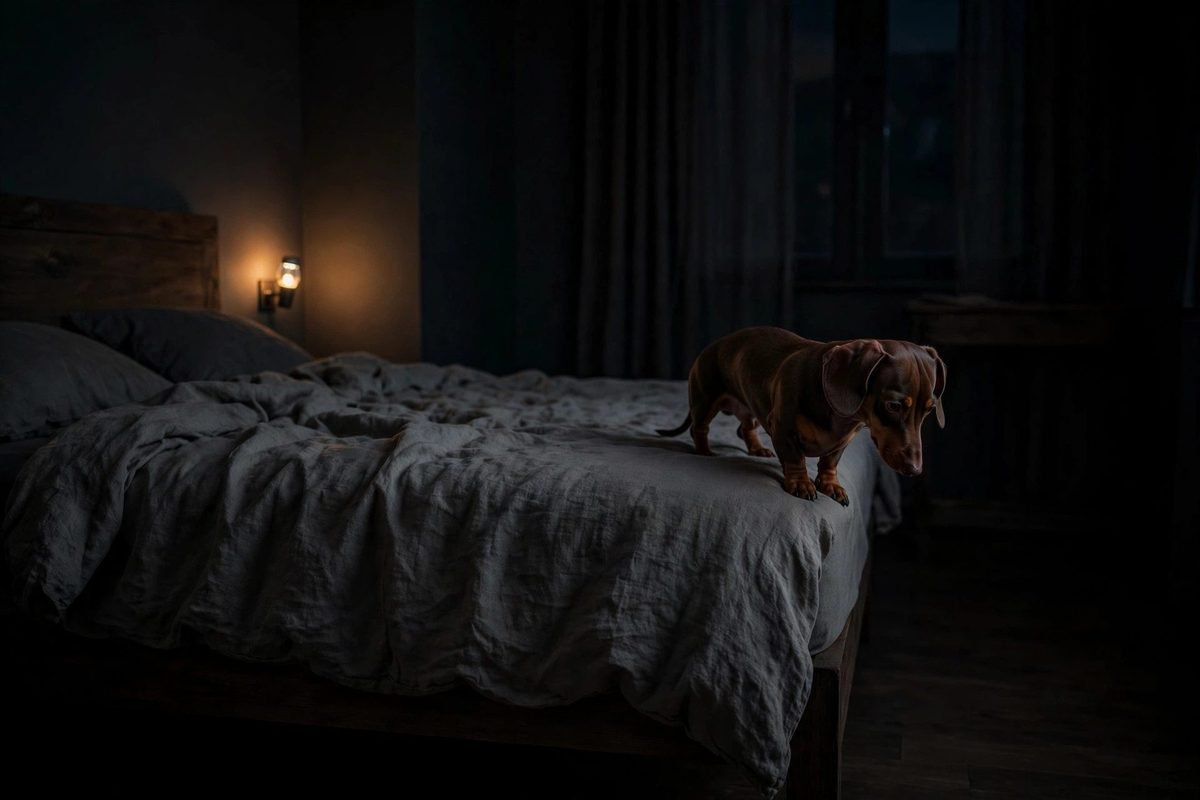
Night is when a Dachshund is most likely to jump off a bed in the dark. The dog wakes up, needs the toilet, hears a noise, or simply decides to move, and before anyone is awake it has dropped from the bed to the floor, landed on hard flooring, and climbed back up again by scrambling at the mattress edge. In daylight that jump is already hard on a long back. At night, in the dark, half asleep, and stiff from hours of lying still, it is harder still.
A back-safe bedtime routine takes the jump out of the night. It gives the dog a ramp or steps that stay in the same place, a small light so the dog can see where it is going, a calm wind-down before sleep, and a clear plan for night waking. This article explains how to set up bedside access, build the routine, and handle the morning, when a stiff dog first gets moving again. It is general information only, not a diagnosis, and a dog with back pain needs a veterinarian, not a new routine.
1. Why Night-Time Bed Access Needs a Plan
Night adds three problems to a simple jump. The first is darkness: the dog cannot see the floor, the landing spot, or anything in the way, such as shoes, a bag, or a rug edge that has curled up. The second is stiffness: after hours of lying still, muscles are cold and tight, and the first movement of the night is the one the body is least ready for. The third is that no one is watching. A jump that happens while the owner is asleep cannot be caught, slowed, or helped, and the dog may land badly and settle back to sleep without anyone knowing it was hurt.
The bed itself is part of the problem. Most beds are higher than a sofa, which means the drop is longer and the landing is harder. A dog that sleeps on the bed and jumps down for a toilet trip may make that drop two or three times a night, every night, and the landing is often followed by a scramble back up, with the dog’s front paws on the mattress and its back legs pushing hard against the floor. Cornell’s information on chondrodystrophy and disc disease explains why this breed’s discs are vulnerable, and disc degeneration in short-legged breeds can begin in the first year of life. A night-time routine that removes the jump does not remove that risk, but it does remove the hardest, least supervised movement of the day.
2. Setting Up a Bedside Ramp or Steps
Start with the bed itself. Measure the height from the floor to the top of the mattress, and choose a ramp or steps that reach that height without a gap. A ramp for a bed needs to be longer than a ramp for a sofa, because the bed is higher and the slope must stay gentle. A good rule is that the ramp should be long enough that the dog walks up a slope, not climbs a wall. If the ramp is too short and steep, the dog will avoid it at night, when it is tired and the room is dark.
Place the ramp or steps on the side of the bed the dog uses, and leave them there every night. A ramp that is folded away during the day and set up at night becomes unfamiliar, and a dog that wakes in the dark will not search for a ramp that was not there when it went to sleep. Keep the route clear: no shoes, bags, laundry, or charging cables in the landing area, and a non-slip mat at the bottom of the ramp so the dog has grip on the first step. Cover the ramp with carpet or rubber matting, and check that the covering is firmly attached, with no loose edges the dog could catch a claw on.
Add light and warmth. A small, low night light near the floor, on the ramp side of the bed, lets the dog see the ramp, the floor, and the way to the door without waking the whole household. A warm blanket or a small dog bed on the floor beside the bed gives the dog a place to go if it wakes and does not want to climb back up, and a non-slip rug between the bed and the door gives the dog grip on the night-time route. The guide to ramps for a Dachshund sofa and bed setup covers height, slope, and surface for beds in detail, and the guide to sleep and bedtime routine for apartments shows how bedtime fits into the whole evening. Check the setup once a week: tighten loose parts, re-stick any mat that has moved, and replace a worn covering before it becomes slippery.
3. Building a Calm Wind-Down Before Bed
The last hour before bed sets the tone for the whole night. Keep it quiet and predictable: a final toilet trip, a short calm walk around the apartment or a brief step outside, a drink of water, and then a settle in the sleeping spot. Dim the lights, turn off the television or lower the volume, and keep voices low. A dog that goes to bed excited, after a game or a loud evening, is more likely to wake restless, move suddenly, and jump off the bed in the night.
Choose one sleeping spot and keep it the same every night. Some dogs sleep on the bed, some sleep in a bed on the floor beside it, and some sleep in a crate with the door open. All three can work, as long as the spot is warm, draught-free, and at a height the dog can reach without jumping. If the dog sleeps on the bed, guide it up the ramp with a calm word and a small treat, and let it circle and settle in its usual place. If the dog sleeps on the floor, put its bed in the same corner every night, with the same blanket, so the dog knows exactly where sleep happens.

4. Handling Night Waking and Toilet Trips
Most Dachshunds wake at least once at night, and the way that waking is handled matters. When the dog stirs, stay calm and quiet. Do not turn on a bright light, do not speak loudly, and do not rush. Guide the dog down the ramp or steps with a soft word, keep the lead loose if one is used indoors, and walk the same short route to the toilet spot every time. A dog that is guided calmly in the dark is far less likely to jump, slip, or rush than a dog that is left to find its own way down in a hurry.
Keep the night toilet trip short and boring. The dog goes to its spot, toilets, and comes straight back, with no play, no treat hunt, and no long sniff around the apartment. A calm return matters as much as a calm exit: guide the dog back up the ramp, let it settle in its spot, and lie down again without fuss. A treat at night can wake the dog up fully and start a game, so save rewards for the morning and keep the night trip quiet. If the dog wakes and does not need the toilet, a soft word and a gentle hand are usually enough to settle it again.
5. Morning Wake-Up and the First Steps of the Day
Morning is the other end of the night-time problem. After hours of lying still, the dog wakes stiff, cold, and slow, and the first movement of the day is often a jump off the bed, a stretch, and a rush to the door. That first jump is the hardest one of the day, because the muscles are at their stiffest and the dog is at its most eager to get outside. A good bedtime routine ends with a good morning routine.
Wake the dog gently and give it a minute before asking it to move. Speak softly, let the dog stretch on the bed, and guide it down the ramp or steps at a slow pace. Take the dog straight to its toilet spot, on the same calm route as the night trips, and let it move at its own speed. The Animal Medical Center explains intervertebral disc disease in dogs, and a stiff morning is a useful early warning: a dog that is slow to rise, reluctant to use the ramp, or limping on the first steps of the day may need a shorter walk, a warmer room, or a call to the veterinarian. Keep a short note of morning stiffness, and share it with a veterinarian if it becomes a pattern.

Back-Safe Bedtime Setup Comparison Checklist
| Bedtime setup | Best for | Limit to watch |
|---|---|---|
| Long bedside ramp | High bed, stiff or senior dog | Needs length for a gentle slope |
| Shallow bedside steps | Dog that prefers steps to a slope | Must be wide, stable, and carpeted |
| Floor bed beside the bed | Dog that wakes often at night | No climbing at all, needs warmth |
| Night light plus non-slip rug | Any setup, dark rooms | Light must be low and steady, not bright |
Common Mistakes
- Leaving the dog to jump off a high bed in the dark.
- Folding the ramp away at night, so it is not there when the dog wakes.
- Using a short, steep ramp that the dog avoids at night.
- Leaving shoes, bags, or cables in the landing area.
- Making night toilet trips exciting, with play or treats.
- Rushing the dog in the morning when it is stiff and cold.
- Ignoring a dog that cries, paces, or cannot settle at night.
When to Call Your Vet
Contact a veterinarian if a Dachshund cries or whines at night, cannot settle, shows back pain or stiffness in the morning, limps on waking, or suddenly refuses the ramp or steps it used before, and seek urgent help for sudden collapse, loss of bladder control, or severe pain. Contact a veterinarian also if the dog wakes far more often than usual, strains to toilet at night, or seems frightened and withdrawn. This article gives general information only and does not diagnose any condition. A veterinarian can examine the dog, check for disc disease, muscle strain, or urinary problems, and advise whether the bedtime setup or routine needs to change. Do not delay veterinary help for a dog that is clearly in pain, cannot move normally, or cannot settle at night.
Pin This: Back-Safe Bedtime Routine Checklist
- Keep a bedside ramp or steps in the same place every night.
- Use a low night light and non-slip mats on the route.
- Keep the landing area clear of shoes and cables.
- Wind down calmly in the last hour before bed.
- Keep night toilet trips short, quiet, and boring.
- Guide the dog down the ramp slowly in the morning.
- Watch morning stiffness, and call a veterinarian if it becomes a pattern.
Frequently Asked Questions
Should my Dachshund sleep on the bed or on the floor?
Either can work, as long as the dog can reach its sleeping spot without jumping. A dog on the bed needs a long, gentle ramp or shallow steps that stay in place all night, while a dog on the floor needs a warm, draught-free bed beside the bed. Choose the option the dog settles in calmly, and keep it the same every night.
How do I stop my dog jumping off the bed at night?
Make the ramp or steps the easiest route, keep them in the same place, and add a low night light so the dog can see them. Guide the dog down the ramp calmly when it wakes, keep night trips short and quiet, and lift the dog down if it wakes before it has learned the ramp. Most dogs stop jumping once the ramp is familiar and easy.
Is a night light really needed for a Dachshund?
Yes, a small low light helps a lot. Dogs can see in low light, but they still need enough light to judge a slope, a step, and the floor. A low light near the ramp lets the dog see where it is going without waking the household, and it also helps the owner guide the dog safely in the dark.
Why is my Dachshund stiff in the morning?
Morning stiffness is common after hours of lying still, especially in older dogs and in cold weather. A gentle wake-up, a slow trip down the ramp, and a calm first hour usually help. If the stiffness lasts more than a few minutes, happens every morning, or comes with limping or reluctance to move, contact a veterinarian.
What if my dog wakes several times every night?
Look at the evening first: a late meal, a late drink, a missed final toilet trip, or a noisy evening can all cause night waking. Keep the last hour calm, take the dog out last thing, and keep night trips short and quiet. If the dog keeps waking often for several nights, or strains to toilet at night, contact a veterinarian.
Conclusion
A back-safe bedtime routine is a quiet change that protects the hardest hours of the day: a bedside ramp or steps that stay put, a low light, a calm wind-down, and a slow, guided morning. Take the jump out of the night, and the dog can sleep, wake, and rise without a single hard landing in the dark.




2 Comments