

Dachshund Back-Safe Routine When a Second Dog Joins
Quick Answer
- A second dog changes everything for a Dachshund: more excitement, more play, and more chances to jump, chase, and twist, so the first weeks need a slow, calm routine.
- Introduce the dogs on neutral ground, keep them separate at first, and give each dog its own bed, bowls, and rest space at home.
- Keep play low, short, and supervised, walk them together only when both are calm on the lead, and watch the Dachshund’s back every day.
- Contact a veterinarian if either dog shows pain, stiffness, limping, or distress during the settling-in period.
Contents
- 1. Why a Second Dog Is a Back Risk for a Dachshund
- 2. Slow Introductions on Neutral Ground
- 3. Separate Spaces, Beds, and Bowls at Home
- 4. Calm Play and Shared Walks
- 5. Watching Both Dogs and Settling the Routine
- Second Dog Routine Comparison Checklist
- Common Mistakes
- When to Call Your Vet
- Pin This: Second Dog Routine Checklist
- Frequently Asked Questions
- Conclusion
A second dog can be a gift for a Dachshund: company, play, and a friend to rest beside. It can also be the biggest change a long back has faced in years, because a new dog brings excitement, competition, and movement that the first dog never had to handle before. The first weeks decide whether the two dogs settle into a calm routine or into a habit of chasing, wrestling, and jumping that puts the Dachshund’s back at risk.
The answer is not to stop the dogs playing. It is to shape how they play, where they rest, and how fast the new routine grows. This guide explains slow introductions, separate spaces, calm play, and shared walks, with the Dachshund’s back in mind at every step. It is general information only, not a diagnosis, and a dog that shows pain or distress needs a veterinarian, not a new routine.
1. Why a Second Dog Is a Back Risk for a Dachshund
A Dachshund that has lived alone has a settled routine: the same bed, the same bowls, the same walk, and the same pace. A second dog breaks that routine in a day. The Dachshund may run to greet the new dog, chase it around the room, jump on and off furniture to follow it, or wrestle on the floor, and each of those movements is harder on a long back than a calm walk. Excitement makes dogs move faster than their bodies can handle, and a stiff or tired dog is more likely to twist or slip.
Size and energy matter. A larger or younger second dog may play roughly, body-slam, or chase at speed, while a smaller or older second dog may still excite the Dachshund into running and jumping. Competition adds to the risk: two dogs racing for a toy, a bowl, or a lap can collide, slip on a smooth floor, or twist as they turn. Disc degeneration in short-legged breeds can begin in the first year of life, so even a young Dachshund needs a routine that keeps play level and calm, not fast and rough.
Stress is part of the picture too. A Dachshund that feels its home, its bed, or its owner is being shared may pace, bark, or guard, and that tension tightens muscles and makes movement less smooth. The Animal Medical Center explains intervertebral disc disease in dogs, and while a second dog does not cause disc disease, rough play and sudden twists add strain to discs that are already vulnerable. A slow introduction, separate spaces, and calm play give both dogs time to learn each other without putting the Dachshund’s back at risk.
2. Slow Introductions on Neutral Ground
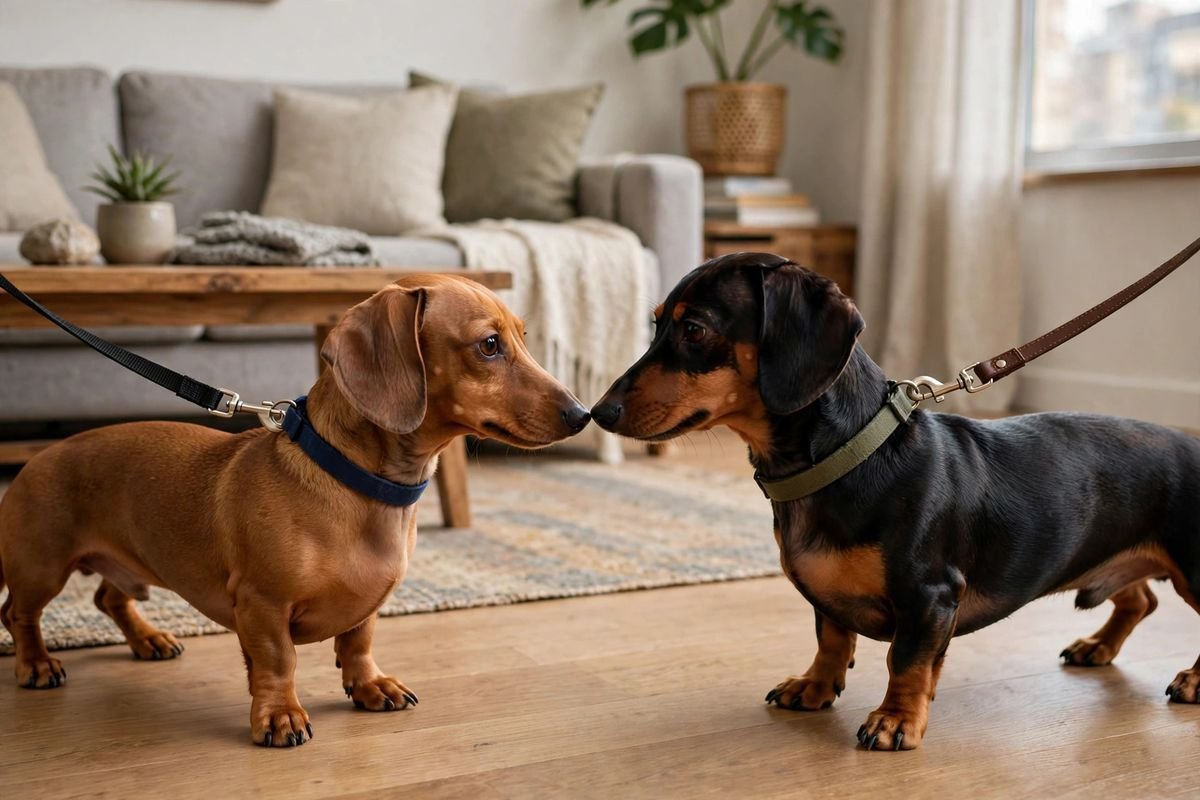
Introduce the dogs outside the home first, on neutral ground such as a quiet street or a garden neither dog owns. Walk them parallel, a few metres apart, on separate leads, and let them see and smell each other without a face-to-face meeting. Keep the walk short, calm, and moving, because walking side by side is easier than standing still and staring, which can feel like a challenge. If both dogs are relaxed, let them meet briefly, sniff, and move on, then walk together again.
Bring the dogs home only when both are calm, and let the new dog explore the home first, on a lead, while the Dachshund waits in another room. Then let the Dachshund in, on a lead, and allow a short, supervised meeting in the living room, with space for either dog to walk away. Keep the first meeting to a few minutes, then separate the dogs calmly, give each a chew or a rest, and try again later. A slow first day beats a fast first hour, because a bad first meeting is hard to undo.
Watch body language closely in the first week. Relaxed bodies, loose tails, and dogs that choose to rest near each other are good signs. Stiff bodies, hard stares, raised hackles, or one dog that will not stop chasing the other are signs to separate the dogs and slow down. If either dog guards food, toys, or a bed, remove the guarded item and give each dog its own, because guarding is when collisions and twists happen most. A veterinarian or a qualified behaviour professional can help if the dogs do not settle after a few weeks of calm, supervised introductions.
3. Separate Spaces, Beds, and Bowls at Home
Give each dog its own bed, in its own spot, with space between them. Two dogs that must share one bed may wrestle for space, push each other off, or jump on and off to claim the best spot, and that is exactly the kind of sudden movement a long back does not need. Separate beds, on the floor, with a rug or mat under each, let both dogs rest without competing, and let the Dachshund step in and out at floor level without jumping over another dog.
Feed the dogs separately, in different corners, with their own bowls at the right height. Dogs that eat side by side may rush, guard, or steal, and a Dachshund that rushes to finish first may gulp, twist, or slip on the floor. Separate feeding spots, with a calm routine and no hovering, let each dog eat slowly and safely. The same applies to water: two bowls, in two spots, so neither dog has to wait or push past the other to drink.
Give each dog a rest space it can retreat to, such as a bed in a quiet corner, a crate with the door open, or a room with a baby gate. A dog that can walk away from play and rest alone is a dog that can control its own energy, and that control protects its back. The guide to barking with two dogs at home covers how two dogs can excite each other into barking, and separate rest spaces help with noise as well as with safety. Keep toys separate too, at first, so the dogs do not have to compete for the same toy.

4. Calm Play and Shared Walks
Keep play low, short, and supervised for the first weeks. Play on the floor, on a rug, with toys that stay on the ground, such as a chew, a puzzle, or a soft toy to carry, rather than a ball that bounces or a toy that must be chased. Five to ten minutes of calm play, followed by rest, is enough, and the dogs should be separated calmly before either one gets tired or overexcited. The guide to back-friendly play at home for Dachshunds explains the same principles for one dog, and they matter twice as much with two, because excitement doubles when dogs play together.
Avoid rough play, wrestling, and chasing in the home, especially on smooth floors. If the dogs start to wrestle, run in circles, or body-slam, interrupt calmly, separate them, and offer a calm activity instead, such as a chew in separate spots. A dog that is tired or overexcited is more likely to slip, twist, or land badly, and a single bad landing can strain a back. Play outside should be on grass or a soft surface, on leads or in a secure area, and at a slow pace, not a sprint.
Walk the dogs together only when both are calm on the lead alone. Start with short, parallel walks, with one person per dog if possible, and keep the leads loose and the pace slow. If one dog pulls, lunges, or tangles the leads, walk them separately until both are calmer, because tangled leads can trip a small dog or pull it sideways. A calm shared walk, with both dogs walking side by side, is a good sign that the routine is settling, and it is also gentle exercise for the Dachshund’s back.
5. Watching Both Dogs and Settling the Routine
Watch the Dachshund every day in the first month. Does it move normally after play, walk freely on a lead, and settle to rest, or does it walk stiffly, hesitate at stairs or ramps, or yelp when lifted? A dog that moves well after playing with a new friend has a routine that works. A dog that is stiff, limping, or reluctant to move needs rest, shorter play, and a veterinarian, not more play to toughen it up.
Watch the second dog too. A new dog that is anxious, overexcited, or unwell can push the Dachshund into rough play, and a second dog that is in pain may guard or snap, which can cause a sudden twist. Both dogs need their own veterinary check, their own routine, and their own rest, and both need to be watched for changes in appetite, movement, and mood. Cornell’s information on chondrodystrophy and disc disease explains why this breed’s discs are vulnerable, and a daily watch is the simplest way to catch a problem early.
Settle the routine slowly over a month. Keep separate beds, bowls, and rest spaces for at least the first few weeks, then let the dogs choose to rest near each other if they want to, without forcing it. Keep play short and supervised, keep walks calm, and keep a short note of how the Dachshund moves after play, so a slow change is easy to spot. A routine that grows slowly is a routine that lasts, and two dogs that learn to live calmly together are safer for each other than two dogs that were rushed into sharing everything on day one.

Second Dog Routine Comparison Checklist
| Second dog setup | Best for | Limit to watch |
|---|---|---|
| Slow introduction on neutral ground | Calm first meeting, less guarding | Takes days, needs patience |
| Separate beds and bowls | Rest, safe eating, less competition | Needs space in a small apartment |
| Short calm play on the floor | Gentle exercise, bonding | Must stop before tiredness or roughness |
| Shared walks when both are calm | Exercise, routine, bonding | Tangled leads can trip a small dog |
Common Mistakes
- Introducing the dogs face to face in the home on day one.
- Forcing the dogs to share one bed or one bowl.
- Letting rough play, wrestling, or chasing go on too long.
- Walking both dogs together before either is calm on a lead.
- Leaving the dogs alone together too soon.
- Ignoring guarding of food, toys, or beds.
- Missing stiffness or a limp after play.
When to Call Your Vet
Contact a veterinarian if a Dachshund shows back pain, stiffness, limping, weakness, reluctance to move, or yelping when lifted, and seek urgent help for sudden collapse, loss of bladder control, or severe pain. Contact a veterinarian also if either dog is very distressed, guards food or toys aggressively, refuses food or water, or injures the other dog during play. This article gives general information only and does not diagnose any condition. A veterinarian can examine both dogs, check for disc disease or injury, and advise on introductions, play, and home safety for that household. Do not delay veterinary help for a dog that is clearly in pain or distress.
Pin This: Second Dog Routine Checklist
- Introduce dogs on neutral ground first.
- Give each dog its own bed and bowls.
- Keep play low, short, and supervised.
- Stop play before tiredness or roughness.
- Walk together only when both are calm.
- Give each dog a rest space to retreat to.
- Watch how the Dachshund moves every day.
Frequently Asked Questions
How long should introductions take?
Days to weeks, not hours. Start with parallel walks on neutral ground, then short supervised meetings at home, then separate rest, and build up slowly. A calm first week is worth more than a fast first day, and a bad first meeting is hard to undo.
Should the dogs share a bed?
Not at first. Give each dog its own bed, on the floor, with space between them, so neither has to compete for rest. If the dogs choose to rest near each other after a few weeks, that is their choice, but a shared bed should never be forced.
Can two Dachshunds play safely together?
Yes, when play is low, short, and supervised, on a rug, with toys that stay on the ground. Avoid wrestling, chasing, and jumping, and separate the dogs calmly before either one gets tired or overexcited. A tired dog is more likely to slip or twist.
When can I leave the two dogs alone together?
Only when both dogs are calm together, rest separately without guarding, and have had several weeks of supervised time with no rough play or distress. Start with a very short absence, and use a camera or a short check to see how they settle. If in doubt, separate them while alone.
What if the new dog is much bigger or younger?
Supervise even more closely, keep play short and on the floor, and give the Dachshund a safe retreat it can reach easily. A larger or younger dog can play roughly without meaning to, so the owner must set the pace, not the dogs.
Conclusion
A back-safe routine when a second dog joins is a slow routine: neutral introductions, separate beds and bowls, calm play, shared walks only when both are ready, and a daily watch on how the Dachshund moves. Two dogs can be a happy household, and a calm first month is what makes it last, for the dogs and for the long back in the middle of it.




One Comment