
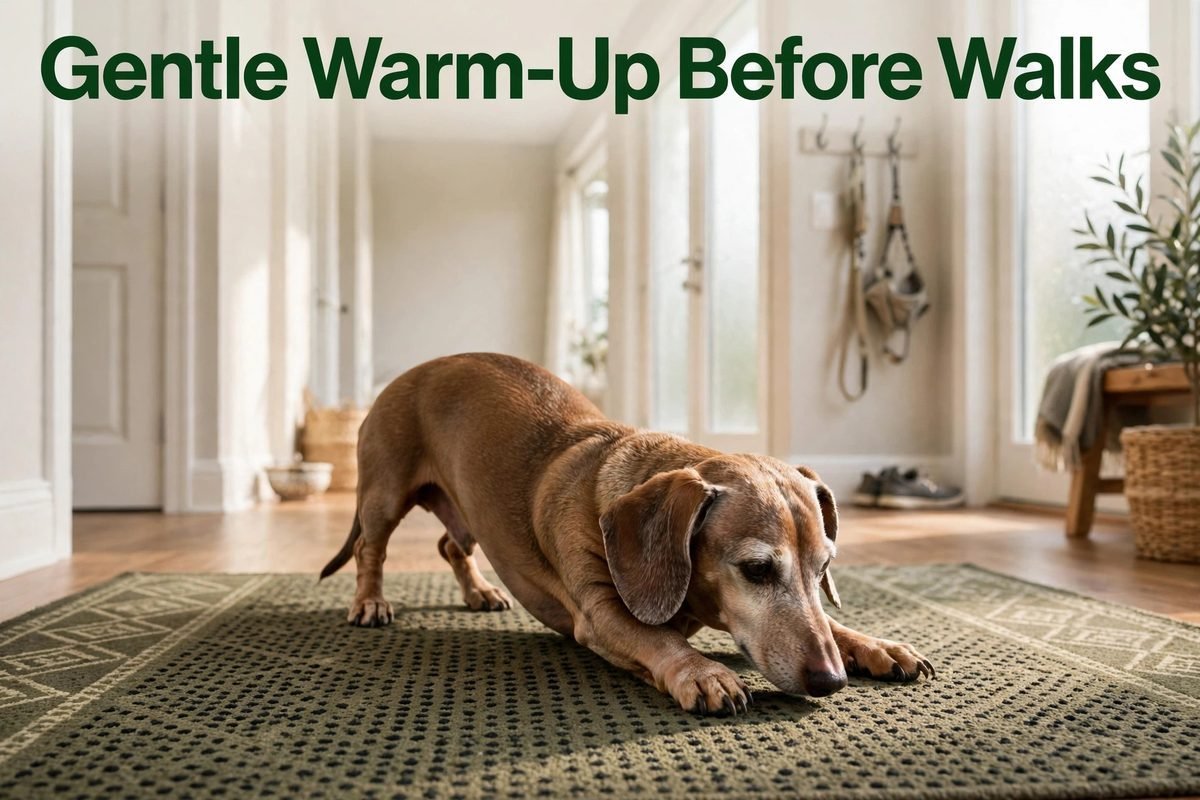
Dachshund Gentle Warm-Up Before Walks for Stiff Dachshunds
Quick Answer
- A gentle warm-up prepares a stiff Dachshund for a walk: five to ten minutes of slow indoor movement, gentle stretches, and calm sniffing before the dog steps outside.
- Start indoors on a non-slip surface, let the dog walk, turn, and stretch at its own pace, and only head out once the dog is moving smoothly and evenly.
- Keep the first few minutes of the walk slow and on a loose lead, on flat ground, before picking up pace or covering any distance.
- Contact a veterinarian if the dog stays stiff after warming up, limps, yelps when moving, or refuses to walk at all.
Contents
- 1. Why a Stiff Dachshund Needs a Warm-Up
- 2. Setting Up a Warm-Up Space Indoors
- 3. A Gentle Five-Step Warm-Up Routine
- 4. Starting the Walk Slowly and Safely
- 5. Cooling Down and Watching the Back After the Walk
- Warm-Up Routine Comparison Checklist
- Common Mistakes
- When to Call Your Vet
- Pin This: Gentle Warm-Up Checklist
- Frequently Asked Questions
- Conclusion
Most Dachshunds start the day stiff. They have been lying still for hours, their muscles are cold, and their joints move slowly for the first few minutes. The owner clips on the lead, opens the door, and the dog steps straight out onto the pavement, down the building steps, and into a brisk walk. That sudden start asks a cold, stiff body to work at full pace with no preparation, and for a long-backed dog, the first minutes of a walk are the ones that matter most.
A gentle warm-up changes that start. Five to ten minutes of slow indoor movement, a few easy stretches, and a calm beginning to the walk give the muscles time to loosen and the dog time to find its stride. It is not exercise, and it is not a training session. It is a short, quiet preparation that happens before the walk, every time, so the walk itself begins with a body that is ready to move. This article explains how to set up the space, run the routine, and start the walk safely. It is general information only, not a diagnosis, and a dog with back pain needs a veterinarian, not a new routine.
1. Why a Stiff Dachshund Needs a Warm-Up
Muscles that have been still for hours are cold, tight, and less flexible than muscles that have been moving. A stiff dog walks with short steps, a low head, and a back that stays rigid, and it may hesitate at the door, at the first step, or at the kerb. That hesitation is useful information: the dog is saying its body is not ready yet. A walk that starts while the dog is still stiff asks those tight muscles to stretch suddenly, to absorb the impact of the pavement, and to cope with turns, steps, and uneven ground, all before they have had a chance to loosen.
Stiffness is more common in some dogs than in others. Senior dogs are stiffer in the morning and in cold weather, dogs that have had a long rest or a vet visit may be stiff the next day, and dogs that are carrying extra weight may find the first minutes of a walk harder. The Animal Medical Center explains intervertebral disc disease in dogs, and disc problems are a known risk for this long-backed breed, with disc degeneration in short-legged breeds can begin in the first year of life. A warm-up does not remove that risk, but it does mean the walk starts with a body that is moving smoothly, rather than a body that is still half asleep.
2. Setting Up a Warm-Up Space Indoors
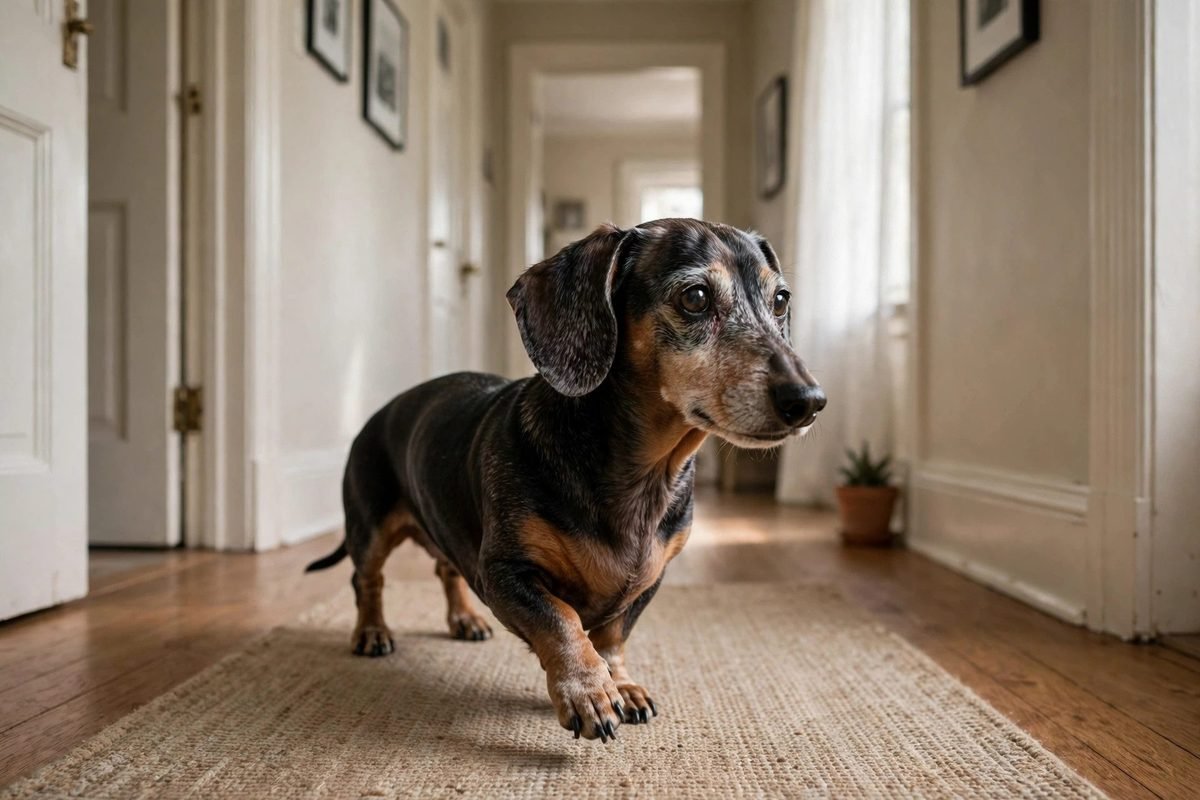
Choose a clear, flat space indoors, large enough for the dog to walk in a straight line for a few metres and to turn around comfortably. A hallway, a living room with the rug in place, or a kitchen with a non-slip mat all work. The key is grip: the dog must be able to walk, turn, and stretch without slipping. A non-slip rug or mat over a smooth floor is enough, and the space should be free of toys, shoes, bags, and anything the dog could trip over. Keep the room warm, especially in winter, because a cold room makes stiff muscles slower to loosen.
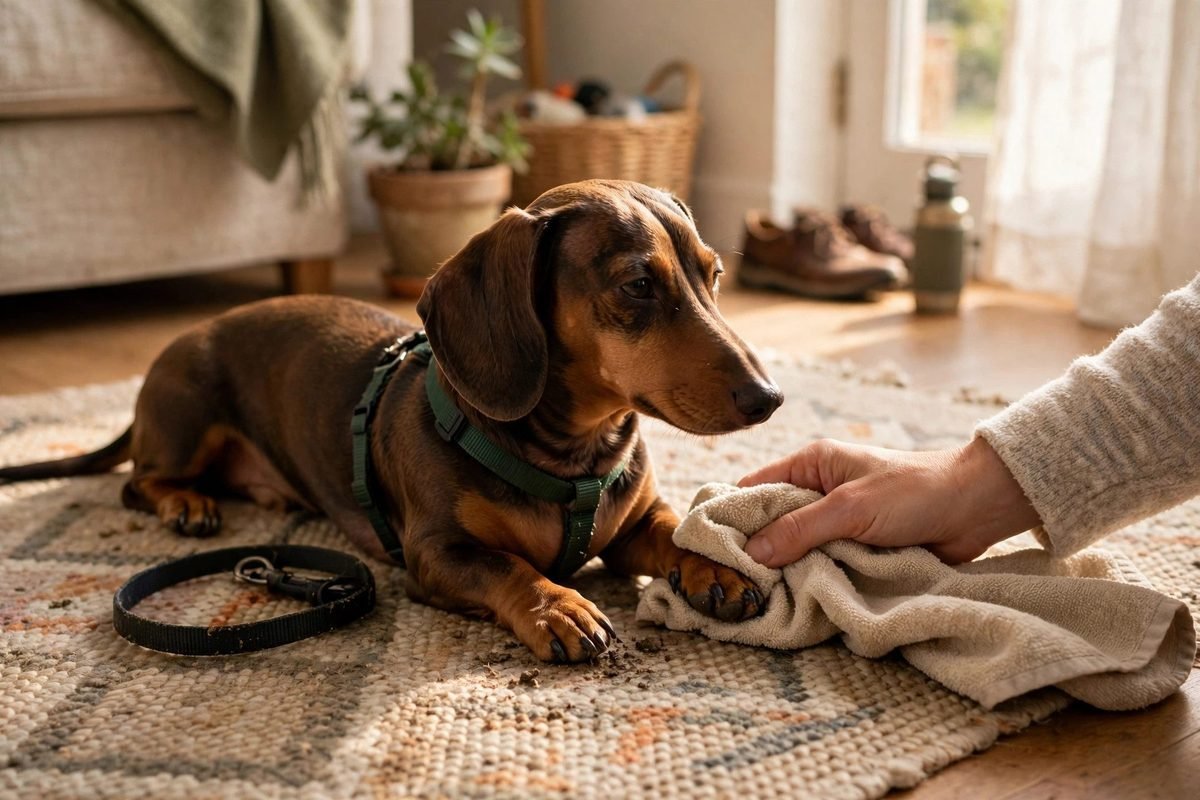
Keep the warm-up kit simple and in one place. A short lead, a few small treats, a favourite toy for a gentle sniff game, and a towel for wiping paws are all that is needed. Put the harness on indoors, before the warm-up begins, so the dog is not fussed with at the door when it is already eager to go out. Check the harness fit while the dog is standing calmly: it should be snug but not tight, with no rubbing at the chest or behind the front legs, and the lead should be loose, not pulling the dog forward.
Pick a consistent time and place for the warm-up, so it becomes part of the walk routine rather than an extra job. The same hallway, the same rug, and the same few minutes before every walk mean the dog learns what is happening and settles into it. A dog that knows the routine will start to move, stretch, and sniff on its own, without being coaxed. If the home is small, a short loop around the living room, repeated a few times, is enough. The space does not need to be large. It needs to be flat, grippy, warm, and free of clutter.
3. A Gentle Five-Step Warm-Up Routine
Step one is slow walking. Walk the dog slowly around the warm-up space for two or three minutes, on a loose lead, letting it set the pace. Do not hurry, do not pull, and do not ask for a trot. Slow walking moves the joints through their normal range, brings blood to the muscles, and lets the dog find its stride. Watch the gait: the steps should become longer and more even as the minutes pass, and the back should stay level rather than hunched or dipped.
Step two is gentle turning. Guide the dog in slow, wide circles, first one way and then the other, so the dog turns its whole body rather than twisting sharply. Wide turns are kinder to a long back than tight spins, and they help the dog loosen the muscles on both sides. If the dog hesitates on a turn, make the circle wider and slower, and do not force it. A dog that turns smoothly both ways is loosening up well.
Step three is easy stretching. Let the dog stretch on its own: a long sniff on the floor, a stretch of the front legs, a shake, or a slow lie-down and rise all count as natural stretches. A treat held low to the floor can encourage a gentle nose-down stretch, and a treat held to one side can encourage a slow turn of the head and neck. Keep every stretch slow and voluntary, and never push, pull, or bend the dog into a position. The guide to gentle back exercises for Dachshunds covers low-impact movement in more detail, and the guide to how much exercise a Dachshund needs without hurting its back shows how a warm-up fits into the total daily amount.
Step four is a short sniff game. Scatter a few treats on a snuffle mat or on the rug, and let the dog search for them with its nose. Sniffing is slow, low, and calming, and it keeps the dog moving gently while its muscles loosen. It also settles the dog’s mind before the excitement of the street. Step five is a final check: watch the dog walk a straight line once more, and ask whether it is moving smoothly, evenly, and without hesitation. If it is, the dog is ready to go out. If it is not, give it a few more minutes, or shorten the walk.

4. Starting the Walk Slowly and Safely
The first five minutes outside are part of the warm-up, not the walk itself. Keep the lead loose, walk slowly, and stay on flat ground: a level pavement, a flat path, or a quiet street, with no steps, kerbs, or steep slopes at the start. Let the dog sniff, pause, and set the pace. A dog that is allowed to start slowly will usually pick up its own pace naturally once it is warm, and that natural pace is the right one for that dog on that day.
Choose the route with the warm-up in mind. Start on the flattest part of the route, and save any steps, slopes, or uneven ground for later in the walk, when the dog is fully warm. Avoid a sudden sprint to the park, a rush across a road, or a steep set of building steps in the first minutes. If the building has steps, carry the dog down them or use a lift, and let the walk begin on level ground outside. In cold or wet weather, keep the start even slower, and consider a light coat for a short-legged dog, because cold muscles take longer to loosen.
5. Cooling Down and Watching the Back After the Walk
A warm-up has a matching cool-down. When the walk ends, do not stop suddenly and put the dog straight to bed. Walk slowly for the last few minutes, let the dog sniff and slow down, and finish with a few minutes of calm indoor movement, just like the warm-up. A slow finish lets the muscles cool gradually, and it gives the owner a chance to watch how the dog is moving after the walk, when tiredness can show up as stiffness or a change in gait.
Check the dog after every walk. Wipe the paws, check between the toes for stones or grit, and feel the back lightly as the dog settles. A dog that lies down, stretches, and relaxes has had a good walk. A dog that lies flat and will not move, walks stiffly to its bed, or yelps when touched may be sore, and needs rest and a call to the veterinarian if the soreness lasts. Cornell’s information on chondrodystrophy and disc disease explains why this breed’s discs are vulnerable, and early signs are easy to miss if no one is watching. Keep a short note of how the dog moved before and after the walk, and share it with a veterinarian if anything changes.
Warm-Up Routine Comparison Checklist
| Warm-up option | Best for | Limit to watch |
|---|---|---|
| Slow indoor walking | Every walk, all ages | Needs a flat, non-slip space |
| Wide turns both ways | Stiff mornings, older dogs | Keep circles wide, never force a turn |
| Sniff game on a mat | Calming an excited dog | Keep treats small, avoid overfeeding |
| Slow first five minutes outside | Cold days, first walk of the day | Stay on flat ground, keep the lead loose |
Common Mistakes
- Skipping the warm-up and stepping straight out at full pace.
- Starting the walk with building steps or a steep slope.
- Pulling the dog forward on a tight lead while it is still stiff.
- Forcing stretches or bending the dog into a position.
- Using tight spins or sharp turns to loosen the dog up.
- Ending the walk suddenly with no slow cool-down.
- Ignoring stiffness that does not ease after warming up.
When to Call Your Vet
Contact a veterinarian if a Dachshund stays stiff after a warm-up, limps, yelps when moving, refuses to walk, or shows back pain, weakness in the legs, or reluctance to move, and seek urgent help for sudden collapse, loss of bladder control, or severe pain. Contact a veterinarian also if the dog is stiff every morning, needs longer and longer to loosen up, or seems worse after walks rather than better. This article gives general information only and does not diagnose any condition. A veterinarian can examine the dog, check for disc disease, muscle strain, or joint problems, and advise whether the warm-up, the walk length, or the routine needs to change. Do not delay veterinary help for a dog that is clearly in pain or cannot move normally.
Pin This: Gentle Warm-Up Checklist
- Warm up indoors for five to ten minutes before every walk.
- Use a flat, non-slip space and a loose lead.
- Walk slowly, turn in wide circles, and let the dog stretch naturally.
- Add a short sniff game to keep the dog calm.
- Start the walk slowly, on flat ground, for five minutes.
- Cool down slowly and check the dog after the walk.
- Call a veterinarian if stiffness does not ease after warming up.
Frequently Asked Questions
Does my Dachshund really need a warm-up before every walk?
Yes, especially for the first walk of the day, in cold weather, and for older or stiffer dogs. Five to ten minutes of slow indoor movement is enough, and it becomes a habit quickly. A dog that is warmed up moves more smoothly, and the owner gets a daily check on how the dog is moving before the walk begins.
How long should a warm-up last?
Five to ten minutes indoors, plus a slow first five minutes outside, is enough for most dogs. A young dog on a warm day may need only five minutes, while a senior dog on a cold morning may need ten. Watch the dog: when it is moving smoothly and evenly, it is ready to walk at a normal pace.
Can I stretch my Dachshund myself before a walk?
Let the dog stretch on its own, with a treat held low or to the side to encourage a gentle nose-down or head-turn stretch. Never push, pull, or bend the dog into a position, and never force a stretch. Natural stretches, slow walking, and sniffing are safer than hands-on stretching, and a dog that is sore should be seen by a veterinarian, not stretched at home.
What if my dog is still stiff after warming up?
Give it a few more minutes indoors, and if it is still stiff, shorten the walk or skip it and rest the dog. Stiffness that does not ease with gentle movement, limping, or reluctance to walk are reasons to contact a veterinarian, especially if the pattern repeats over several days.
Is a warm-up needed in summer too?
Yes, though it can be shorter. Muscles are still cold after rest, even on a warm day, and a short indoor warm-up still helps the dog start smoothly. In hot weather, keep the warm-up indoors in the shade, offer water, and keep the walk itself short and in the cooler parts of the day.
Conclusion
A gentle warm-up is five quiet minutes that change the whole walk: slow indoor movement, wide turns, natural stretches, and a slow start outside mean a stiff Dachshund steps onto the street warm, loose, and ready. Warm up first, walk second, and the dog’s back gets the easiest start every day.





5 Comments