

Dachshund Joint Care at Home: Gentle Movement Guide
Quick Answer
- Dachshund joint care at home means gentle daily movement, a healthy weight, and a routine that protects the long back and short legs.
- Short, flat walks, slow play on a non-slip floor, and ramps or steps for the couch keep joints moving without hard impact.
- Extra weight adds load to small joints and the spine, so measured meals and limited treats matter as much as exercise.
- Watch for stiffness after rest, a change in stride, reluctance to climb or jump, and yelping when touched.
- Ask a veterinarian about any joint sign that lasts more than a day or two, or any sudden change in how the dog moves.
Contents
- 1. Why a Dachshund’s Joints Need Gentle Daily Care
- 2. Gentle Movement That Builds Strong Joints
- 3. Weight, Food, and the Load on Small Joints
- 4. A Simple Daily Joint Care Routine for Apartments
- 5. Signs to Ask a Vet About
- Dachshund Joint Care at Home: Daily Checklist
- Common Mistakes
- When to Call Your Vet
- Pin This: Daily Joint Care Checklist
- Frequently Asked Questions
- Conclusion
1. Why a Dachshund’s Joints Need Gentle Daily Care
Dachshund joint care at home starts with the shape of the dog. A Dachshund has a long spine and short legs, and that shape puts more work on the joints of the legs and the discs of the back than a taller dog of the same weight carries. The joints of the hips, knees, and elbows bend more with every step, and the spine flexes with every turn, jump, and landing. None of that means a Dachshund is fragile. It means the daily routine — how the dog moves, eats, and rests — has a bigger effect on joint health.
Age is only part of the story. In short-legged breeds, disc degeneration can begin in the first year of life, not only in old age, so joint care is not something to start when a dog turns gray. The Cornell guide to chondrodystrophy and intervertebral disc disease explains that the short-legged body shape raises the risk of disc problems, and that the changes in the discs start early. A young Dachshund that moves gently, keeps a healthy weight, and uses ramps instead of jumping is building habits that protect joints for years, not just for a season.
Most joint care at home is simple and cheap: a short walk instead of a long run, a ramp instead of a leap off the couch, a measured meal instead of a full bowl, and a warm-up before the first walk. None of these need special equipment. They need consistency, every day, so the joints are never asked to do more than they are ready for.
2. Gentle Movement That Builds Strong Joints
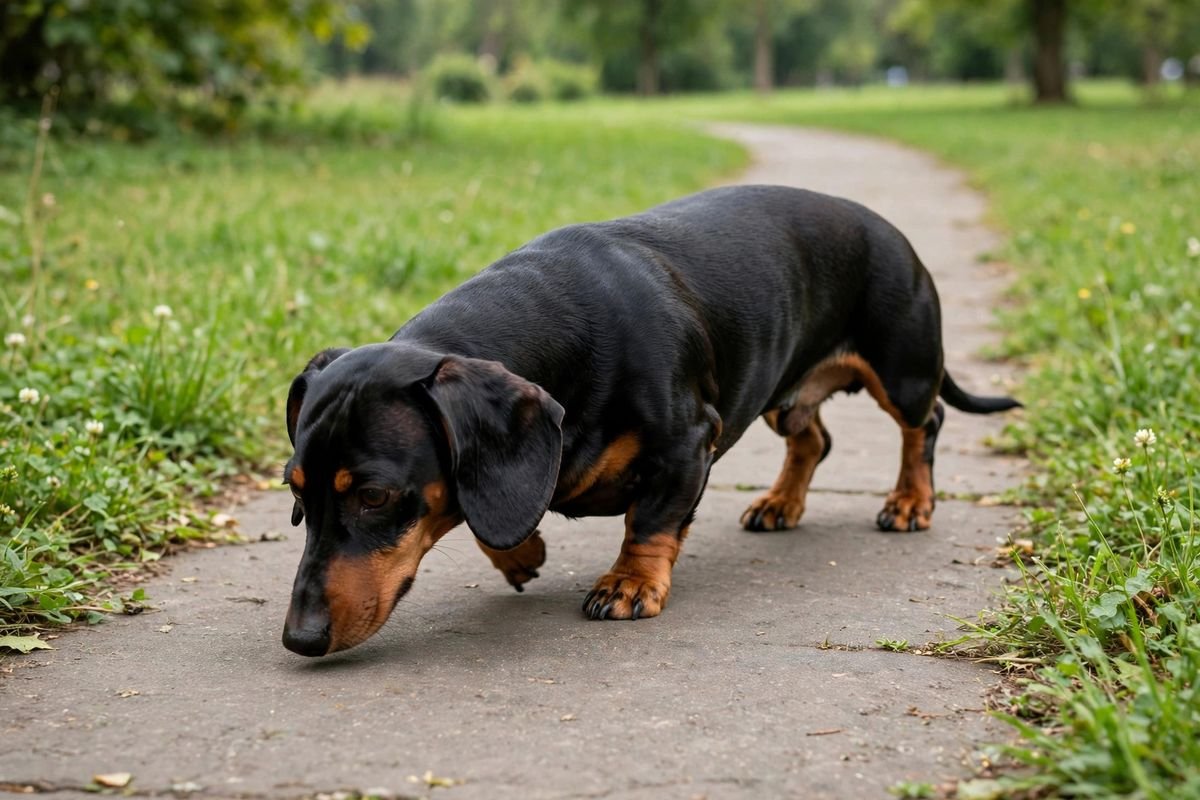
Movement keeps joints healthy, but the kind of movement matters more than the amount. A short walk on a flat path, at the dog’s own pace, moves every joint through its full range without jarring it. Sniffing walks are ideal: the dog stops, turns, steps, and starts again, which works the muscles that support the joints. Two or three short walks a day suit most Dachshunds better than one long walk, and a walk that ends while the dog still looks fresh is better than one that ends with a tired, dragging dog.
Play at home should be gentle too. A slow game of fetch across a rug, a puzzle feeder, and a few minutes of training with sit and stand cues all move the joints without impact. Avoid games that twist the spine: hard tug games, chasing a ball at full speed, and jumping up to catch a toy in the air. A gentle warm-up before walks for stiff Dachshunds helps a dog that wakes up slow, and it takes only a few minutes indoors before the leash goes on.
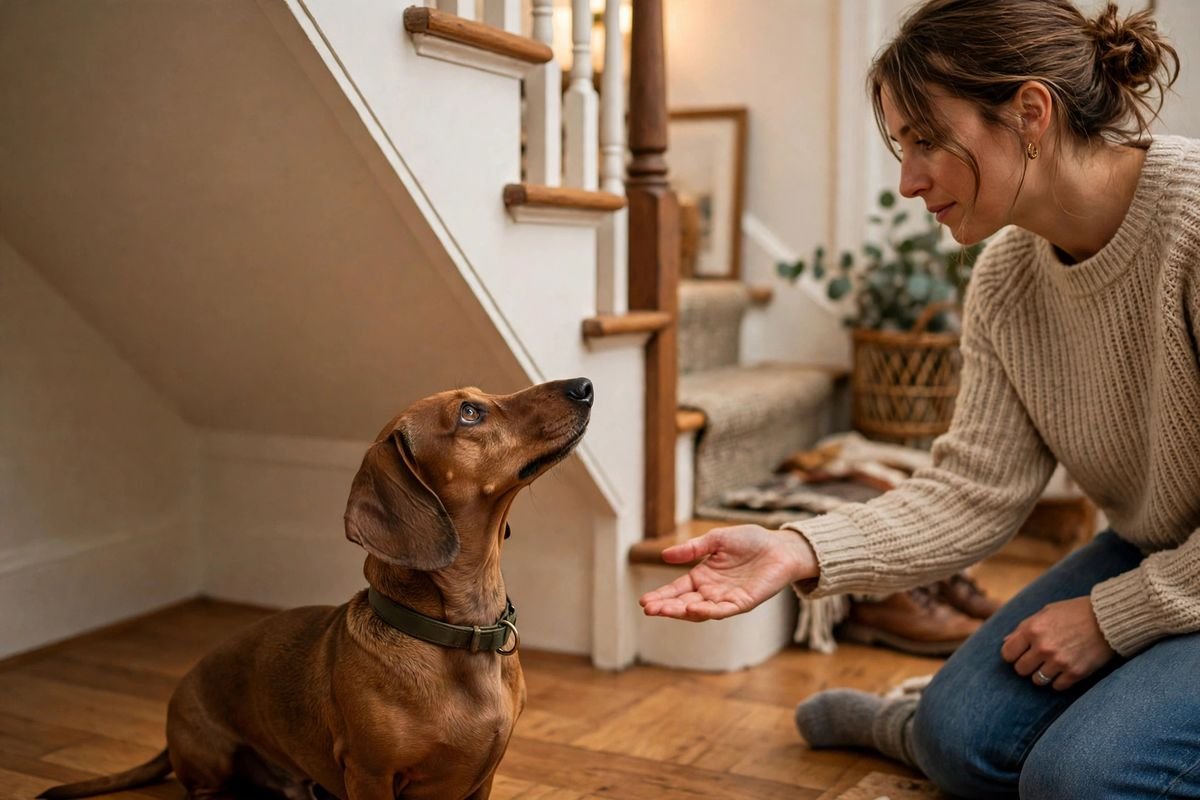
Stairs and furniture deserve a plan, not a ban. Vets commonly advise at-risk dogs to avoid running on stairs and jumping from furniture, and to use steps or ramps instead, and the Animal Medical Center guide to intervertebral disc disease in dogs explains the signs that need prompt attention. The evidence on stairs and jumping is mixed and observational, so a veterinarian’s advice for this dog matters more than any general rule. A ramp by the couch and steps by the bed take the leap out of the day, and a gate at the top of a steep staircase stops a fast run down. The goal is not to wrap the dog in cotton; it is to take the hardest landings out of an ordinary day.
3. Weight, Food, and the Load on Small Joints
Weight is the joint care step an owner controls at every meal. Every extra pound a Dachshund carries adds load to the same small joints and the same long spine, and a dog that is overweight moves less, which weakens the muscles that support the joints. The cycle feeds itself: extra weight makes movement harder, less movement makes weight gain easier, and the joints carry the cost. A healthy weight is not about looks. It is about how much load the joints carry on every step.
The rib check is the simplest way to judge weight at home. Run a flat hand along the dog’s ribs: the ribs should be easy to feel under a thin layer of fat, without pressing hard. Look at the dog from above: there should be a waist behind the ribs, narrower than the chest. Look from the side: the belly should tuck up behind the ribs, not hang level with the chest. If the ribs are hard to find, or the waist has disappeared, ask a veterinarian about the right weight and the right daily food amount for this dog.
Measured meals beat a full bowl. Feed the amount the veterinarian suggests, measured with a cup or a kitchen scale, split into two meals a day. Treats count as food, so keep them small and count them in the daily amount: a treat the size of a pea, given for a good recall or a calm sit, does the job without adding much. Table scraps, especially fatty ones, add weight fast and can upset the stomach, so keep them out of the routine. A dog that eats measured meals, at set times, is easier to keep at a healthy weight than a dog that grazes all day.

4. A Simple Daily Joint Care Routine for Apartments
A good joint care routine fits into a normal apartment day without taking over the day. Start in the morning with a slow indoor warm-up: a few minutes of calm movement around the apartment, a stretch, and a short walk to the door before the first walk outside. A dog that warms up indoors moves more easily on the first walk, and the first walk can stay short and flat. After the walk, check the dog’s stride: a level back and even steps mean the joints are moving well.
Midday is for rest and gentle play. A Dachshund that sleeps on a supportive bed, off a cold floor, wakes up looser than one that sleeps on bare tile. A rug or mat on a slippery floor gives the dog grip, so it does not splay its legs when it stands up or turns. A short play session on the rug, with a puzzle feeder or a slow game, keeps the joints moving without the hard stops of a hallway sprint. Keep the water bowl and the bed on the same floor, so the dog is not climbing stairs all day for the basics.
Evening is the second short walk, then a calm night. The senior mobility routine at home covers the same pattern for an older dog, with slower walks and more rest built in. The routine is the same at any age: warm up, move gently, rest well, and repeat. A short note once a week — how the dog rose in the morning, how the walk went, whether the dog hesitated at the stairs — shows whether the routine is working, or whether something is changing.
5. Signs to Ask a Vet About
Most joint problems show up first as small changes in how the dog moves. A dog that is slow to rise in the morning, that hesitates before the stairs, or that takes short steps for the first few minutes of a walk may be stiff rather than lazy. A dog that stops jumping onto the couch, or that yelps when picked up, may be sore. A change in stride — one leg moving differently, a back that looks arched, a tail that hangs low — is worth noting, even if the dog still eats and plays. Small changes noticed early are easier to act on than big ones noticed late.
Keep a simple log when a sign appears. Note the date, what the dog did, and how long it lasted: slow to rise for two mornings, a yelp when lifted on Tuesday, a skipped jump on Thursday. A log turns a vague worry into a clear story the veterinarian can use, and it shows whether a sign is fading or getting worse. A sign that lasts more than a day or two, or one that comes back every week, is worth a call. A sudden change — a dog that cannot move a leg, that cries out in pain, or that refuses to walk — needs a veterinarian the same day.
Do not try to fix a joint sign at home with rest alone for more than a day or two. Rest helps a tired muscle, but a joint problem that keeps coming back needs a veterinarian’s exam. The DachsLife study from 2015, published by the Royal Veterinary College, surveyed about 2,000 Dachshunds and found the evidence on lifestyle factors like stairs and exercise to be observational and mixed, which is why a veterinarian’s advice for one dog matters more than a general rule. The DachsLife study is a useful reminder that every Dachshund is different, and the right care plan is the one a veterinarian shapes for that dog.
Dachshund Joint Care at Home: Daily Checklist
| When | What to Do | What to Watch For |
|---|---|---|
| Morning | Slow warm-up indoors, then a short flat walk | Slow rising; short steps; arched back |
| Meals | Measured food, twice a day; small treats only | Ribs easy to feel; waist visible from above |
| Midday | Rest on a supportive bed; gentle play on a rug | Dog moves easily after rest; no slipping |
| Evening | Second short walk; calm night; ramp to the couch | Even stride; dog uses the ramp, not a leap |
| Weekly | Short note on rising, walks, and stairs | Any sign that repeats or gets worse |
A routine followed every day catches a joint problem early, because the owner knows what normal looks like for this dog.
Common Mistakes
- One long weekend run instead of short daily walks, which tires the joints without building strength.
- Letting the dog jump off the couch and bed every day, instead of using a ramp or steps.
- Feeding by eye instead of measuring, so the dog gains weight a little at a time.
- Counting treats as free, when they add up to a real share of the daily food.
- Skipping the warm-up and heading straight out into the cold for the first walk.
- Letting the dog play tug games that twist the spine, or chase a ball at full speed down a hallway.
- Leaving slippery floors bare, so the dog splays its legs every time it stands or turns.
- Waiting weeks to call a veterinarian about a limp or stiffness that keeps coming back.
When to Call Your Vet
Contact a veterinarian if the dog is stiff or limping for more than a day or two, hesitates at stairs, yelps when lifted or touched, or stops jumping onto furniture it used to reach. Contact a veterinarian urgently if the dog cannot move a leg, loses bladder control, or is in severe pain. A veterinarian can examine the dog, check the joints and spine, and advise whether the routine, the food, or the exercise plan needs to change. This article gives general information only and is not a diagnosis.
Pin This: Daily Joint Care Checklist
- Warm up indoors before the first walk each morning.
- Keep walks short, flat, and at the dog’s own pace.
- Use a ramp or steps for the couch and bed.
- Measure meals and keep treats small.
- Put rugs on slippery floors for grip.
- Call a veterinarian if stiffness lasts more than a day or two.
Frequently Asked Questions
How much exercise does a Dachshund need for healthy joints?
Most Dachshunds do well with two or three short walks a day, plus gentle play at home. Walks should be flat, at the dog’s own pace, and end while the dog still looks fresh.
Is my Dachshund too heavy for its joints?
Feel the ribs with a flat hand: they should be easy to find under a thin layer of fat. From above, there should be a waist behind the ribs. If the ribs are hard to find, ask a veterinarian about the right weight and daily food amount.
Should my Dachshund use a ramp?
A ramp or steps for the couch and bed take the hard landing out of the day, and vets commonly advise them for at-risk dogs. A dog that learns the ramp as a puppy will use it without thinking, so it is worth teaching early.
What does joint stiffness look like in a Dachshund?
Slow rising in the morning, short steps for the first few minutes of a walk, hesitation at stairs, and yelping when lifted or touched are the usual signs. A sign that lasts more than a day or two is worth a call to a veterinarian.
Can a young Dachshund have joint problems?
Yes. In short-legged breeds, disc degeneration can begin in the first year of life, so gentle movement, a healthy weight, and ramps are worth starting early. Any change in how a young dog moves is worth asking a veterinarian about.
Conclusion
Dachshund joint care at home is a daily habit, not a big project: a slow warm-up, short flat walks, measured meals, a ramp for the couch, and rugs on slippery floors. The next step is simple — feel the dog’s ribs today, and note how it rises tomorrow morning.



One Comment