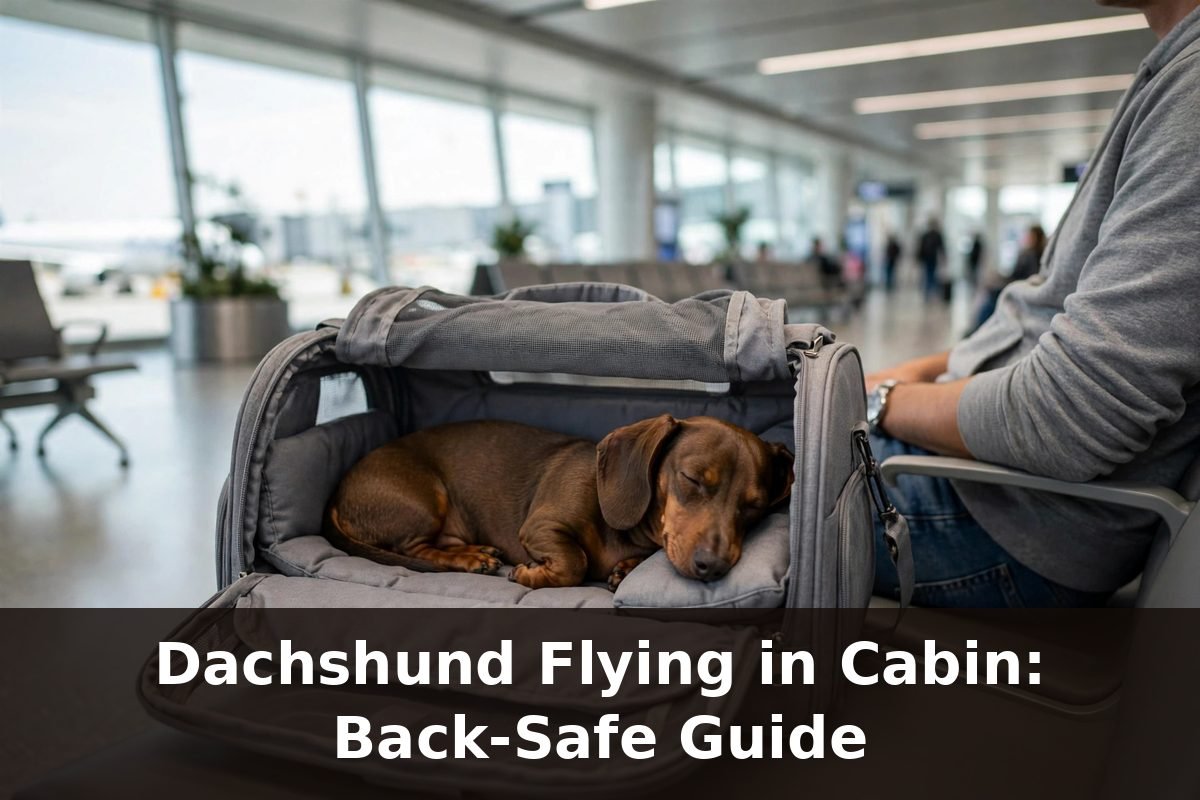
Dachshund Flying in Cabin: A Back-Safe Plane Guide
Quick Answer
- Dachshund flying in cabin means the dog travels in a soft carrier under the seat, never in the hold, with the back kept level at every lift, carry, and settle.
- Choose a carrier the dog can stand, turn, and lie down in, with a flat, firm base and a soft blanket inside, and practise at home for weeks before the trip.
- Lift the carrier level with both hands, keep it off the floor while walking through the airport, and set it down gently rather than dropping it.
- Keep the dog calm and still during the flight: no lap time, no climbing out, and short, quiet checks instead of constant handling.
- Contact a veterinarian before booking if the dog has back pain or stiffness, and again after the trip if anything changes.
Contents
- 1. Why Flying Is Different for a Dachshund’s Back
- 2. Choosing and Preparing the In-Cabin Carrier
- 3. The Airport: Lifting, Carrying, and Waiting
- 4. During the Flight: Keeping the Back Still and Safe
- 5. Landing, Arrival, and the First Day After
- Flight Day Checklist: Before, During, and After
- Common Mistakes
- When to Call Your Vet
- Pin This: Flying in the Cabin With a Dachshund
- Frequently Asked Questions
- Conclusion
1. Why Flying Is Different for a Dachshund’s Back
Flying is different from every other kind of travel for a Dachshund, because the dog spends hours in a small carrier, in a cramped space, with no chance to stretch, walk, or change position. A car journey allows stops, and a train allows a short walk down the aisle, but a flight keeps the dog in one place from take-off to landing. That stillness is the main risk for the back: muscles that support the spine cool and tighten without movement. Dachshund flying in cabin care is therefore a plan for stillness, with the carrier, the lifting, and the rest breaks all arranged before the trip begins.
The long back of a Dachshund adds to the flying problem. A short-legged breed carries its spine close to the ground, and the back works hard with every rise, every step, and every turn. Disc degeneration in short-legged breeds can begin in the first year of life, so the spine of a Dachshund deserves gentle handling from an early age, and the long stillness of a flight adds to that load rather than starting it. A carrier that is too small forces the back into a curve for hours, and a carrier that is lifted by one handle swings and twists with every step. Both problems are easy to prevent with the right carrier and a level carry.
Flying is not the same as travelling by train or bus, although the two share the idea of a calm carrier and a planned route. The train and bus travel routine covers journeys where the dog can be taken out for a short walk at a station, and this article covers the stricter case of a flight, where the dog stays in the carrier the whole time. The long car journey guide covers rest stops and recovery after road travel, and the recovery ideas there work well after a flight too. What matters most is the plan: a calm dog in a good carrier makes a quiet journey.
2. Choosing and Preparing the In-Cabin Carrier
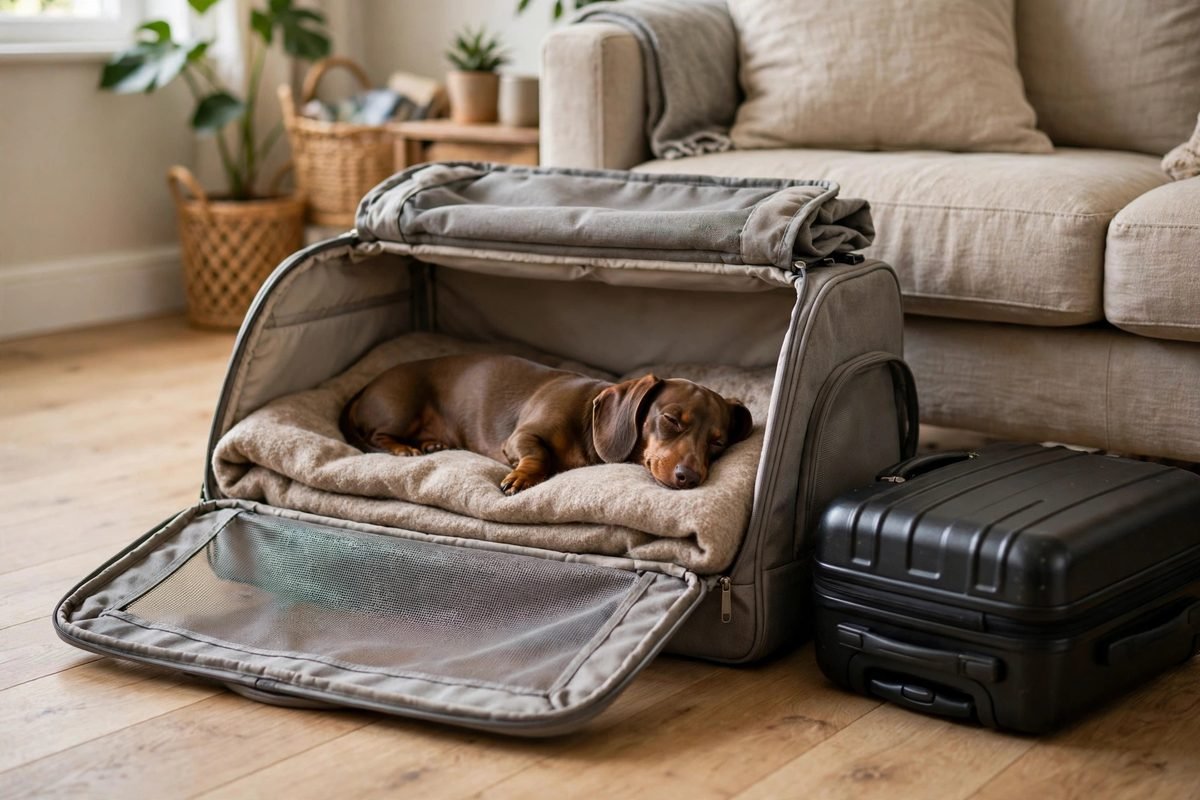
The carrier is the most important choice for the whole trip, so it deserves time and testing. Choose a soft-sided carrier that fits under the seat of the airline being used, with a flat, firm base that does not sag under the dog’s weight. The dog must be able to stand, turn around, and lie down flat inside, with room for a folded blanket. A carrier that is too large slides around under the seat. Check the airline’s size limits before buying, because the limits differ between airlines, and a carrier that fits one airline may not fit another.
Put a soft, flat blanket inside the carrier, with no lumps or folds that push the back into an uneven shape. The blanket should cover the whole base, so the dog lies on a level surface, and it should be familiar from home, carrying the smell of the house. Add a small, flat water bowl or a water bottle that clips to the carrier door, and a chew or a familiar toy that keeps the dog settled without excitement. Avoid anything that encourages jumping or climbing inside the carrier.
Practise at home for at least two weeks before the flight. Leave the carrier open on the floor with the blanket inside, and let the dog walk in and out freely, with a small treat placed inside. Close the door for a few minutes at a time, then longer, until the dog can rest calmly inside for an hour. Carry the closed carrier around the home, lifting it level with both hands, so the dog learns that a level carry is normal. A dog that has practised at home will settle on the plane.
3. The Airport: Lifting, Carrying, and Waiting
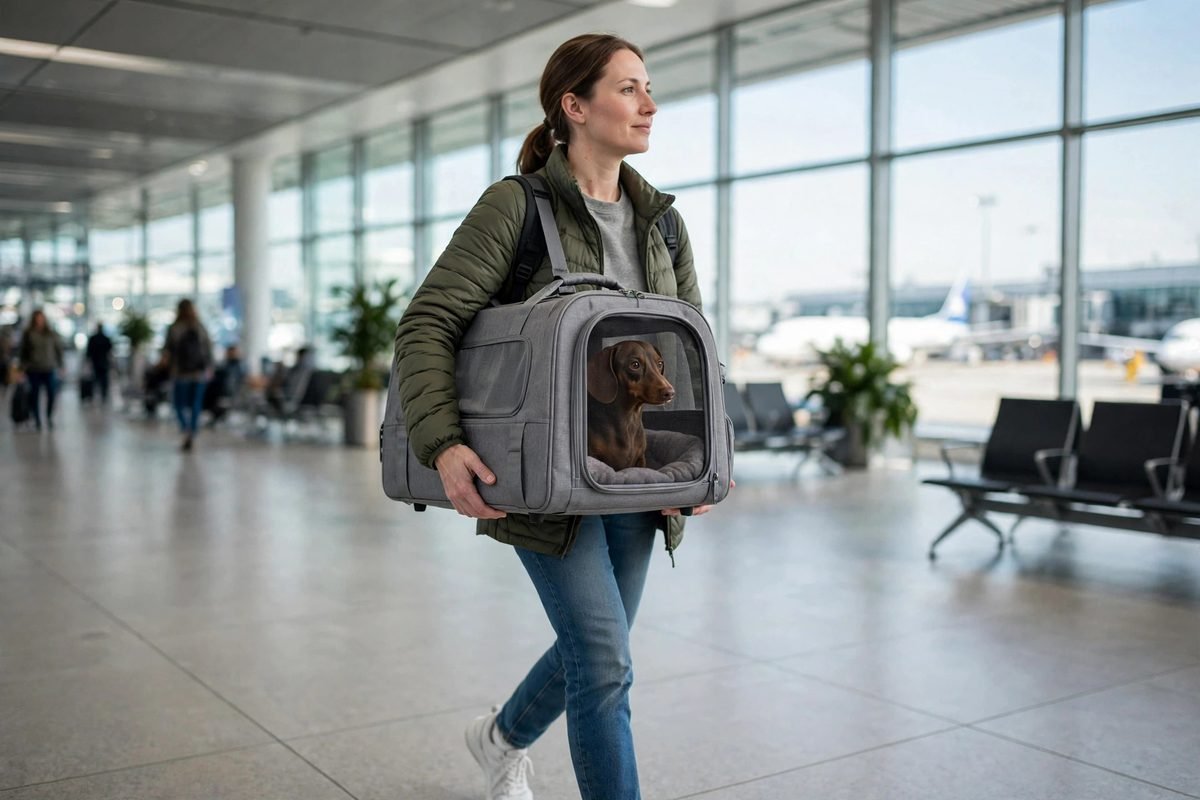
The airport is the busiest part of the trip, and the back is most at risk in the crowds. Lift the carrier level with both hands, one at each end, keeping the base flat and the dog’s back level inside. Never carry the carrier by one handle, because a one-handed carry swings with every step and twists the dog inside. Never set the carrier down hard on a counter or the floor. Walk slowly through the terminal, keeping the carrier close to the body, and stop often to let the dog settle after each move.
Keep the carrier off cold, hard floors while waiting. Put it on a bench, a chair, or a folded blanket, never directly on bare tile, because cold floors chill the muscles along the spine during a long wait. Choose a quiet corner away from crowds, loudspeaker noise, and other dogs, and keep the carrier door closed. Open the door only for a short, calm check, with the dog staying inside, and close it again before the dog tries to climb out. A dog that climbs out in a busy terminal can jump down or be stepped on.
Plan the airport time as part of the flight, not as a break from it. Arrive with enough time to move slowly, and avoid rushing between check-in and the gate. Use the waiting time for quiet checks: a look at how the dog is lying, a small drink of water, and a calm word. Avoid rushing to the gate, because a hurried carry through a crowd can swing the carrier. If the dog needs a toilet break before boarding, use the airport pet area on a leash, with a short, flat walk, and then settle the dog back into the carrier with time to spare.
4. During the Flight: Keeping the Back Still and Safe
During the flight, the dog stays in the carrier under the seat, and the aim is calm stillness. Slide the carrier under the seat gently, keeping the base flat, and check that the dog can lie down comfortably. Keep the carrier door closed for the whole flight, and resist the urge to lift the dog onto a lap, because a lap lift in a cramped seat twists the back and leaves the dog with nowhere safe to settle. Talk softly to the dog.
Check the dog quietly at intervals, without taking it out. A short look through the carrier opening shows whether the dog is lying flat, curled comfortably, or restless. Offer a small drink of water during a calm moment, and a small chew if the dog is settled. Avoid constant handling, because every lift and settle in a cramped seat is a chance for a twist. If the dog becomes restless, wait for a calm moment before checking. A dog that is left to rest will usually sleep through much of the flight.
Take-off and landing deserve extra care. The changes in pressure and the movement of the plane can make a dog tense, and a tense dog braces its back. Keep the carrier still during take-off and landing, with a hand steadying it, and avoid lifting or moving it until the plane is level and the seatbelt sign is off. Once the plane is cruising, the dog can be checked and watered. A calm, still flight is the safest flight for a Dachshund’s back, and it is also the most comfortable for everyone nearby.
5. Landing, Arrival, and the First Day After
Landing is the moment when a long period of stillness ends, and the back needs a slow restart. Wait for the aisle to clear before lifting the carrier, and lift it level with both hands, as at the airport. Carry it slowly through the terminal, keeping the base flat, and set it down gently on a bench or a chair. Let the dog rest in the carrier for a few minutes after landing, because the muscles along the spine need time to warm up after hours without movement. Do not open the door in the crowd.
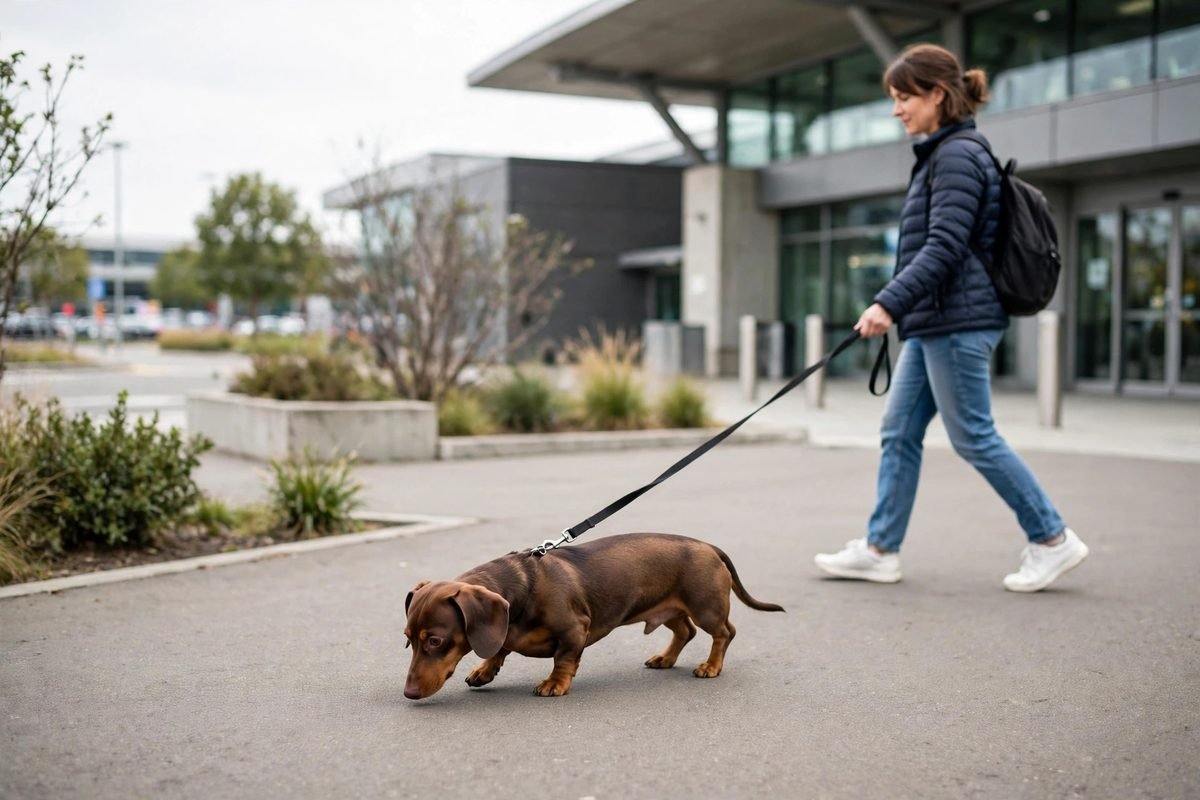
Once outside the terminal, give the dog a short, flat walk on a leash, with time to sniff and stretch. Five to ten minutes on level ground is enough for the first walk after a flight, because the aim is to loosen the back, not to tire it. Offer water, and let the dog move at its own pace. Watch how the dog walks: a level back and an even stride mean the flight went well, while a dipping back, a slow rise, or a reluctance to move means the dog needs a quieter first day. Keep the first day after the flight calm, with short walks, a warm bed, and no stairs or jumping.
Watch the dog closely for the first day after the flight, and note anything unusual. A dog that is stiff for an hour and then moves well is recovering normally from the long stillness. A dog that is still stiff the next morning, yelps when lifted, or refuses to move needs a veterinarian, not another day of rest. Keep the routine calm at home until the dog is moving normally again. The flight is over, but the recovery is part of the trip.
Flight Day Checklist: Before, During, and After
| When | What to Do | What to Watch For |
|---|---|---|
| Before the trip | Carrier practice at home; flat blanket inside; airline size checked | Dog refusing the carrier; back curving inside; carrier sagging |
| At the airport | Level carry with both hands; carrier off cold floors | Swinging carrier; dog trying to climb out; restlessness |
| During the flight | Carrier under the seat, door closed; quiet checks | Dog curled tightly; panting; restlessness |
| After landing | Slow lift; short flat walk outside; water and a warm rest | Dipping back; slow rise; reluctance to move |
| First day after | Short walks only; warm bed; no stairs or jumping | Stiffness lasting past the next morning; yelping |
Common Mistakes
- Using a carrier that is too small, so the back stays curved for the whole flight.
- Carrying the carrier by one handle, so it swings and twists with every step.
- Meeting the carrier for the first time at the airport, with no practice at home.
- Lifting the dog onto a lap during the flight, in a cramped seat with nowhere safe to settle.
- Setting the carrier down hard on counters, floors, or under-seat frames.
- Opening the carrier in a busy terminal and letting the dog climb or jump out.
- Rushing the dog into a long walk straight after landing, before the back has loosened up.
When to Call Your Vet
Contact a veterinarian before booking if the dog has back pain, recent stiffness, weakness in the back legs, or any sign of a back problem, because a flight may not be the right choice for that dog. Contact a veterinarian after the trip if stiffness lasts past the next morning, the dog yelps when lifted, flinches when the back is touched, or refuses to move or eat. Contact a veterinarian urgently if the dog cannot move its back legs, loses bladder control, or is in severe pain. A veterinarian can examine the dog, and the Animal Medical Center guide to intervertebral disc disease in dogs explains the signs that need prompt attention. The Cornell guide to intervertebral disc disease notes that the condition ranges from mild pain to paralysis, which is why early contact matters. The Cornell guide to chondrodystrophy and intervertebral disc disease explains the breed background behind that caution. This article gives general information only and is not a diagnosis.
Pin This: Flying in the Cabin With a Dachshund
- Choose a carrier the dog can stand, turn, and lie flat in.
- Practise at home for two weeks before the flight.
- Carry the carrier level with both hands, never by one handle.
- Keep the dog in the carrier for the whole flight, door closed.
- Walk short and flat after landing, then rest the back.
- Ask a veterinarian before booking if the dog has any back signs.
Frequently Asked Questions
Can a Dachshund fly in the cabin?
Many airlines allow a small dog in a soft carrier under the seat, but the rules, size limits, and fees differ between airlines. Check the airline’s pet policy before booking.
What size carrier does a Dachshund need for a flight?
The carrier must fit under the seat and still let the dog stand, turn around, and lie down flat. Check the airline’s size limits first, then test the carrier at home with the dog inside before the trip.
Should the dog come out of the carrier during the flight?
No, keep the dog in the carrier with the door closed for the whole flight. A lap lift in a cramped seat twists the back, and the carrier is the safest place for the dog while the plane is moving.
How is a Dachshund kept calm on a plane?
Practise at home first, use a familiar blanket, keep the carrier still and close, and offer small drinks and a quiet chew. A dog that has rested calmly in the carrier at home will usually settle on the plane.
When should a vet be asked about flying?
Ask a veterinarian before booking if the dog has back pain, stiffness, or weakness, and again after the trip if stiffness lasts past the next morning or the dog yelps when lifted. Bring notes on how the dog moved before and after the flight.
Conclusion
A flight is a long period of stillness for a Dachshund, but a good carrier, a level carry, and a calm plan make it a safe one. Check the airline’s rules, start carrier practice at home, and ask a veterinarian before booking.