
Questions to Ask Your Vet About Dachshund Back Health
Quick Answer
- Questions to ask your vet about Dachshund back health should cover risk, daily activity, weight, home setup, warning signs, and what to do if a problem appears.
- Take a short written list, a weekly movement note, and details of food, treats, and activity, so the veterinarian can give tailored advice.
- Ask what is normal for your dog, what should prompt an earlier visit, and which home changes matter most, rather than relying on general articles alone.
- After the visit, write down the answers and follow them, because tailored veterinary advice always takes priority over general guidance.
Contents
- 1. Why a Written Question List Helps
- 2. Questions for a Routine Visit When Your Dog Seems Well
- 3. Questions When Stiffness, Pain, or a Change Appears
- 4. Questions About Exercise, Weight, and Home Setup
- 5. After the Visit: Notes, Follow-Up, and When to Call Again
- Visit Question Checklist
- Common Mistakes
- When to Call Your Vet
- Pin This: Vet Visit Checklist
- Frequently Asked Questions
- Conclusion
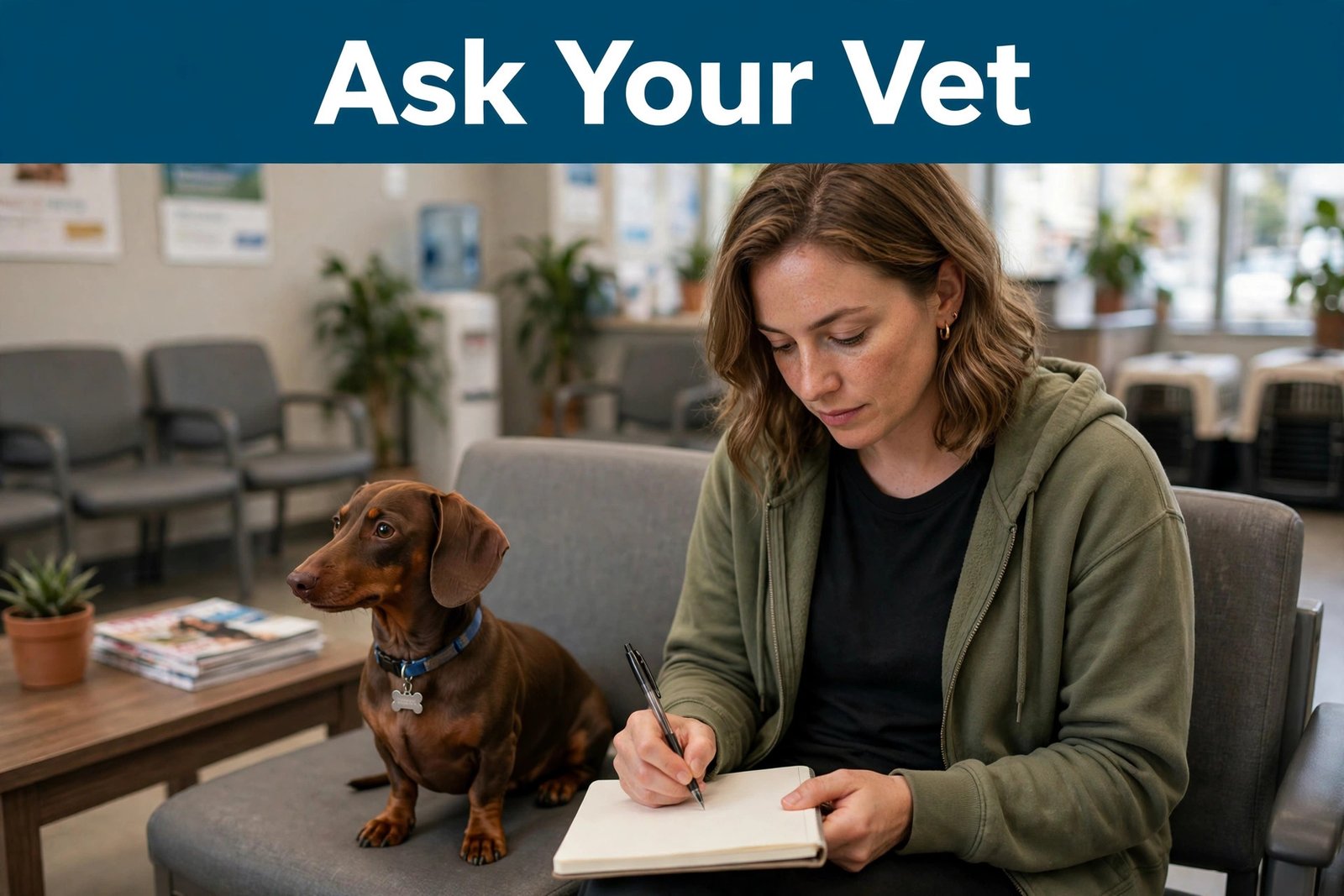
Most owners leave a veterinary visit remembering only half of what was said, and many forget the question they most wanted to ask. That is normal, especially when a dog is nervous, a waiting room is busy, and a visit covers several topics at once. A short written list changes that. It keeps the visit focused, it gives the veterinarian clear information, and it means the owner leaves with answers that fit one dog, not general advice from an article.
This guide gives questions to ask a veterinarian about Dachshund back health, grouped by situation: routine visits, visits after a change, and questions about exercise, weight, and home setup. It does not replace veterinary advice, and it does not diagnose any dog. It helps an owner ask better questions and understand the answers, so the advice received can actually be followed at home.
1. Why a Written Question List Helps
A veterinarian sees many dogs in a day and relies on the owner for the daily picture. An owner who says a dog is “slower” gives less useful information than an owner who says a dog has been slower for three weeks, stiff in the morning, reluctant to jump onto a sofa, but still eating and greeting normally. Details, dates, and patterns help a veterinarian judge whether a change is normal aging, a minor strain, or something that needs examination.
A written list also prevents the most common visit problem: remembering the important question in the car on the way home. Writing questions before the visit, in order of importance, means the most important ones are asked first, even if time runs short. It also helps an owner who feels nervous or rushed, because reading a list is easier than remembering under pressure.
Bring three things to every back-related visit: the question list, a short weekly note of movement, appetite, rest, and any new sign, and a list of current food, treats, and activity. Note any recent events too, such as a fall, a jump from furniture, a long walk, or a change in home layout, because these details often explain a new sign.
It also helps to bring another person if possible, or to take notes during the visit. One person can hold the dog and listen while the other writes, and the written answers can be checked at home afterward. If a visit is by phone or video, the same list and note work just as well, and the owner should still write down the answers.

2. Questions for a Routine Visit When Your Dog Seems Well
Routine visits are the best time to ask about back health, because there is time to discuss prevention without the pressure of a problem. Start with risk: ask whether this dog, at its age, weight, and body shape, faces added back risk, and whether any breed-specific screening or examination is advised. The answer will be tailored, and it may differ from general breed information.
Ask about activity: how much daily walking, play, and exercise fits this dog, and which movements should be avoided or limited. Ask specifically about jumping, stairs, and fast play, because these are the movements owners most often get wrong. Ask whether ramps are advised, where they matter most, and whether any particular room or route in the home needs attention.
Ask about weight: what weight range fits this dog, how to measure portions, and how often to weigh the dog at home. Weight is one of the few back-health factors an owner can directly control, and a clear target makes daily feeding decisions easier. Ask about treats too, including training treats, because small dogs reach a daily limit quickly.
Ask about warning signs: what early signs should prompt an earlier visit, and what should be treated as urgent. A veterinarian can list the signs that matter for this dog, and can explain which changes are worth a phone call and which need an immediate visit. Writing these down gives an owner confidence at home, because the next decision is already planned.
Ask about handling: is the owner lifting the dog correctly, and is there a better way for this dog’s size and temperament? Demonstrating a lift in the visit room, or describing it in detail, often reveals a small correction that makes daily handling safer. For a step-by-step lifting guide, the article on how to lift a Dachshund correctly without hurting its back covers the two-hand method, but a veterinarian’s demonstration for one dog is the best version.
3. Questions When Stiffness, Pain, or a Change Appears
When a change appears, the questions change. Start by describing the change clearly: when it started, whether it is constant or intermittent, what makes it better or worse, and what the weekly note shows. Then ask the key question: does this need an examination now, or can it be watched at home for a short time, and if watched, for how long and with what limits?
Ask what to do at home while waiting: should activity be restricted, should stairs and jumping be stopped completely, should the dog rest in a confined area, and for how long? Ask what signs would mean the plan should change sooner, such as worsening pain, weakness, or loss of bladder control. A clear home plan prevents both under-reaction and over-reaction.
Ask about pain relief: is any pain relief appropriate, what should never be given at home, and what human medicines must be avoided? Never give a dog pain relief without veterinary guidance, because medicines that are safe for people can be harmful for dogs, and a medicine that helps one condition can worsen another. This question alone can prevent a serious mistake.
Ask about examination and next steps: what will the examination involve, are any further tests advised, and what are the possible outcomes? Understanding the process reduces worry and helps an owner prepare, especially if a dog is nervous at the clinic. Ask also about cost and timing in general terms, so there are no surprises.
Ask about recovery and return to normal activity: if rest is advised, how long should it last, how should activity be reintroduced, and what signs would mean recovery is not progressing? A gradual return plan is safer than a sudden return to full activity, and a veterinarian can set the pace.
General background can help an owner understand the conversation. The Animal Medical Center explains intervertebral disc disease in dogs, including signs that need veterinary attention, and Cornell information on chondrodystrophy and intervertebral disc disease describes added disc risk in this breed group. For a fuller list of signs to mention, the guide to 7 early signs of IVDD every Dachshund owner should know is a useful checklist before a visit, not a substitute for one.

4. Questions About Exercise, Weight, and Home Setup
Exercise questions should be specific. Ask how long daily walks should be, whether short frequent walks are better than one long walk, and whether any particular exercise, such as swimming, gentle play, or indoor games, is advised or should be avoided for this dog. Ask about puppies, senior dogs, and heavier dogs separately if relevant, because advice changes with age and weight.
Weight questions should be practical. Ask for a target weight or weight range, a daily portion in grams or cups, and guidance on treats, dental chews, and table scraps. Ask how often to weigh the dog, what scale to use, and what change in weight should prompt a call. A written feeding plan, kept where everyone who feeds the dog can see it, turns veterinary advice into a daily routine.
Home setup questions often reveal simple improvements. Ask whether ramps are needed beside every piece of furniture or only the highest ones, whether a gate at the top of stairs is advised, and whether flooring changes, such as runners or rugs, would help this dog. Ask about beds: should the bed be on the floor, how firm should it be, and does the dog need a different resting spot?
Ask about other pets and household routines too. A second dog that plays roughly, a child who lifts the dog incorrectly, or a daily routine that involves stairs many times a day can all affect back health. A veterinarian can suggest practical changes that fit the household, rather than ideal advice that cannot be followed.
Finally, ask about long-term planning: as this dog ages, what changes should the owner expect, and what should be reviewed at each future visit? A long-term view helps an owner plan home changes gradually, rather than reacting to each new change as a crisis.
5. After the Visit: Notes, Follow-Up, and When to Call Again
After the visit, write down the answers the same day, while they are fresh. Note the advice, any new plan, any medicine or feeding change, and the date of the next visit. Keep these notes with the weekly movement note, so the full history is in one place and can be brought to the next visit.
Follow the plan as written, and note any difficulty following it. If a ramp is not used, a portion is hard to measure, or a rest plan is difficult in a small apartment, tell the veterinarian at the next contact rather than silently dropping the plan. A veterinarian can often suggest a practical alternative, but only if the difficulty is known.
Watch for the signs the veterinarian listed as reasons to call sooner, and call promptly if they appear. Do not wait for the next routine visit when a listed warning sign appears, and do not assume a new sign is the same as a previous one. Each new sign deserves its own judgment, and a phone call is a low-cost way to get it.
Share the plan with everyone in the household. A plan that only one person knows will fail when that person is away, and a dog that is lifted correctly by one person and incorrectly by another gets mixed handling. A short written plan on the fridge, covering lifting, feeding, stairs, and warning signs, keeps the whole household consistent.
Over time, the question list itself becomes a record of care. Looking back at earlier lists shows how the dog has changed, what advice has worked, and what questions remain. That record is valuable for the owner, for the veterinarian, and most of all for the dog, whose daily comfort depends on the quality of the questions asked on its behalf.

Visit Question Checklist
| Topic | Ask | Write down |
|---|---|---|
| Risk | Does this dog face added back risk? | Age, weight, body shape notes |
| Activity | How much, what type, what to avoid? | Walk length, play limits |
| Weight | Target range and daily portion? | Portion, treats, weigh frequency |
| Warning signs | What needs an earlier visit? | Urgent vs watch-and-wait signs |
| Handling | Am I lifting correctly? | Demonstrated method |
| Home | Ramps, gates, flooring, bed? | Changes to make, in order |
Common Mistakes
- Going to a visit without a written list and forgetting the main question.
- Describing a change vaguely instead of with dates and patterns.
- Giving pain relief at home without veterinary guidance.
- Testing a dog with jumps or stairs before a visit to see what happens.
- Following general article advice instead of tailored veterinary advice.
- Not writing down answers, so the plan is forgotten within days.
When to Call Your Vet
Contact a veterinarian promptly if the dog shows pain, yelping when lifted or touched, a hunched back, wobbliness, weakness in the legs, dragging paws, loss of bladder or bowel control, sudden reluctance to move, or any sudden change in movement, appetite, or toileting. This article gives general information only and is not a diagnosis. A veterinarian can examine the dog, ask about recent changes, and advise on examination or care. Do not attempt home treatment for suspected back pain, and avoid stairs, jumping, and active play until veterinary advice has been received if signs are present. A second reason to call a veterinarian is uncertainty itself: if an owner is unsure whether a change is normal aging or a back problem, a phone call is the right next step, and a veterinarian would rather hear early than late.
Pin This: Vet Visit Checklist
- Write questions in order of importance before the visit.
- Bring a weekly note of movement, appetite, and rest.
- List current food, treats, and daily activity.
- Ask about risk, activity, weight, warning signs, and handling.
- Write down answers the same day and share them at home.
- Call sooner if a listed warning sign appears.
- Never give pain relief without veterinary guidance.
Frequently Asked Questions
What if I forget to ask something at the visit?
Call the clinic afterward with the question. Most clinics welcome a follow-up call, and a written question is easier to answer than a vague worry.
Should I bring my dog’s weekly note to every visit?
Yes. A short note of movement, appetite, rest, and new signs gives a veterinarian patterns over weeks, which are more useful than a single-day impression.
Can I ask about cost and timing?
Yes, asking about general cost and timing helps an owner prepare and avoids surprises. A veterinarian or clinic staff can explain the process in general terms.
What if different sources give different advice?
Follow the veterinarian who has examined the dog. General articles, including this one, cannot replace tailored advice for an individual dog.
How do I prepare a nervous dog for a visit?
Keep the visit calm, bring a familiar blanket, use the carrier or harness routine the dog knows, and ask the clinic about low-stress handling if the dog is very nervous.
Conclusion
Questions to ask your vet about Dachshund back health are simple to prepare and powerful to use. Write your list before the next visit, bring your weekly note, and leave with answers that fit your dog.





4 Comments