Dachshund Barking at Mealtimes and Begging at the Table
Quick Answer
- Mealtime barking is usually begging: the dog has learned that barking at the table brings food, attention, or a tasty scrap.
- Feed the dog before the family meal, give it a calm spot away from the table, and keep a chew or food puzzle ready for mealtimes.
- Everyone at the table must follow the same rule: no food from the table, no attention for barking, and a reward for quiet settling.
- Contact a veterinarian if the dog refuses its own food, loses weight, vomits, or shows signs of pain or distress around meals.
Contents
- 1. Why Dachshunds Bark and Beg at Mealtimes
- 2. Setting Up a Calm Mealtime Spot
- 3. Teaching the Mealtime Routine Step by Step
- 4. Handling Guests, Children, and Special Meals
- 5. Keeping the Routine Going Every Day
- Mealtime Barking Comparison Checklist
- Common Mistakes
- When to Call Your Vet
- Pin This: Mealtime Barking Checklist
- Frequently Asked Questions
- Conclusion
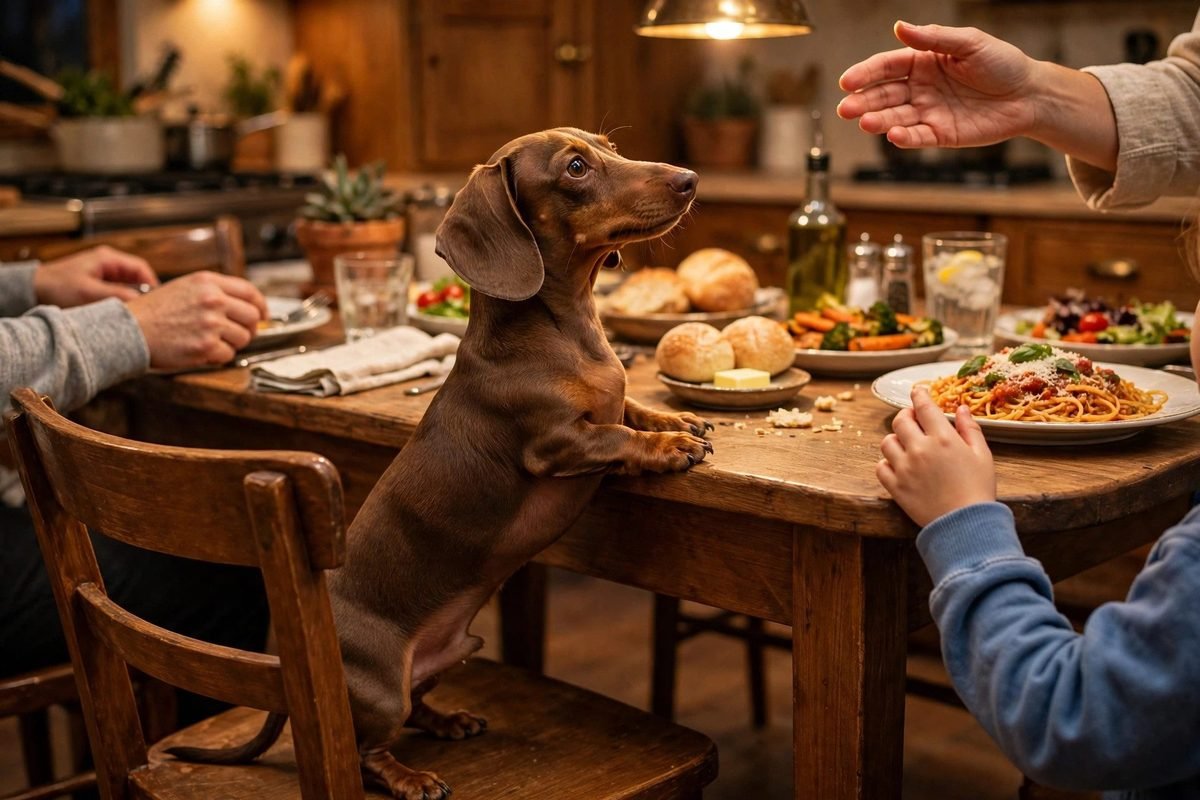
Most families know the scene: plates are served, the food smells fill the kitchen, and the Dachshund is suddenly under the table, barking, pawing at a leg, and staring at every forkful. It is hard to ignore, and it is even harder when guests are there, because the barking feels rude and the dog looks hungry. In most cases the dog is not hungry at all. It has simply learned that barking at mealtimes works, because someone, at some point, gave in and shared a scrap to buy a moment of quiet. This article is about that exact routine, mealtime begging at the table, not about general demand barking, and it gives a plan that fits a normal family meal. It is general information only, not a diagnosis, and a dog that refuses its own food or loses weight needs a veterinarian, not a new rule.
1. Why Dachshunds Bark and Beg at Mealtimes
Dachshunds are food-loving dogs, and they are also clever about patterns. A dog that barks once at the table and gets a piece of chicken learns a simple lesson: barking brings food. The next time, it barks louder and longer, because the first bark worked and a bigger bark might work faster. If different people react differently, the lesson gets stronger, because the dog learns to try each person in turn until someone gives in. A guest who feels sorry for the dog, a child who drops food by accident, or an owner who shares a scrap to stop the noise can all keep the habit alive, even if everyone else follows the rules.
Mealtimes are also exciting in ways that have nothing to do with hunger. The kitchen fills with smells, plates clatter, chairs move, and everyone is sitting in one place, which is the perfect audience for a small dog. A dog that has been resting all afternoon may have energy to use, and the table is the most interesting thing in the room. A dog that is fed at a different time from the family may also be confused, because it can smell food but has no food of its own, and barking is its way of joining in. None of this means the dog is greedy or badly behaved. It means the dog has learned a routine that works, and the routine can be replaced.
2. Setting Up a Calm Mealtime Spot
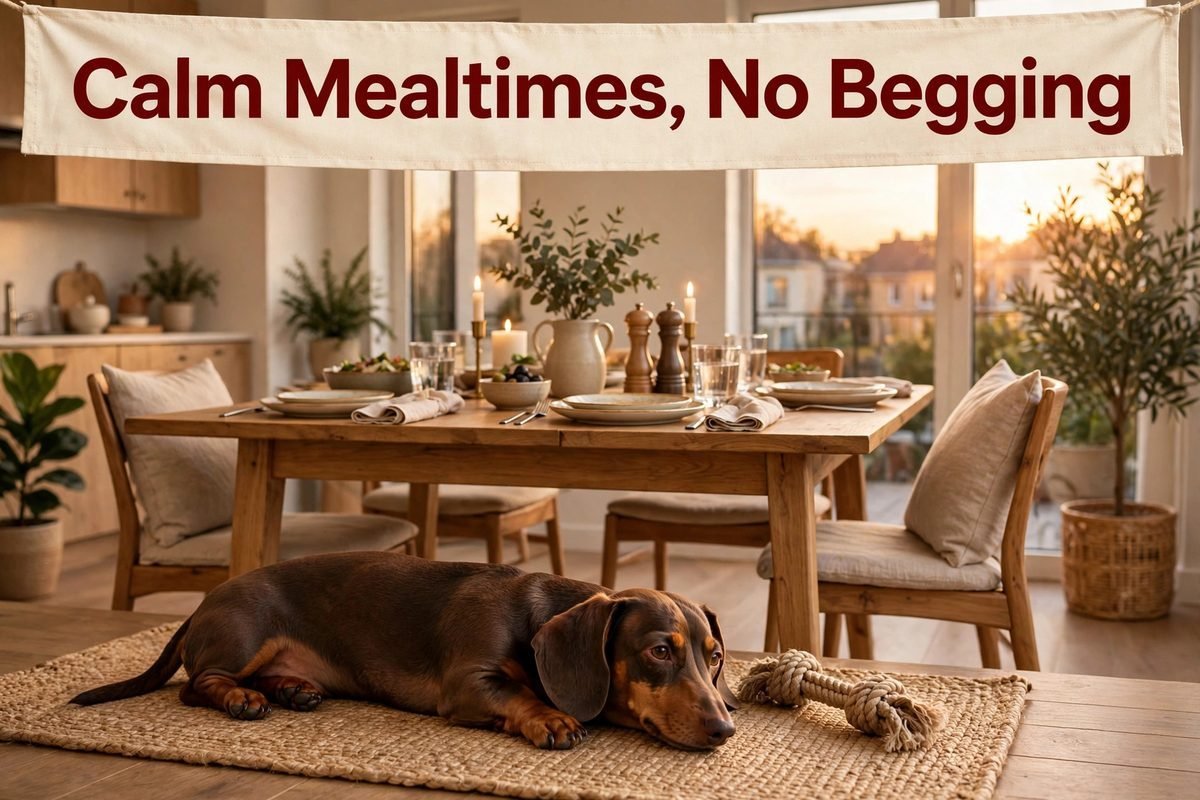
Choose a spot a few steps from the table, where the dog can see the family but cannot reach the plates. A mat or a small bed in a corner of the kitchen or dining area works well, as long as it stays in the same place for every meal. The spot should be far enough from the table that the dog cannot paw at legs or sniff plates, but close enough that the dog does not feel shut out of the family meal. Keep the spot clear of clutter, and put a familiar blanket on it, so the dog links the place with rest.
Feed the dog before the family sits down to eat, so the dog is not hungry while the family eats. A dog that has just had its own meal, a short toilet break, and a few minutes to settle is far less likely to bark at the table than a dog that is still waiting for food. Serve the dog’s meal in its usual bowl, in its usual place, and keep the amount the same as always, because a sudden change in food can upset the stomach. After the dog has eaten, guide it to the mealtime spot with a chew or a food puzzle, so the dog has something to do while the family eats.
Keep the tools for the routine ready before cooking starts. A long-lasting chew, a food puzzle filled with a small part of the dog’s daily food, or a lick mat can keep the dog busy for most of a meal, and they are far better than a bone or a treat that is gone in seconds. Avoid giving the dog anything from the table, even a plain piece of food, because the dog cannot tell the difference between a plain scrap and a seasoned one, and the habit is the same either way. A chew that lasts the whole meal is the goal, so choose one that suits the dog’s size and chewing style.
3. Teaching the Mealtime Routine Step by Step
Start at a quiet meal, not at a big family dinner. At breakfast or a light lunch, guide the dog to its spot, ask it to settle, and give it the chew or the puzzle. Sit down to eat, and reward the dog with a quiet word or a small treat placed on the mat whenever it stays quiet for a minute. If the dog leaves the mat and barks, guide it back calmly without scolding, and make the next meal easier by using a better chew or a spot further from the table. Short, calm meals teach more than one long dinner where the dog gets tired and frustrated.
Ignore barking at the table, and reward quiet settling instead. That means no eye contact, no talking to the dog, and no food while it is barking, even if the barking is loud and the meal is being spoiled. The moment the dog is quiet, even for a few seconds, reward it calmly on the mat. The guide to calm behaviour for demand barking for attention and toys uses the same idea for a different kind of asking, and the same rule works here, because the dog is learning that quiet, not barking, brings attention. Everyone at the table must follow the same rule, or the dog will keep trying the person who gives in.
Build the routine slowly over a week or two. Start with short meals, then move to longer ones, and add a second meal a day once the dog settles well at the first. If the dog settles for ten minutes, that is a success, even if it barks at the end of a long dinner, and the next step is to make the chew last a little longer, not to expect a full hour of silence straight away. The guide to a calm mealtime routine for a picky Dachshund covers the same steady pattern of feeding at set times and in a set place, and the same order helps here, because the dog learns that meals have a shape it can trust. A routine that grows slowly is a routine that lasts.

4. Handling Guests, Children, and Special Meals
Guests and special meals are the hardest test, because the food is more exciting, the table is fuller, and the rules are easier to forget. Tell guests before they sit down that the dog has a spot, that it should not be fed from the table, and that ignoring barking is the kindest help they can give. Most guests are glad to know, because they do not want to be the reason the dog barks. Seat the dog’s mat where guests cannot easily reach it, and give the dog its best chew for a guest meal, so the dog has a good reason to stay on the mat.
Special meals, such as a holiday dinner or a takeaway night, need the same routine, not a day off. Feed the dog first, set up the mat with a long-lasting chew, and keep the meal as calm as possible. If the meal will be long, plan a short break for the dog halfway through, such as a toilet break in the garden or a few minutes on the mat with a fresh chew. A dog that is given a break will settle better afterwards than a dog that is expected to lie still for two hours. If the evening is too busy for the routine, it is better to feed the dog and settle it in another room with a chew than to let it practise barking at a crowded table.
5. Keeping the Routine Going Every Day
Once the routine works, protect it by keeping mealtimes predictable. Feed the dog at the same times each day, keep the mat in the same place, and keep the same chew box ready before cooking. Avoid feeding the dog from the table even once, because a single scrap can undo a week of quiet meals, and the dog will bark every day in the hope that today is the day. A routine that is followed every day, by everyone, is a routine the dog can trust, and a dog that trusts the routine stops testing it.
Watch the dog’s weight and appetite as the routine settles in. Treats for quiet settling, chews, and food puzzles all add up, so take the treats from the dog’s daily food where possible, and keep the total amount the same. A dog that gains weight because of mealtime treats is not healthier, and a long-backed breed needs to stay lean. If the dog starts to refuse its own bowl food but barks for table food, go back to set mealtimes, remove food after fifteen minutes, and contact a veterinarian if the refusal lasts more than a day or the dog loses weight.
Mealtime Barking Comparison Checklist
| Approach | Best for | Limit to watch |
|---|---|---|
| Feed the dog before the family meal | Everyday meals | Keep the amount the same |
| Calm spot with a chew or puzzle | Most meals, small flats | Choose a chew that lasts the meal |
| Ignore barking, reward quiet settling | Dogs that bark for attention | Everyone must follow the same rule |
| Settle the dog in another room | Long guest meals | Only for busy evenings, not every day |
Common Mistakes
- Giving a scrap from the table to stop the barking.
- Feeding the dog after the family, so it waits by the table.
- Different people following different rules at the table.
- Scolding the dog while it is barking at the table.
- Using a chew that is gone in seconds.
- Letting guests or children feed the dog from the table.
- Expecting a full hour of silence on the first day.
When to Call Your Vet
Contact a veterinarian if the dog refuses its own food, loses weight, vomits, has diarrhoea, or shows signs of pain around mealtimes, and seek urgent help if the dog collapses, cannot breathe normally, or shows sudden weakness. Contact a veterinarian also if the dog eats something from the table that could be harmful, chokes, or becomes distressed after a meal. This article gives general information only and does not diagnose any condition. A veterinarian can check for pain, dental problems, or digestive issues, and advise whether a calmer routine, a feeding plan, or a health check is the right next step for that individual dog. Do not delay veterinary help for a dog that is clearly distressed or in pain.
Pin This: Mealtime Barking Checklist
- Feed the dog before the family sits down.
- Set up a calm spot a few steps from the table.
- Give the dog a chew or puzzle for the meal.
- No food from the table, from anyone, ever.
- Ignore barking, reward quiet settling on the mat.
- Tell guests and children the rule before the meal.
- Keep mealtimes at the same times every day.
Frequently Asked Questions
Why does my dog bark at mealtimes even when it is not hungry?
The dog has learned that barking at the table brings food or attention, and mealtimes are full of smells, sounds, and people sitting in one place. Feeding the dog first and giving it a chew on a mat gives it a better job than barking.
Should I feed my dog at the table?
No, because feeding at the table teaches the dog to wait there and bark for more. Feed the dog in its usual place, before the family meal, and keep table food off the dog’s menu entirely.
Can children help with the mealtime routine?
Yes, if the rule is simple: no food from the table, and treats go in the dog’s bowl after the meal. Giving a child the job of putting the chew on the mat before the meal helps the child feel part of the routine.
What if my dog barks only when guests come for dinner?
Guest meals are more exciting, with new smells and new people, so use the dog’s best chew, seat the mat out of easy reach, and tell guests the rule before they sit down. If the meal is very long, plan a short break for the dog halfway through.
How long does it take for mealtime barking to stop?
Many dogs show small improvements in one to two weeks of daily practice, such as settling for ten minutes instead of barking straight away. Full calm at most meals can take several weeks, and one scrap from the table can set the routine back.
Conclusion
Mealtime barking is a learned routine, and a calmer routine can replace it: feed the dog first, give it a spot away from the table with a chew that lasts the meal, and let everyone at the table follow the same rule. Quiet settling, rewarded every day, turns dinner into a calm part of the day for the whole family.