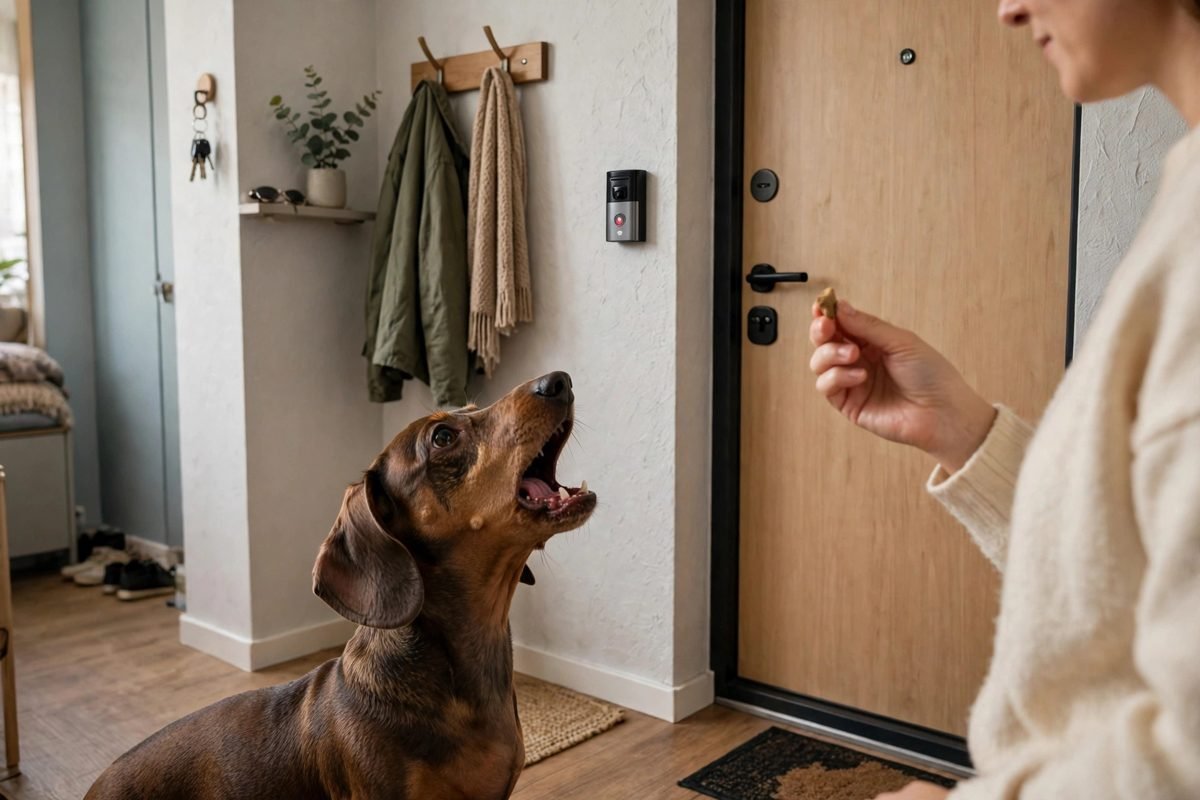
Dachshund Barking at the Doorbell? Try This Quiet Routine
If you live with a Dachshund in an apartment, you probably know the sound well: the doorbell rings, and within a second your mini Dachshund is barking, racing to the door, and hard to calm down. It can feel embarrassing with neighbours, stressful for visitors, and exhausting for you. The good news is that doorbell barking is very common in Dachshunds, and it can usually be improved with a short, calm routine practised little and often. You do not need to shout, punish, or expect silence overnight. You need a clear plan that teaches your dog what to do instead of barking.
Why doorbell barking happens
Dachshunds were bred to alert and to work close to their people, so many are naturally watchful and quick to sound the alarm. A doorbell is a strong trigger because it predicts something exciting: a visitor, a delivery, or a stranger at the door. For an apartment Dachshund, sounds from the hallway can also be harder to ignore, especially in a small space with thin walls. Your dog is not being naughty on purpose. Barking is communication, and often it is driven by excitement, alerting, uncertainty, or a habit that has been rewarded without anyone realising it. If barking always leads to the door opening and a new person appearing, the behaviour is reinforced. That is why the most helpful training does not just try to stop barking. It builds a new habit: hear the sound, stay calm, go to a spot, and wait for a reward.
Step-by-step quiet routine (distance, treat, doorbell sound practice, calm greeting)
Start training when there is no real visitor. Keep sessions short, about five minutes, and work at a distance where your Dachshund can still think and take treats. First, choose a calm place away from the door, such as a mat or bed in the living room. Reward your dog for settling there, so the place itself becomes a good thing. Next, practise with a very quiet doorbell sound on your phone, played from another room or at low volume. The moment your dog hears it but stays quiet, mark the calm moment with a soft word like yes and give a small treat. Repeat only a few times, then stop while your dog is still successful. Over days, slowly increase the volume, move a little closer to the door, and add small steps such as standing up, walking toward the door, or touching the handle. If barking starts, you have moved too fast. Go back to an easier step, wait for calm, and reward that. The goal is a simple chain: sound, calm, place, treat, and then a calm greeting.
What to do when visitors arrive
Real visitors are the hardest test, so plan ahead. Before the doorbell rings, send your Dachshund to its place and have treats ready. Open the door only a little at first, and only when your dog is relatively calm. Ask visitors to ignore barking and excitement at first, avoid direct eye contact, and wait until your dog has four paws on the floor before saying hello calmly. A short leash indoors can help you guide your dog gently to its place without chasing or grabbing. If your dog becomes too excited, calmly close the door partway, reset, and try again. Keep early greetings brief. A calm two-minute hello is a better success than a long, chaotic welcome. In an apartment, also warn neighbours when you are practising, and choose times that are not during quiet hours. Short, well-planned practice is kinder to everyone than repeated real-life chaos.
Mistakes to avoid (shouting, punishment)
Shouting over barking often makes things worse because your dog may think you are joining in, and the extra noise adds excitement. Punishment, including scolding, spraying, or using harsh tools, can increase fear and anxiety, and may damage trust without teaching a calmer alternative. It can also be unsafe for a Dachshund with a long back if the dog lunges or jumps in panic. Avoid repeating the doorbell many times in one session until your dog is overwhelmed, and avoid rewarding barking by opening the door while your dog is at its loudest. Instead, wait for a pause, even a short one, and reward calm. Be consistent across the household, so everyone uses the same place, the same calm word, and the same greeting rules. If barking is sudden, severe, or paired with signs such as trembling, hiding, or distress that does not improve, talk to your veterinarian or a qualified behaviour professional for personalised advice. With patience, clear steps, and daily five-minute practice, many apartment Dachshunds learn that the doorbell means go to your place and good things happen quietly.