Dachshund Barking at Sirens: Calm Plan for Apartments
Quick Answer
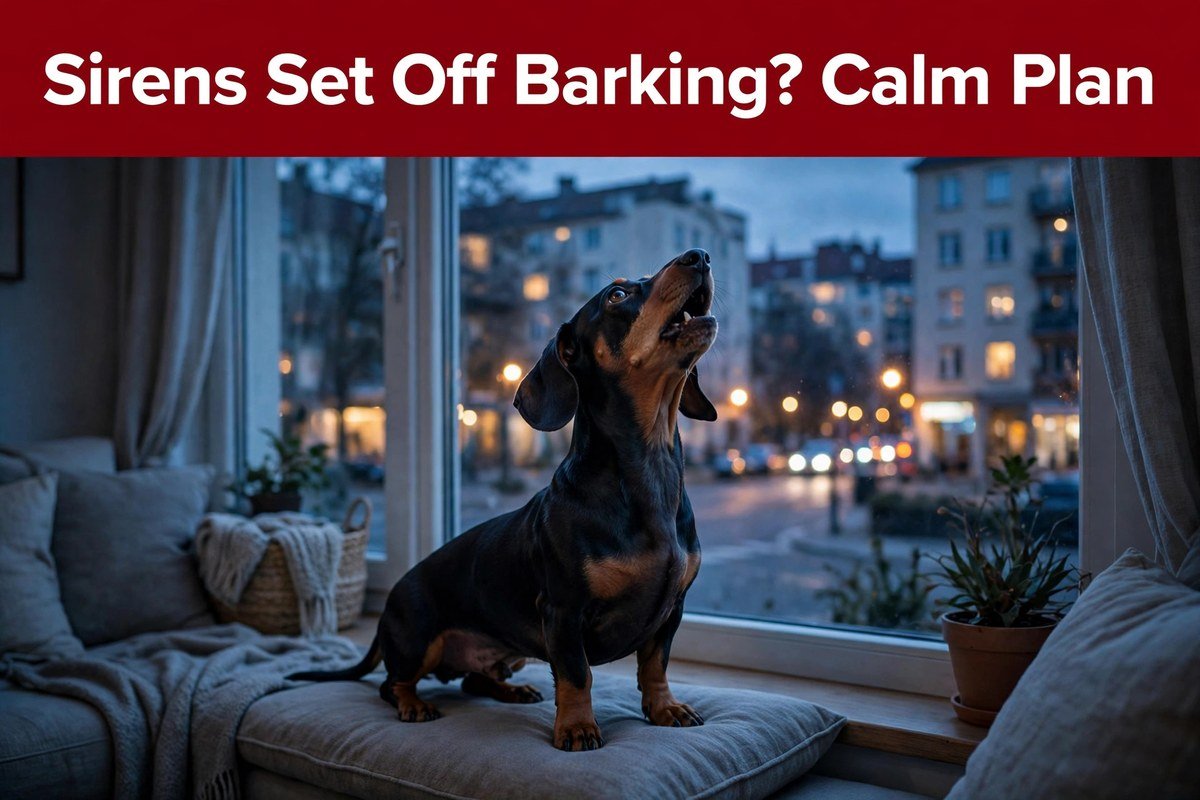
- A Dachshund often barks or howls at sirens because the rising and falling sound is close to the pitch of a dog’s howl, and the dog answers it as if another dog were calling, especially when the siren is loud or passes close to the flat.
- Stay calm during a siren: keep your voice low, move slowly, and guide the dog to its safe spot with a chew, because a dog that sees its owner panic will bark more.
- Play recordings of sirens at a very low volume while the dog rests on its mat, reward quiet behavior, and raise the volume only a little at a time over days and weeks.
- Give the dog a safe spot it can reach on its own, with its bed, water, and a long-lasting chew, and keep the curtains half closed so the flashing lights are less bright.
- Contact a veterinarian if the dog stops eating, hides for hours, or shows signs of pain or distress.
Contents
- 1. Why Sirens Trigger Barking and Howling
- 2. Stay Calm During a Siren: What to Do in the Moment
- 3. Desensitization: Siren Sounds at a Low Volume
- 4. A Safe Spot for Loud Sirens at Night
- 5. Walks and Sirens Outside the Flat
- Siren Barking Checklist
- Common Mistakes
- When to Call Your Vet
- Pin This: Sirens and Emergency Vehicles Checklist
- Frequently Asked Questions
- Conclusion
Sirens are one of the loudest and most sudden sounds in a city, and they are one of the hardest for a Dachshund to ignore. An ambulance, a fire truck, or a police car can pass the flat without warning, the sound rises and falls for a minute, and then it is gone, leaving a dog that is barking at the window and an owner who does not know what to do. The barking that follows is not bad behavior, and it is not a sign that the dog is afraid of ambulances. It is a dog answering a sound that is close to its own voice, and the plan in this article teaches the dog a calmer answer. This article covers sirens and emergency vehicles, which is different from fireworks or thunder, because sirens are short, frequent, and close to the pitch of a howl. It is general information only, not a diagnosis.
1. Why Sirens Trigger Barking and Howling
Sirens are also loud and sudden, and a dog that is resting quietly will startle when one begins. A siren that starts close to the flat, or that passes right under the window, can be loud enough to make a dog jump, and a dog that has been startled will bark at the sound until it feels safe again. The flashing lights add to the effect, because a dog that sees red and blue lights flashing through the curtains will bark at the lights as well as the sound. A dog that lives on a busy road, near a hospital, or near a fire station will hear sirens many times a day, and the barking can become a habit, because the dog practices it every time a siren passes. The guide to calm behavior with fireworks and loud noises covers the same idea of a sudden loud sound, and the same care helps here, because the first step is always to stay calm and give the dog a safe place to go.

2. Stay Calm During a Siren: What to Do in the Moment
When a siren starts, the most important thing is the owner’s own behavior. Keep your voice low, move slowly, and do not rush to the window or shout at the dog. A dog that sees its owner jump up and shout will bark more, because the owner is telling the dog that something is wrong. A dog that sees its owner stay calm, speak in a low voice, and walk slowly to the dog’s bed will learn that a siren is not an emergency for the household, and it will settle faster.
Guide the dog to its safe spot with a calm word and a small treat, and give it a long-lasting chew. The safe spot should be a place the dog already likes, away from the window, with its bed and water nearby, and the chew will give the dog something to do with its mouth other than barking. Do not pick the dog up to carry it away from the window, because a stressed dog that is carried through a room can be dropped, and a long-backed breed that is lifted while it is tense can hurt its back. Walk the dog to its spot on a lead if needed, and let it settle there on its own.
3. Desensitization: Siren Sounds at a Low Volume
Desensitization is a slow training plan that makes the siren sound ordinary, and it works because the dog hears the sound at a volume it can cope with, and learns that nothing bad happens. Find a recording of a siren online, and play it at a very low volume while the dog rests on its mat. Keep the volume so low that the dog notices the sound but does not bark, and reward the dog with a small treat every time it is quiet. Keep the session short, under five minutes, and end it while the dog is still calm.
Play the recording at different times of day, and in different rooms, so the dog learns that the sound is ordinary wherever it hears it. Start in the living room, where the dog is most relaxed, and move to the bedroom later, where the dog is more watchful. Keep the sessions short and regular, once a day, and do not play the recording for a long time, because a long session will tire the dog and make it bark. The guide to calm behavior during thunder and storms uses the same idea of a slow, low-volume plan, and the same care helps here, because the goal is a dog that hears a siren and settles, not a dog that is forced to cope with the full sound at once.

4. A Safe Spot for Loud Sirens at Night
Night sirens are the hardest, because the flat is quiet, the dog is half asleep, and the siren wakes it suddenly. Set up the dog’s safe spot before the first night siren, not after the barking starts. Choose a quiet corner away from the window, and put the dog’s bed or mat there with a familiar blanket, fresh water, and a long-lasting chew. Keep the curtains half closed, so the flashing lights are less bright, and keep a fan or a white noise machine on at a low, steady volume through the night, so the siren does not arrive out of silence.
Keep the dog’s sleep routine the same every night, even after a bad night with sirens. A tired dog barks more, so a good walk in the evening, a calm hour before bed, and a regular bedtime will help the dog sleep through the night. Disc degeneration in short-legged breeds can begin in the first year of life, so lift the dog carefully and use a ramp or steps for the sofa and the bed, because a stressed dog that jumps on and off the bed to reach the window is at risk of a back injury as well as a barking habit.
5. Walks and Sirens Outside the Flat
Sirens on a walk need a different plan, because the dog is outside, on a lead, and the siren may pass close by on the road. Keep the dog on a short lead, and when a siren starts, stop walking, step to the side of the pavement, and let the dog stand still. Keep the lead loose, speak in a low voice, and reward the dog with a small treat every time it is quiet. Do not pull the dog along while it is barking, and do not pick it up, because a dog that is pulled while it is excited will bark more, and a dog that is lifted on a busy street can be dropped.
If the siren is very loud or the emergency vehicle is close, step into a doorway or behind a wall, so the sound is less direct, and wait until the vehicle has passed. A dog that has a wall between it and the road will hear the siren as a duller sound, and it will settle faster. Once the siren has faded, give the dog a small treat, and walk on at a slow pace. A dog that learns that a siren on a walk means a treat and a calm pause will bark less each time, and a dog that is rushed through the noise will only learn to fear it.

Siren Barking Checklist
| When | What to Do | What to Watch For |
|---|---|---|
| Siren starts | Stay calm; low voice; guide the dog to its safe spot with a chew | Dog settles within a minute |
| At home, daily | Play siren recordings at a very low volume; reward quiet; raise slowly | Barking at the recording |
| At night | Curtains half closed; fan or white noise on; safe spot ready | Dog waking and barking at night |
| On a walk | Short lead; step aside; wait for the vehicle to pass; reward quiet | Pulling or barking at the road |
| After a siren | Reward quiet; keep the routine the same; note what worked | Barking that carries on after the sound ends |
Common Mistakes
- Shouting at the dog every time it barks at a siren.
- Running to the window and looking out, which tells the dog something is wrong.
- Playing siren recordings at full volume on the first day.
- Picking the dog up while it is barking to carry it away from the window.
- Turning the television up loud to drown out the siren.
- Pulling the dog along on a walk while it is barking at a passing ambulance.
- Expecting the dog to stop barking at sirens in a week, and giving up when it does not.
- Leaving the dog to bark at the window alone at night, with no safe spot and no chew.
When to Call Your Vet
Contact a veterinarian if the dog stops eating, hides for hours, trembles, vomits, has diarrhea, or shows signs of pain after the barking starts, and seek urgent help if the dog collapses, cannot breathe normally, or shows sudden weakness in the back legs. Contact a veterinarian also if the barking is joined by pacing, panting, or a loss of interest in walks and play that lasts more than a few days, because stress can hide pain, and a long-backed breed can hurt its back while jumping or rushing to the window. This article gives general information only and does not diagnose any condition. A veterinarian can check for pain, anxiety, or a health problem, and advise whether a calmer routine, a training plan, or a health check is the right next step. The Animal Medical Center guide to intervertebral disc disease in dogs explains the back signs that need prompt attention, and the Cornell guide to intervertebral disc disease in dogs explains the breed background that makes back care important. Do not delay veterinary help for a dog that is clearly distressed or in pain.
Pin This: Sirens and Emergency Vehicles Checklist
- Stay calm when a siren starts; low voice, slow movements.
- Guide the dog to its safe spot with a chew, away from the window.
- Curtains half closed; fan or calm music on at a low volume.
- Play siren recordings at a very low volume; reward quiet; raise slowly.
- On a walk: short lead, step aside, wait for the vehicle to pass.
- Keep the sleep routine the same, even after a bad night.
- Ask a trainer for help if the barking does not fade in a few weeks.
Frequently Asked Questions
Why does my Dachshund howl at sirens?
A siren rises and falls in pitch, and that sound is close to the sound a dog makes when it howls. Many dogs answer a siren with a howl because they hear it as another dog calling, and a Dachshund that howls will often bark as well. The dog is not in pain, and it is not warning the household about danger.
Will my Dachshund ever stop barking at sirens?
Many dogs bark less with a slow plan, such as low-volume recordings, a safe spot, and rewards for quiet behavior. Some dogs will always answer a very loud siren that passes close by, but the barking can become shorter and quieter, and the dog can learn to settle on its bed instead of barking at the window.
Is it safe to play siren sounds for training?
Yes, if the volume is very low and the sessions are short. Play the recording at a volume so low that the dog notices the sound but does not bark, reward quiet behavior, and raise the volume only a little at a time over days and weeks. Stop if the dog barks, hides, or trembles, and go back to a lower volume.
What should I do if a siren passes while we are on a walk?
Stop walking, step to the side of the pavement, keep the lead loose, and wait for the vehicle to pass. Reward the dog with a small treat every time it is quiet, and walk on at a slow pace once the sound has faded. Do not pull the dog along while it is barking, and do not pick it up on a busy street.
What if my Dachshund barks at sirens all night?
Keep the curtains half closed, a fan or white noise machine on at a low volume, and the dog’s safe spot ready with a chew. Guide the dog to its spot with a calm word when a siren wakes it, and keep the room dim and quiet. If the dog hides, trembles, or stops eating, contact a veterinarian.
Conclusion
Sirens are loud, sudden, and close to a dog’s own voice, so it is no surprise that a Dachshund answers them. A calm owner, a safe spot away from the window, curtains half closed, a low steady sound, and a slow plan with low-volume recordings will turn a siren from a reason to bark into a sound the dog can hear and settle through. This article is general information only, not a diagnosis, and a dog that stops eating or shows signs of pain needs a veterinarian. Keep the routine steady, and the sirens will get quieter for the dog week by week, even when the road outside stays just as busy.