
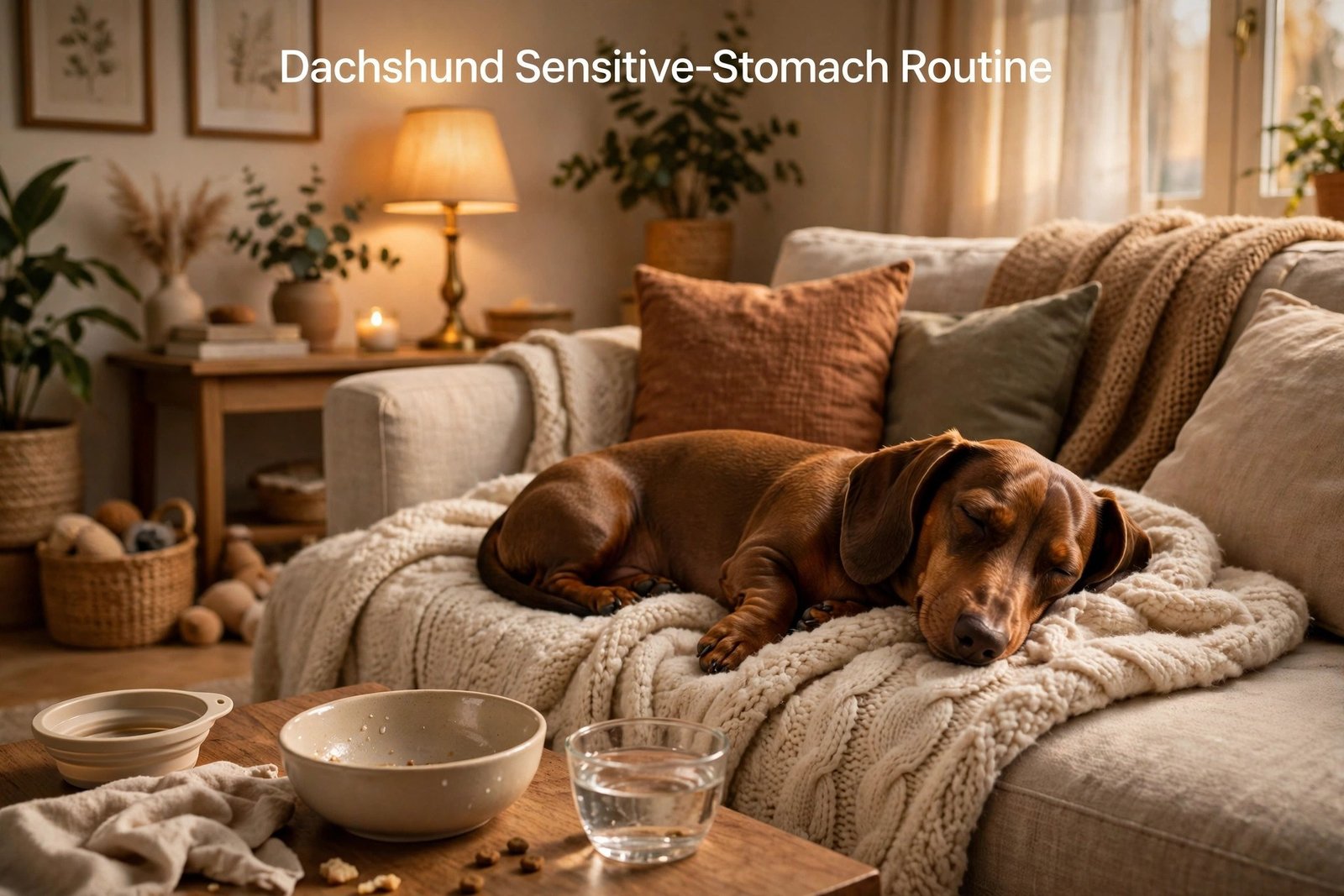
Dachshund Digestion and Sensitive-Stomach Routine Guide
Quick Answer
- A sensitive-stomach routine for a Dachshund is built on consistency: the same food, measured portions, regular meal times, and a calm place to eat.
- Change only one thing at a time, whether food, treats, or schedule, so a digestive change can be traced to its cause.
- Watch stool, appetite, energy, and comfort, and note patterns over days rather than reacting to a single soft stool.
- Contact a veterinarian promptly for vomiting, diarrhoea, or food refusal lasting more than a day, blood in stool, lethargy, or signs of pain.
Contents
- 1. What a Sensitive Stomach Looks Like in a Dachshund
- 2. Steady Feeding Habits That Support Digestion
- 3. Treats, Table Food, and Everyday Extras
- 4. Stress, Exercise, and the Daily Digestive Rhythm
- 5. Tracking Patterns and Knowing When to Seek Help
- Digestion Routine Comparison Checklist
- Common Mistakes
- When to Call Your Vet
- Pin This: Sensitive-Stomach Checklist
- Frequently Asked Questions
- Conclusion
Some Dachshunds digest food without fuss, while others seem to react to every small change: a new treat, a different meal time, a busy day, or a rich extra from the table. Owners often call this a sensitive stomach. In practice, it usually means the dog’s digestive system is less forgiving of inconsistency, and the routine around meals matters as much as the food itself. A steady routine does not cure a digestive problem, but it removes the everyday ups and downs that make a sensitive stomach worse.
This guide covers a practical daily routine for digestion: steady feeding habits, careful treat management, the role of stress and exercise, and how to track patterns so a veterinarian gets useful information. It does not diagnose a digestive condition, and it does not recommend a specific food, supplement, or home remedy, because those decisions depend on the individual dog and veterinary examination. The goal is a calmer digestive life at home, built on consistency and observation.
1. What a Sensitive Stomach Looks Like in a Dachshund
A sensitive stomach usually shows up as a pattern rather than a single event. The dog may have soft stool after a change in food or treats, occasional gas, stomach gurgling after meals, or periods of reduced appetite. Some dogs eat eagerly one day and pick at food the next, without an obvious reason. Others have normal stool most of the time, with occasional soft days that seem to follow busy or stressful events.
It helps to distinguish a pattern from an isolated incident. A single soft stool after a stolen extra or a stressful day is not the same as repeated digestive upset over weeks. A pattern suggests that something in the routine, the food, or the dog’s health needs attention, and that attention should start with a veterinarian, not with repeated home experiments. A single incident usually settles when the routine returns to normal.
Digestive comfort also affects the wider daily routine. A dog with an unsettled stomach may be reluctant to walk, may need to go outside more urgently, or may be restless at night. For a long-backed breed, that reluctance to move matters, because regular, gentle movement supports weight control and back health. A routine that keeps digestion steady therefore supports the dog’s whole daily life, not just its meals.
Weight and back health connect here too. Digestive upset can lead to inconsistent eating, which makes portion control harder, and weight changes in either direction can affect a long back. General background on the breed helps explain why steady weight matters: the Animal Medical Center explains intervertebral disc disease in dogs, and Cornell information on chondrodystrophy and intervertebral disc disease describes added disc risk in this breed group. Those sources are background on the breed, not guidance on digestion.

2. Steady Feeding Habits That Support Digestion
The foundation of a sensitive-stomach routine is consistency. Feed the same food, in measured portions, at the same times each day, in the same place, from the same bowl. That sounds simple, and it is, but it is also the habit most often broken in a busy apartment: a meal skipped, a portion guessed, a different bowl, or a meal served an hour late. Each small inconsistency is a small digestive variable, and variables add up for a sensitive dog.
Measure portions with a scoop or kitchen scale, and write the portion down where everyone who feeds the dog can see it. Avoid free-feeding, where food stays available all day, because it makes portion tracking impossible and can lead to overeating or to grazing that never gives the stomach a settled rhythm. Regular meal times give the digestive system a predictable pattern, and predictability is exactly what a sensitive stomach needs.
Serve meals in a calm place, away from high traffic, other pets, and loud noise. A dog that eats hurriedly because another pet is nearby, or because people are moving past, may gulp food and swallow air, which can worsen digestive discomfort. Allow a calm rest period after meals before play or a walk, rather than moving straight from the bowl to an exciting activity. A short, quiet pause after eating is a simple habit with a real effect.
Food choice itself should be stable. Once a food suits the dog, keep it, and change it only gradually and for a clear reason, with veterinary guidance where weight or health is a factor. The guide to healthy food for Dachshunds covers balanced bowl habits and portion awareness, and its central point applies here: a simple, consistent bowl, repeated daily, is more useful than frequent changes in search of a perfect food.
3. Treats, Table Food, and Everyday Extras
Treats are the most common hidden variable in a sensitive-stomach routine. A training treat here, a dental chew there, a small extra from a family member, and a table scrap on a weekend can add up to a significant share of a small dog’s daily intake, and each item is a new ingredient for the stomach to handle. For a sensitive dog, treats should be few, familiar, and counted.
Choose one or two usual treats, in small amounts, and keep them the same from week to week. Count treats in the daily plan, and keep a daily limit that everyone in the household knows. A treat jar with a daily limit, rather than an open supply, helps the whole household stay consistent. If a new treat is introduced, introduce it alone, in a small amount, and watch digestion for a few days before adding anything else new.
Table food deserves a clear household rule. Rich, fatty, spicy, or unfamiliar foods are the most likely to upset a sensitive stomach, and a small dog reaches a problem amount quickly. The simplest rule for a sensitive dog is no table food, or table food limited to a single agreed item in a small amount. Whatever the rule, it should be the same for every family member and every visitor, because one exception repeated by several people is no longer an exception.
Chews and enrichment items also count. A new chew, a new lick mat filling, or a new enrichment food should be introduced one at a time, in a small amount, with digestion watched afterward. If a chew consistently causes soft stool or discomfort, stop using it and mention it to a veterinarian, rather than trying a series of similar chews in quick succession. One variable at a time is the rule that makes patterns readable.

4. Stress, Exercise, and the Daily Digestive Rhythm
Stress affects digestion in dogs as it does in people. A move, a new household member, building noise, a vet visit, or a change in the owner’s schedule can all unsettle a sensitive stomach, even when food and treats stay exactly the same. That does not mean stress is the cause of every digestive sign, but it is a variable worth noting when a pattern appears.
Keep the daily rhythm as steady as possible during stressful periods: the same meal times, the same walk times, the same resting place, and the same calm mealtime routine. A predictable day is reassuring for a dog, and a reassured dog digests more steadily. If a stressful event is unavoidable, such as a move, keep feeding habits unchanged through it, so at least one part of the day stays familiar.
Gentle, regular exercise supports digestion and the wider daily routine. Short, regular walks, calm play, and a predictable toilet routine help the digestive system stay regular. Avoid vigorous play immediately after meals, and avoid long, exciting outings on a day when digestion is already unsettled. The guide to Dachshund feeding schedule for apartments covers portions and timing in a way that pairs naturally with a walk routine, because meal times and walk times shape the digestive day together.
Sleep and rest matter too. A dog that rests well after meals, sleeps through the night, and has a quiet resting place is more likely to digest steadily than a dog whose rest is constantly interrupted. In a small apartment, a defined resting area, away from the busiest part of the home, helps the dog settle after meals and overnight. Rest is part of the digestive routine, not separate from it.
5. Tracking Patterns and Knowing When to Seek Help
Tracking turns vague worry into useful information. Keep a short daily note for a few weeks: the food and portion, treats given, meal times, stool firmness and frequency, appetite, energy, and any signs of discomfort. A note does not need to be detailed; a line a day is enough. Over time, patterns become visible: a treat that precedes soft stool, a stressful day that precedes a restless night, or a steady improvement after a routine change.
Look for patterns over days and weeks, not single events. A single soft stool after a known extra is usually not a cause for alarm, and it usually settles when the routine returns to normal. Repeated soft stool, a gradual change in appetite, weight change, or a new pattern of night-time restlessness deserves veterinary attention, because it may reflect a health issue that home routine alone cannot address.
When contacting a veterinarian, the note is the most useful thing an owner can bring. It shows what changed, when signs appeared, and how long they lasted, which helps the veterinarian distinguish a food issue, a stress effect, and a health problem. Without a note, the conversation relies on memory, and memory smooths over the very details that matter most.
Do not try a series of home remedies, supplements, or food switches while waiting for veterinary advice, because each new variable makes the pattern harder to read. Keep the routine steady, keep the note going, and let the veterinarian guide the next step. A steady routine plus a clear note is the best home contribution to a digestive investigation, and it is also the routine that keeps a sensitive stomach as comfortable as possible in the meantime.

Digestion Routine Comparison Checklist
| Habit | Steady routine | Unsteady routine |
|---|---|---|
| Food | Same food, changed only gradually | Frequent switches, new foods often |
| Portions | Measured, written down | Guessed, different each day |
| Meal times | Same times daily | Irregular, skipped, or late meals |
| Treats | Few, familiar, counted | Many, new, uncounted extras |
| Mealtime place | Calm, same spot | Busy, rushed, near other pets |
| Tracking | Short daily note | Memory only, no pattern visible |
Common Mistakes
- Changing food, treats, and schedule all at once, then being unable to tell what caused a problem.
- Adding table food and extras without counting them in the daily plan.
- Reacting to a single soft stool with an immediate food switch.
- Leaving food available all day, which removes any digestive rhythm.
- Feeding immediately before vigorous play or a long, exciting outing.
- Trying a series of supplements or home remedies without veterinary advice.
When to Call Your Vet
Contact a veterinarian promptly for vomiting, diarrhoea, or food refusal lasting more than a day, blood in stool, black or very dark stool, lethargy, signs of pain, a hunched back, or a sudden change in appetite, weight, or movement. Also contact a veterinarian if digestive signs recur over weeks, even if each episode seems mild, because a pattern over time deserves examination. This article gives general information only and is not a diagnosis. A veterinarian can examine the dog, review the feeding note, and advise on food, portions, and whether further investigation is needed. Do not start a restricted diet, a supplement, or a home remedy for a digestive problem without veterinary guidance, and do not delay a needed visit because the routine seems steady.
Pin This: Sensitive-Stomach Checklist
- Feed the same food, measured, at the same times, in a calm place.
- Keep treats few, familiar, and counted, with a household daily limit.
- Change only one thing at a time, and watch for a few days after.
- Allow a calm rest after meals before play or walks.
- Keep a short daily note on food, treats, stool, and appetite.
- Contact a veterinarian for signs lasting more than a day, or a pattern over weeks.
Frequently Asked Questions
What counts as a sensitive stomach?
A pattern of digestive upset linked to small changes in food, treats, stress, or routine, rather than a single incident. A pattern over weeks deserves veterinary attention, while a single soft stool usually settles when the routine returns to normal.
Should a sensitive dog eat fewer meals or more meals?
Meal frequency depends on the dog’s age, weight, and veterinary advice. What matters most is consistency: the same number of meals, at the same times, with measured portions, day after day.
Can stress alone upset a dog’s stomach?
Stress can contribute to digestive upset, especially in a sensitive dog, but it should not be assumed to be the only cause. Repeated or lasting signs deserve veterinary examination.
How long should a food or treat change be watched?
Watch for at least a few days after a change, and longer if signs are mild. A single day is not enough to judge whether a change suits the dog.
What should be brought to a vet visit about digestion?
A short daily note covering food, portions, treats, meal times, stool, appetite, and energy. That note shows patterns that memory alone usually misses.
Conclusion
A sensitive stomach responds best to a steady, observable routine: the same food, measured portions, calm mealtimes, counted treats, and a short daily note. Start with one week of that routine, kept exactly, and use the note to guide the next conversation with a veterinarian.





2 Comments