Reading a Dachshund Food Label Before You Buy Guide
Quick Answer
- Read a Dachshund food label from the top: the first ingredients, the named protein source, the life-stage line, and the feeding guide.
- Look for a named meat or fish first, a clear statement that the food is complete and balanced, and a feeding amount that fits a small dog.
- Check the best-before date, the bag size, and the storage advice, and compare cost per day, not cost per bag.
- Contact a veterinarian before choosing a special diet, and if the dog loses weight, has ongoing loose stools, or refuses the food, ask for advice.
Contents
- 1. Where to Start on the Label
- 2. Ingredients: What the Order Really Means
- 3. The Life-Stage Line and the Complete and Balanced Statement
- 4. The Feeding Guide, the Weight Table, and Cost per Day
- 5. Dates, Storage, and Switching Without Upset
- Food Label Check Before You Buy
- Common Mistakes
- When to Call Your Vet
- Pin This: Food Label Checklist
- Frequently Asked Questions
- Conclusion
A bag of dog food carries more useful information than any advert, but the label is written for a shelf, not for a shopper in a hurry. Big words on the front promise a lot, while the small print on the back holds the facts that matter: what is actually in the food, which dogs it suits, and how much a small Dachshund should eat each day. Learning to read that small print takes a few minutes and saves months of guesswork.
This guide explains how to read a Dachshund food label before buying, step by step, from the ingredient list to the feeding guide. It is general information about reading labels, not veterinary advice and not a diagnosis, and it does not recommend any brand. A dog with a health condition, allergies, or a weight problem needs a veterinarian’s advice on diet, and a label can never replace that conversation. The aim is simpler: to choose a bag with open eyes.
1. Where to Start on the Label
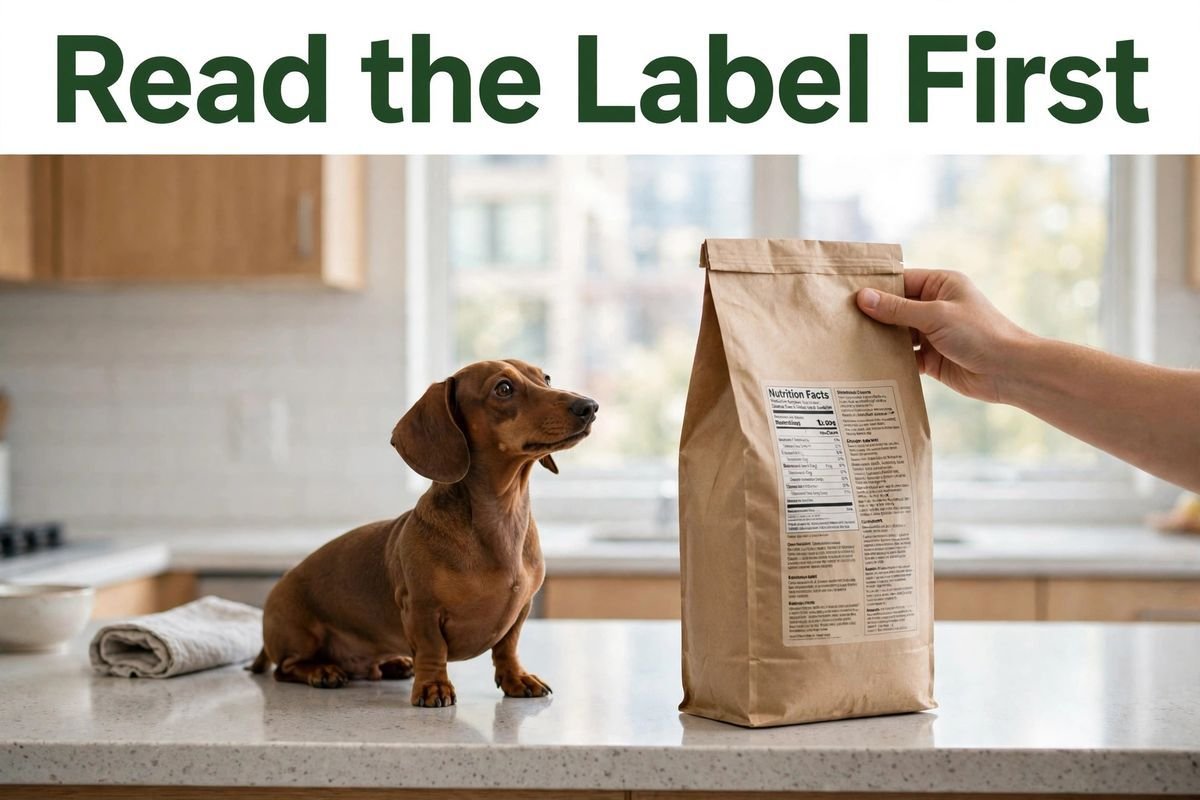
Start on the back of the bag, not the front. The front is marketing: pictures, big claims, and friendly words chosen to catch the eye. The back holds the legal facts: the ingredient list, the analysis, the life-stage statement, and the feeding guide. Turn the bag over in the shop, find the small print, and read it before the price or the picture decides the purchase.
Read in a fixed order so nothing is missed. First, the ingredient list, which shows what the food is made of. Second, the analytical parts, which show protein, fat, fibre, and moisture as percentages. Third, the life-stage line, which says whether the food suits puppies, adults, or all life stages. Fourth, the feeding guide, which gives daily amounts by body weight. These four parts together tell the buyer more than any claim on the front.
Check the basics at the same time. Look at the best-before date, because an old bag can lose freshness and smell stale to a fussy dog. Check the net weight and the bag size, because a large bag that sits open for months in a small apartment goes stale before it is finished. A veterinarian can help interpret a label for a dog with special needs, and a short note of the foods already tried, with the dog’s reaction to each, makes that conversation much easier.

2. Ingredients: What the Order Really Means
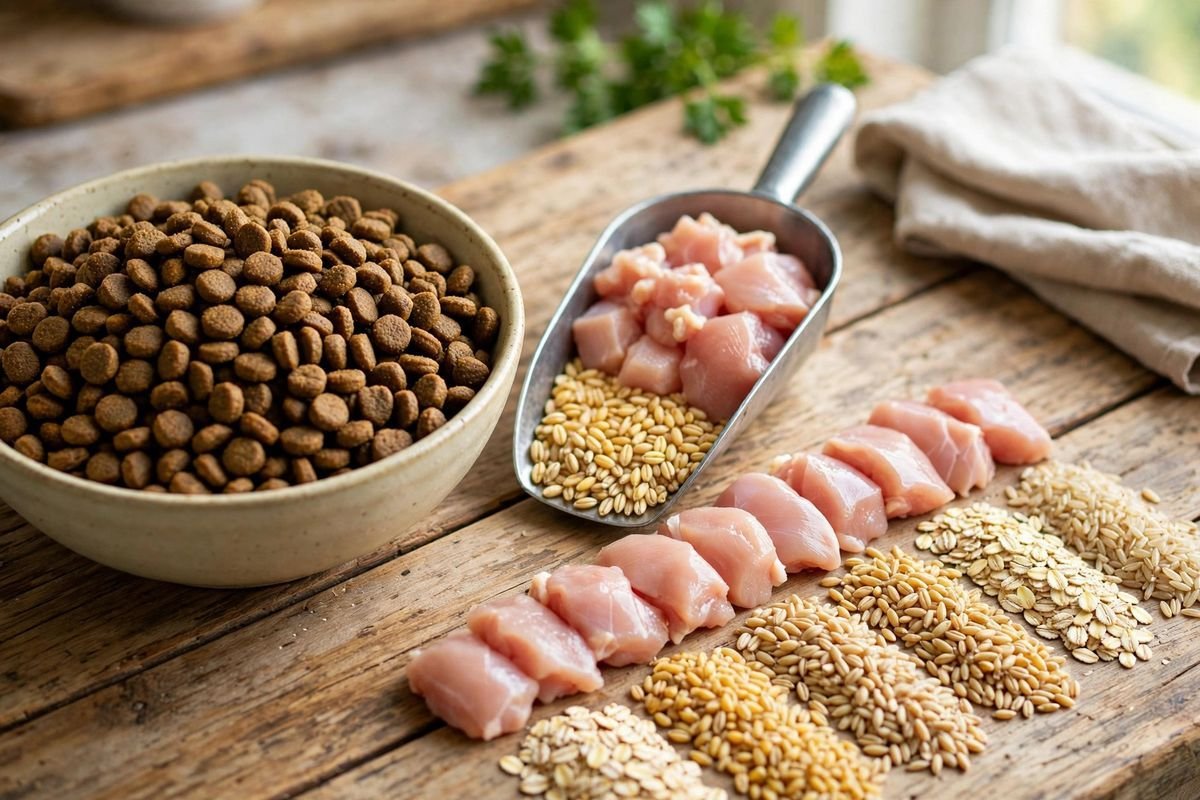
Ingredients are listed by weight, from the most to the least, before cooking. The first few ingredients make up most of the food, so they deserve the closest look. A named protein such as chicken, lamb, or salmon at or near the top is a clear sign, while a vague word such as meat or animal derivatives tells the buyer very little about what is actually inside. Named sources are easier to track if the dog later shows a sensitivity to one protein.
Watch for splitting, where one ingredient is listed under several names to push it lower down the list. Rice, rice flour, and rice bran are all rice, and together they may outweigh the protein at the top. The same trick appears with maize, wheat, and their flours. A list that looks varied at first glance may be built mostly on one grain, and the only way to see it is to read the whole list slowly and add up the related names.
Look at the whole list, not just the first line. A long list of additives, colours, and flavourings is not needed in a good food, and artificial colours serve no purpose for a dog that cannot see them. Preservatives are needed to keep food safe, but they should be named plainly on the label. The guide to healthy food for Dachshunds and what to feed a mini Dachshund explains which foods suit this small breed and how protein, fat, and fibre fit together, and the label check here is the practical way to apply that knowledge in the shop.
3. The Life-Stage Line and the Complete and Balanced Statement
Every bag should state which dogs it is made for. Puppy food is richer in energy and nutrients for growth, adult food suits a grown dog at a steady weight, and senior food is usually lighter in calories. An all-life-stages food is made to suit most dogs, but a small puppy and an older dog have different needs, so the life-stage line is the first filter: if it does not match the dog, put the bag back.
Look for a statement that the food is complete and balanced. That phrase means the food is designed to provide everything a healthy dog needs, without extra supplements. A food labelled complementary is not a full diet on its own and needs other foods alongside it, which is easy to miss if the front of the bag looks like a main meal. Treats and mixers are often complementary, and they should never replace the main food.
Be careful with front-of-pack claims. Words such as natural, premium, and holistic have no fixed legal meaning on most labels, and a picture of fresh meat on the front does not mean the food is mostly fresh meat. The ingredient list and the analysis are the facts, and the front is the promise. If the front and the back seem to tell different stories, trust the back. A veterinarian can advise when a dog needs a special diet for a health reason, and that advice matters more than any claim printed on a bag.

4. The Feeding Guide, the Weight Table, and Cost per Day
The feeding guide is a table, usually by body weight, that gives a daily amount in grams. Find the dog’s weight, read across to the daily amount, and measure it with a cup or scales. The guide is a starting point, not a rule, because a very active dog needs more and a quiet apartment dog needs less. Adjust slowly over two weeks, watching the waist and ribs, and keep the amount steady once the weight is right.
Small dogs need small numbers, and the guide makes that clear. A miniature Dachshund may need only a modest scoop each day, split across two meals, and a scoop that looks small to a person is often exactly right. Overfeeding by a little each day adds weight over months, and extra weight strains a long back, so the feeding guide is also a back-care tool. Weigh the dog monthly at home or at the vet clinic, and write the weight down, so slow changes are noticed early.
Compare foods by cost per day, not cost per bag. A large cheap bag that needs a big daily scoop can cost more per day than a smaller bag with a smaller daily amount. Divide the bag price by the number of days it lasts at the guide amount, and the real price appears. Check the kibble size too: tiny kibble suits a small mouth, while large kibble can be hard for a miniature Dachshund to chew, and a dog that struggles to chew may swallow whole pieces and eat too fast.

5. Dates, Storage, and Switching Without Upset
Check the best-before date before paying. A bag near its date may still be safe, but it can taste stale, and a picky Dachshund notices stale food first. Choose the freshest bag on the shelf, and check that the bag is sealed, dry, and undamaged, because a torn bag lets air and damp in and spoils the food faster. Keep the receipt until the dog has tried the food, in case the bag needs returning.
Store the food in a cool, dry place, sealed tightly after every meal. A large bag that sits open in a warm kitchen goes stale within weeks, so a smaller bag, or an airtight container with the food kept inside its original bag, stays fresher longer. Do not store food in a damp cupboard or next to the cooker, and wash the storage container between bags. Stale food is a common reason a dog suddenly refuses a food it used to eat.
When a new food is chosen, switch slowly over seven to ten days, mixing a little of the new food into the old and raising the share bit by bit. A sudden swap can upset the stomach and make the dog refuse the new food, which looks like dislike when it is really a sore stomach. The guide to Dachshund safe foods and everyday choices explains which everyday foods are safe alongside a main diet, and a slow switch protects the stomach while the dog adjusts. Keep a short note of the switch dates and the dog’s stools, so a veterinarian can see the pattern if problems appear.

Food Label Check Before You Buy
| Label part | What to check | Good sign |
|---|---|---|
| Ingredient list | First ingredients, named protein | Named meat or fish near the top |
| Ingredient splitting | Same grain under several names | No repeated grain names filling the list |
| Life-stage line | Puppy, adult, senior, or all stages | Matches the dog’s age |
| Complete and balanced | Full diet or complementary | States complete and balanced |
| Feeding guide | Daily grams by body weight | Clear amount for a small dog |
| Dates and bag | Best-before date, seal, size | Fresh, sealed, right size for the home |
| Cost per day | Bag price divided by days it lasts | Compared fairly across bags |
Common Mistakes
- Trusting the front of the bag instead of reading the back.
- Buying a food whose life stage does not match the dog.
- Missing a complementary food sold as if it were a main meal.
- Guessing portions instead of using the feeding guide.
- Comparing bags by price instead of cost per day.
- Buying a huge bag that goes stale before it is finished.
- Switching foods suddenly and blaming the new food for the upset.
When to Call Your Vet
Contact a veterinarian before choosing a special diet for a dog with allergies, a sensitive stomach, kidney or liver disease, or a weight problem, because a label cannot replace medical advice. Contact a veterinarian also if the dog loses weight, has ongoing loose stools or vomiting after a food change, refuses food for more than a day, or shows itching, ear problems, or sore skin after starting a new food. This article gives general information only and does not diagnose any condition. A veterinarian can advise on the right diet, check the dog’s weight and health, and help interpret a label for a dog with special needs.
Pin This: Food Label Checklist
- Read the back of the bag, not the front.
- Look for a named protein near the top.
- Watch for one grain split under several names.
- Match the life-stage line to the dog.
- Check the food is complete and balanced.
- Use the feeding guide and measure portions.
- Compare cost per day, not per bag.
Frequently Asked Questions
What is the first thing to check on a dog food label?
The ingredient list, starting with the first few ingredients, because they make up most of the food. Look for a named protein such as chicken, lamb, or salmon near the top, and read the whole list for repeated grain names that push one ingredient down the list.
What does complete and balanced mean?
It means the food is designed to provide everything a healthy dog needs as a full diet, without extra supplements. A food labelled complementary is not a full diet on its own and needs other foods alongside it, so the two words are worth checking every time.
Should I trust words like natural or premium on the front?
Not on their own. Those words have no fixed legal meaning on most labels, and a picture on the front does not show what is inside the bag. Trust the ingredient list, the analysis, the life-stage line, and the feeding guide on the back.
How much should a miniature Dachshund eat each day?
Follow the feeding guide for the dog’s weight, then adjust slowly by watching the waist and ribs over two weeks. A miniature Dachshund usually needs only a modest daily amount split across two meals, and a veterinarian can confirm the right amount for the dog’s age and activity.
How do I compare two bags fairly?
Divide each bag’s price by the number of days it lasts at the feeding guide amount. That gives the cost per day, which is the fair comparison, because a cheaper bag that needs a bigger daily scoop can cost more per day than a smaller bag.
Conclusion
Reading a food label takes a few minutes and changes every purchase after it. Turn the bag over, check the first ingredients, match the life stage, confirm the food is complete and balanced, and use the feeding guide to measure the daily amount. A label read well is the cheapest health check a Dachshund owner can do in the shop.