

Dachshund Barking at Hallway Sounds: A Calm Apartment Plan
Quick Answer
- Hallway barking usually starts as alerting: a Dachshund hears a footstep, a door, or a voice it cannot see, and barks to warn the household.
- Lower the trigger first by muffling sound, covering the view under the door, and giving the dog a job away from the front door.
- Teach a short, repeatable routine: hear the sound, go to a place, settle, earn a reward, then release.
- Progress is gradual. Expect steadier responses over weeks of short daily sessions, not silence after a single afternoon.
Contents
- 1. Why Hallway Sounds Trigger a Dachshund
- 2. Make the Hallway Less Triggering
- 3. Teach the Place-and-Settle Routine
- 4. Desensitize Sounds at Low Volume
- 5. Build a Daily Apartment Routine That Holds
- Hallway Barking Response Checklist
- Common Mistakes
- When to Call Your Vet
- Pin This: Hallway Barking Checklist
- Frequently Asked Questions
- Conclusion
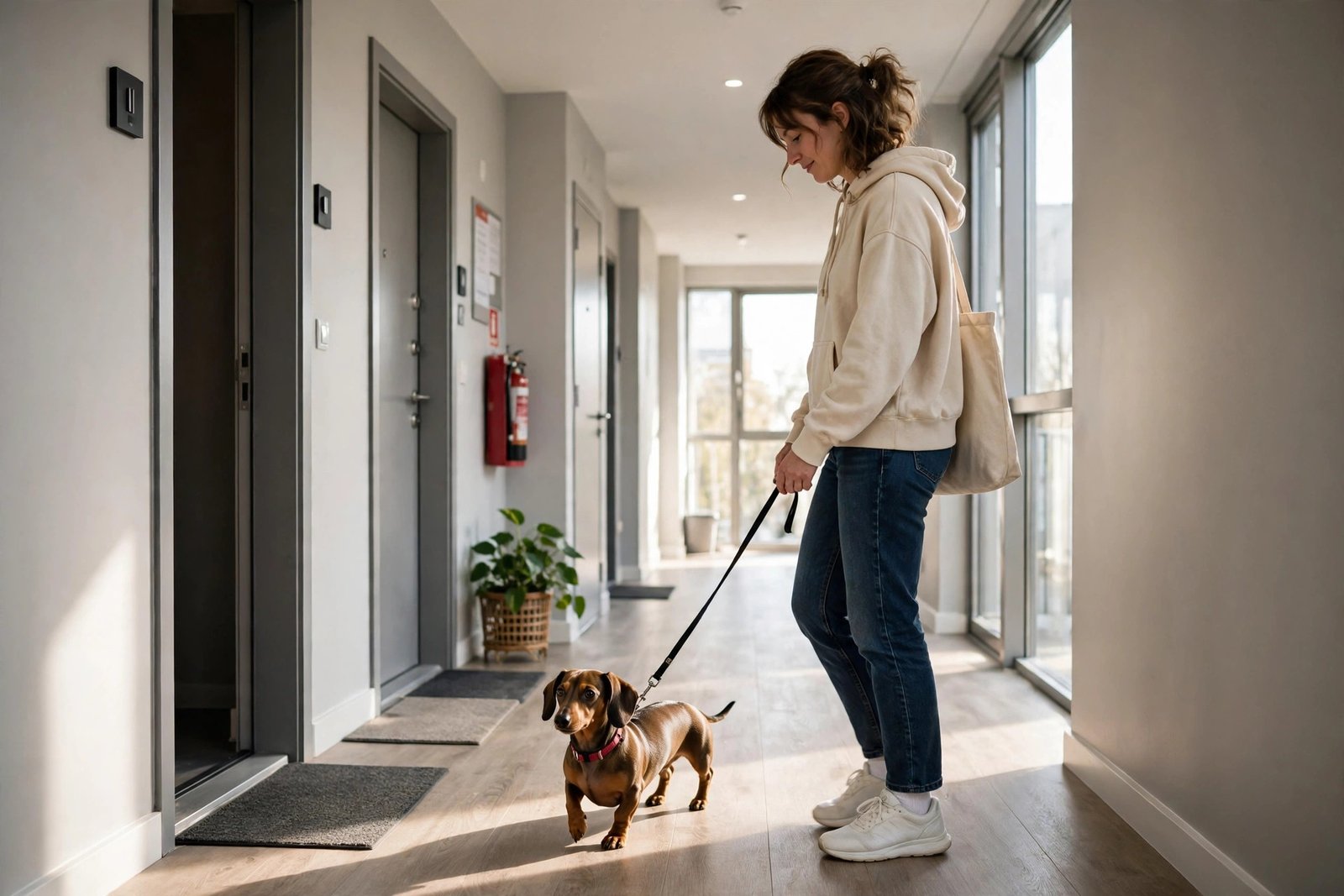
Apartment hallways are noisy in a particular way. Sounds arrive suddenly, without a visible cause, and they stop just as quickly. A lift door opens, a neighbor passes with a bag, a key turns in a lock two doors away, and a Dachshund hears all of it from behind a closed front door. For a breed developed to notice movement and sound, that pattern is almost designed to cause barking. The dog is not being difficult for the sake of it. It is responding to information it cannot check, in a space it considers its own territory.
Hallway barking responds well to a structured plan, because the same sound types repeat daily: footsteps, doors, voices, lifts, and deliveries. That repetition gives many short practice opportunities. The plan here does not aim to stop a dog from noticing a sound, but to change what it does next: a brief alert, then settling on a chosen spot.
1. Why Hallway Sounds Trigger a Dachshund
Dachshunds were developed as alert, watchful dogs, and that heritage still shows in apartment life. A sound in the hallway carries two messages at once: something is moving nearby, and the dog cannot see what it is. Uncertainty tends to increase barking, because barking is the dog’s way of gathering information and warning the household at the same time. A dog that can see a visitor through a window often barks less than a dog that hears only footsteps behind a solid door.
Apartment acoustics make the problem worse. Hard floors, tiled hallways, and thin doors carry sound clearly, and echoes can make a single footstep sound like several. Sounds also arrive in bursts, often in the early morning and evening when neighbors come and go. A dog that is resting, bored, or already slightly restless is more likely to react strongly to the first burst of the day. Over time, the hallway itself can become a cue: the dog learns to wait near the door and bark at the smallest noise, because barking has previously been followed by attention, movement, or the sound fading on its own.
It helps to separate alerting from other causes. A dog that barks only at hallway sounds, settles quickly once the sound passes, and is otherwise relaxed is usually alerting. A dog that barks for long periods, paces, pants, or cannot settle after the sound ends may be anxious, under-exercised, or uncomfortable, and that picture deserves a closer look. Keep a simple log for a few days: time of day, type of sound, how long the barking lasted, and what helped. Patterns usually appear quickly, and they make the rest of the plan much easier to target.
Finally, remember that barking is communication, not defiance. Punishing every bark without teaching an alternative often creates a more stressed dog. The approach below gives the dog a calmer, rewarded response instead.

2. Make the Hallway Less Triggering
Before training begins, reduce how much hallway sound reaches the dog. Small environmental changes can cut reactions noticeably, and they make every training session easier. Start at the front door. A draught excluder or door seal reduces both sound and the scents that drift under the door. A thick rug inside the door softens footsteps and gives the dog a less exciting surface to wait on. If the door has a letterbox that rattles, a simple cover or brush strip can remove a frequent, sharp trigger.
Next, change where the dog waits. Many hallway barkers station themselves beside the front door, where every sound is loudest and most surprising. Move the dog’s bed or resting mat to a spot a few steps away from the door, ideally with a view of the room rather than the door itself. A bed near a window or beside a sofa often works well. The goal is not to ban the dog from the hallway, but to break the habit of guarding the exact threshold where sounds arrive.
Background sound also helps. A radio, a fan, or a white-noise machine at low volume in the living area can mask faint hallway sounds, so only louder, clearer sounds need a trained response. Keep the volume low enough that conversation is still easy. The aim is a gentle sound floor, not a wall of noise that hides everything. Combine this with visual barriers where needed: a frosted panel on a glass door, or a closed inner door during the busiest hallway hours, can reduce the feeling that the hallway is part of the dog’s territory.
These changes lower the daily trigger load, so the training routine has more chances to succeed.
3. Teach the Place-and-Settle Routine
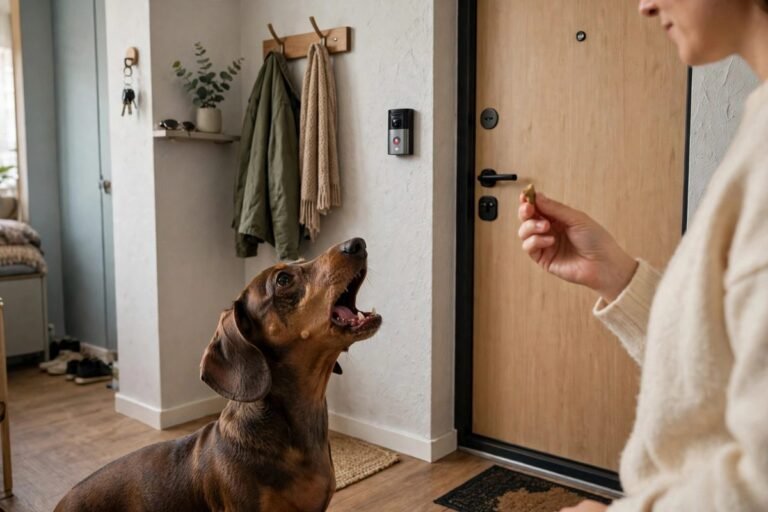
The core skill for hallway barking is a place routine: on a cue, the dog goes to a mat or bed, lies down, and stays calm until released. Start without any hallway sound at all. Place the mat in a quiet room, lure the dog onto it with a treat, reward lying down, and repeat. Keep sessions to two or three minutes. Once the dog goes to the mat eagerly, add a cue word such as “place” or “mat,” said once, calmly, before the dog moves.
Build duration slowly. Reward the dog for staying on the mat for a few seconds, then ten, then thirty, always releasing before the dog chooses to leave. If the dog breaks position, simply guide it back without scolding and try a shorter duration. The routine should feel like a game with frequent rewards at first, not a test of willpower. Over several days, move the mat closer to its final spot, a few steps from the front door, and practice there when the hallway is quiet.
Now connect the routine to sounds. When a real hallway sound occurs, calmly say the cue, guide the dog to the mat if needed, and reward settling. In the early stages, reward generously: several small treats delivered quietly on the mat, one after another, while the sound passes. The dog is learning a new sequence, and that sequence is sound, mat, settle, reward. Do not shout over the barking, chase the dog, or drag it to the mat, because that adds excitement to the exact moment that needs calm.
Practice with staged sounds as well, using the same calm steps as the guide to teaching quiet in 7 days. Ask a family member to walk past the door, knock softly, or open a nearby door while you run the routine. Keep the staged sounds mild at first and increase them only when the dog succeeds most of the time. End every session on a success, even if that means finishing with an easy repetition in a quiet room. The dog should remember the routine as something pleasant and predictable.

4. Desensitize Sounds at Low Volume
Desensitization means exposing the dog to hallway sounds at a level it can cope with, and rewarding calm behavior, so the sound gradually loses its power to trigger barking. Recordings are a useful tool here, because volume can be controlled precisely. Play a recording of footsteps, a door closing, or a lift bell at a very low volume, so low that the dog notices it but does not bark. Reward calm noticing: ears up, looking toward the sound, then settling again. Repeat a few times, then stop.
Increase the volume only in small steps, and only when the dog is succeeding at the current level. If barking returns, the step was too large. Go back to the previous volume, rebuild success, and try a smaller increase next time. Short sessions work best, perhaps five minutes, once or twice a day. Long, intense sessions tire the dog and can make reactions worse rather than better.
Pair desensitization with the place routine whenever possible. Play a sound at low volume, cue the dog to its mat, reward settling, and then let the sound fade. Over time, the dog begins to offer the mat behavior on its own when it hears a real hallway sound, because that behavior has been rewarded so consistently. That is the moment the plan starts to feel easy: the dog hears a sound, glances at its mat, and chooses to go there.
Real sounds will still surprise the dog sometimes, and that is normal. A neighbor dropping something heavy, a sudden argument in the hallway, or a fire alarm will startle any dog. The goal is not a dog that never barks, but a dog that recovers quickly, returns to its place, and stops within a short time. Note which real sounds still cause long episodes, and use recordings of similar sounds in the next desensitization session.
5. Build a Daily Apartment Routine That Holds
Training works best inside a day that meets the dog’s basic needs. A Dachshund that has had a walk, a play session, and a chance to sniff and explore is less likely to bark at every hallway sound than a dog that has been indoors, bored, and under-exercised all day. Plan a morning walk before the busiest hallway period, a short midday enrichment activity such as a snuffle mat or a food puzzle, and an evening walk that tires the body without overexciting the mind.
Meals and rest also matter. Feed at consistent times, and give the dog a quiet resting period after meals, away from the front door. A tired, well-fed dog with a comfortable resting spot is more likely to sleep through faint hallway sounds, and the apartment night routine covers the same settle skills for evenings. If the dog is left alone during the day, leave a safe chew or a long-lasting enrichment item, and consider whether a midday visit or a dog walker would reduce the hours spent listening at the door.
Consistency across the household is essential. Everyone who lives with the dog should use the same cue word, the same mat, and the same response to barking: calm, brief, and directed toward the place routine. If one person shouts, another laughs, and a third gives attention for barking, the dog receives mixed messages and progress slows. A short family agreement, written on the fridge if needed, can keep everyone aligned.
Review progress weekly, not daily. Barking often improves unevenly, with a worse day when the hallway is unusually busy. Compare average episode length week to week, and look for longer gaps and faster settling.
Hallway Barking Response Checklist
| Step | What to do | What to avoid |
|---|---|---|
| Before a sound | Door seal, rug, mat away from the door, low background sound | Dog stationed at the door all day |
| During a sound | Calm cue to the mat, quiet rewards for settling | Shouting, chasing, or dragging the dog |
| After a sound | Release calmly once the dog is settled | Releasing while the dog is still barking |
| Daily | Walk, enrichment, consistent routine | Long bored hours beside the door |
| Weekly | Review the log, adjust sound levels | Judging progress from one bad day |
Common Mistakes
- Shouting at the dog, which adds noise and excitement to the barking moment.
- Only training when the dog is already barking, instead of practicing the place routine in quiet times.
- Jumping to loud staged sounds before the dog succeeds at low volume.
- Leaving the dog beside the front door all day with nothing else to do.
- Changing cue words, mats, or rules between household members.
- Expecting silence in a week and giving up when a busy hallway day causes a relapse.
When to Call Your Vet
Contact a veterinarian if barking is sudden and much worse than usual, or if it comes with pain, limping, a hunched back, reluctance to walk, appetite changes, or any sudden change in behavior. Back discomfort can make a dog more reactive, and a veterinary check can rule out pain as a contributor. This article gives general information only and is not a diagnosis. A veterinarian can examine the dog, discuss whether pain, anxiety, or hearing changes play a role, and refer to a qualified behavior professional where appropriate. If barking is paired with distress when left alone, destructive behavior, or self-harm, seek professional help promptly rather than relying on training alone.
Pin This: Hallway Barking Checklist
- Seal the door and move the resting mat away from the threshold.
- Teach place-and-settle in quiet rooms first.
- Use low-volume sound recordings and reward calm noticing.
- Cue the mat calmly when a real hallway sound happens.
- Walk and enrich daily so the dog is not bored at the door.
- Keep one cue, one mat, and one household response.
- Review the log weekly and adjust in small steps.
Frequently Asked Questions
Should a Dachshund be allowed to bark once at hallway sounds?
A brief alert bark is normal and often acceptable in an apartment, as long as the dog settles quickly afterward. The training goal is a short alert followed by settling, not a dog that never notices a sound.
How long does hallway barking training take?
Many owners see steadier responses within three to six weeks of short daily sessions, but progress depends on hallway noise levels, consistency, and the dog’s starting habits. Older, well-practiced habits take longer to change.
Do sound recordings really help with real hallway noise?
Yes, at low volume with rewards for calm behavior. Recordings allow control of volume and timing, which real hallway sounds do not.
What if neighbors complain while training is in progress?
Reduce trigger exposure during the busiest hours, use background sound and door seals, and keep training sessions short and calm. A brief, friendly note explaining that training is underway often helps, and faster settling usually follows within a few weeks.
When is professional help the right step?
Seek a qualified trainer or veterinary behavior professional if barking is worsening, if the dog shows signs of anxiety or pain, or if progress stalls for several weeks despite consistent practice.
Conclusion
Hallway barking improves when the hallway becomes less startling and the dog has a calmer job instead. Start by sealing the door, moving the mat, and practicing place-and-settle quietly, then add low-volume sounds daily.




6 Comments