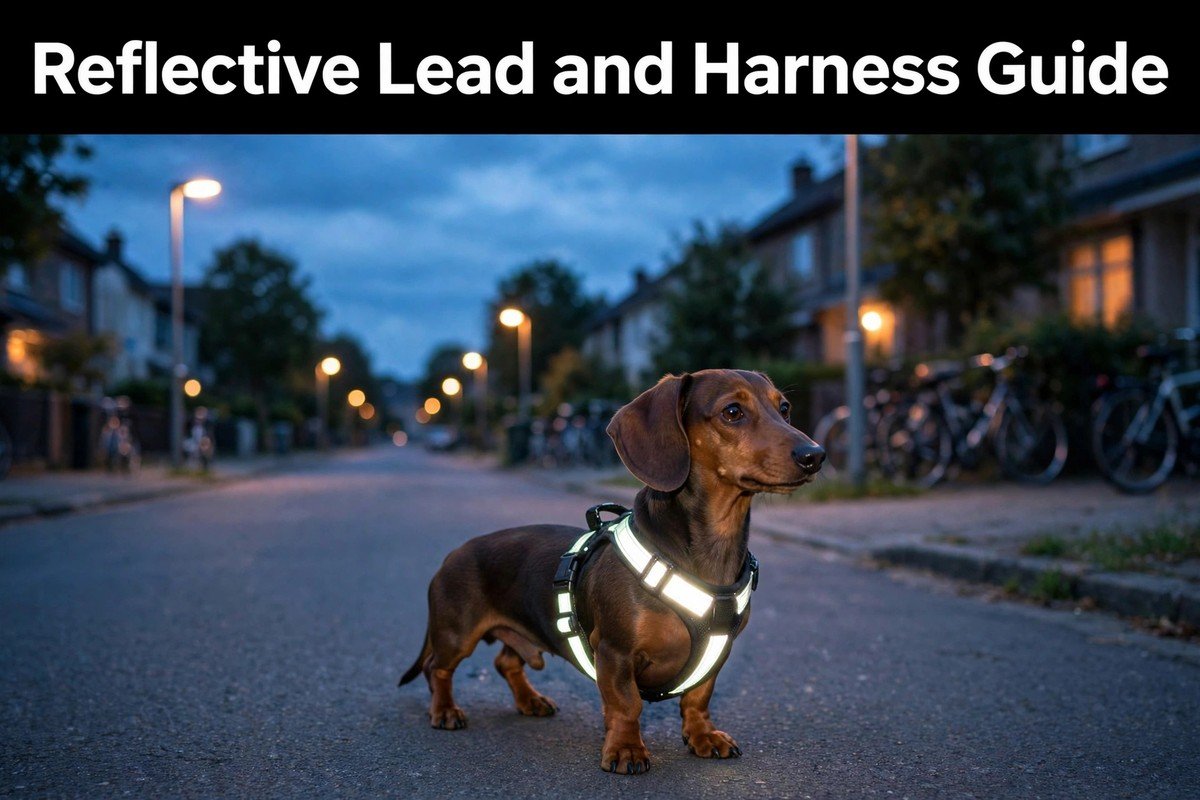
Reflective Lead and Harness Set for Dachshund Night Walks
Quick Answer
- A reflective lead and harness set makes a low Dachshund visible from every side at night, when a dark coat and a small body are hard for drivers and cyclists to see.
- Choose a harness that spreads pressure across the chest, with wide reflective strips on the chest, the back, and the sides, and a lead with reflective stitching along its full length.
- Fit the harness snugly with two fingers under every strap, keep the lead short on roads, and check the reflective strips under a light before every night walk.
- Pair the set with a collar light and a lit route, so the dog is seen by its own light and by reflection, from the front, the back, and the side.
- Contact a veterinarian if a Dachshund is startled, injured, or shows back pain, stiffness, or reluctance to move after a night walk.
Contents
- 1. Why a Reflective Lead and Harness Set Matters at Night
- 2. Choosing a Reflective Harness for a Dachshund
- 3. Choosing a Reflective Lead and Fitting the Set Together
- 4. Walking at Night with Light and Reflection
- 5. Cleaning, Checking, and Replacing Reflective Gear
- Reflective Lead and Harness Comparison Checklist
- Common Mistakes
- When to Call Your Vet
- Pin This: Reflective Lead and Harness Checklist
- Frequently Asked Questions
- Conclusion
A Dachshund is hard to see after dark. A small dog walks close to the ground, with a long, low body, and a dark coat can vanish against a dark pavement, a shadow, or a hedge, so a driver, a cyclist, or another walker may not see the dog until it is very close. A reflective lead and harness set fixes that problem from every side at once, and this guide explains how to choose it, fit it, and use it on night walks. This article is general information only, not a diagnosis.
1. Why a Reflective Lead and Harness Set Matters at Night
A low dog sits below the headlights of many cars. A driver looking ahead sees the road, the pavement edge, and the owner, but a small dog at ankle height can sit in a blind spot, especially on a bend, at a junction, or where a parked car blocks the view. A reflective strip shines back when headlights, a street light, or a torch fall on it, so a dog wearing reflective gear lights up in the beam, and a driver who sees that flash early has time to slow down. A reflective lead adds a moving line of light between the owner and the dog.
Reflection works best when it covers the dog from every side. A single patch on the back helps a driver behind the dog, but it does nothing for a cyclist coming the other way, or a car turning across the dog’s path. A set with reflective strips on the chest, the back, and both sides, plus a reflective lead, makes the dog visible from the front, the back, and the side, and that matters because danger on a night walk can come from any direction.
Disc degeneration in short-legged breeds can begin in the first year of life, so being seen is back care as well as road safety. A startled Dachshund that bolts, twists, or slips on a dark pavement puts a sudden load on a long spine, and the Animal Medical Center guide to intervertebral disc disease in dogs explains why that sudden loading matters for this breed.
2. Choosing a Reflective Harness for a Dachshund
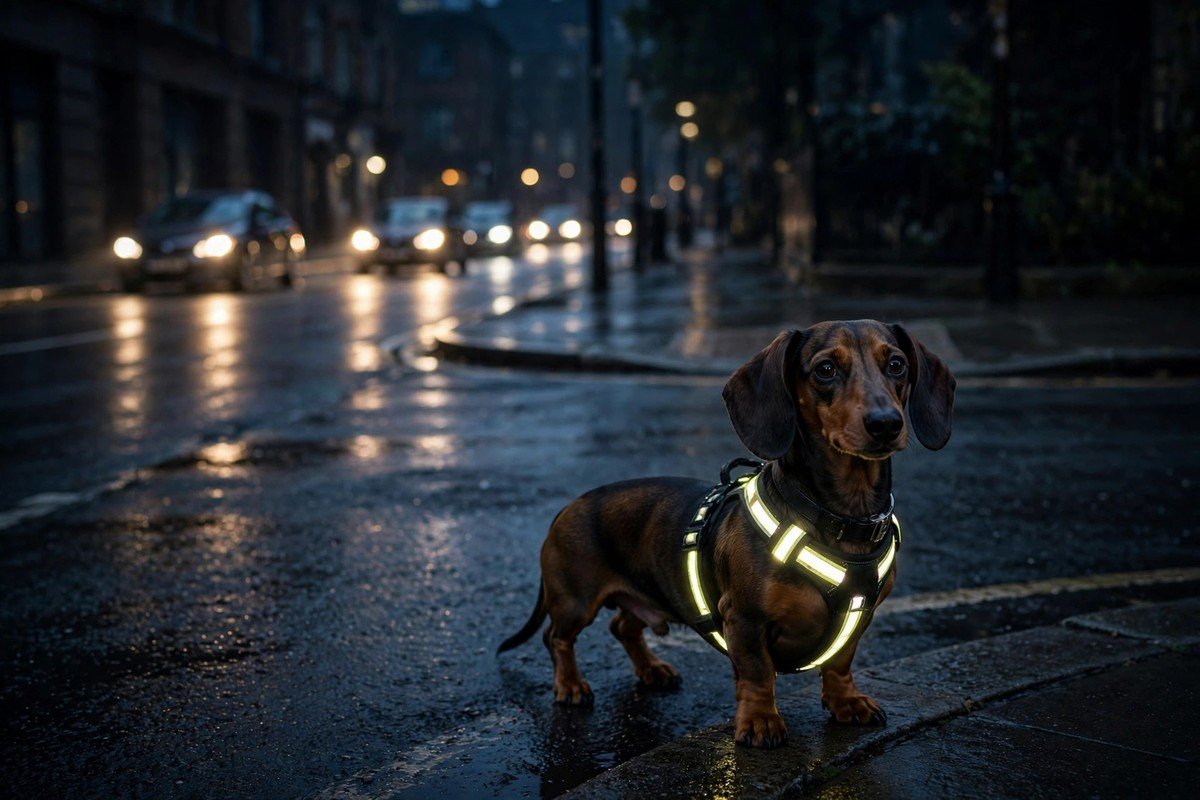
Start with the shape, not the shine. A Dachshund walks best on a harness that spreads pressure across the chest and the shoulders, not on the neck or the spine, and the harness should sit flat against the body, with no strap pressing on the throat or digging into the armpits. Look for a Y-shaped front, with a strap between the front legs and a chest piece that sits below the throat, and a back piece that lies flat along the spine without pressing down on it.
Check the reflective strips next. Look for wide, bright strips on the chest, the back, and both sides, made of a material that shines strongly under a torch, and check them in a dark room with a phone light before trusting them on a walk. A strip that looks bright in a shop may be dull in the dark, and a strip that is narrow, patchy, or only on the back leaves the dog dark from the front and the side. The guide to a reflective night vest covers vests and strips for night walks, and a harness with good reflection can be worn under a vest on the darkest nights for a second layer of shine.
Check the weight, the fabric, and the fastenings. A harness for a Dachshund should be light and soft, with padded straps that do not rub the skin, and a buckle that clicks firmly and can be opened quickly with one hand. Avoid a heavy harness with metal fittings that bang against the chest, and thin straps that cut into the skin when the dog pulls. Measure the chest behind the front legs and the neck at the base, because a Dachshund’s deep chest and slim neck mean the size on the label is often wrong.
3. Choosing a Reflective Lead and Fitting the Set Together
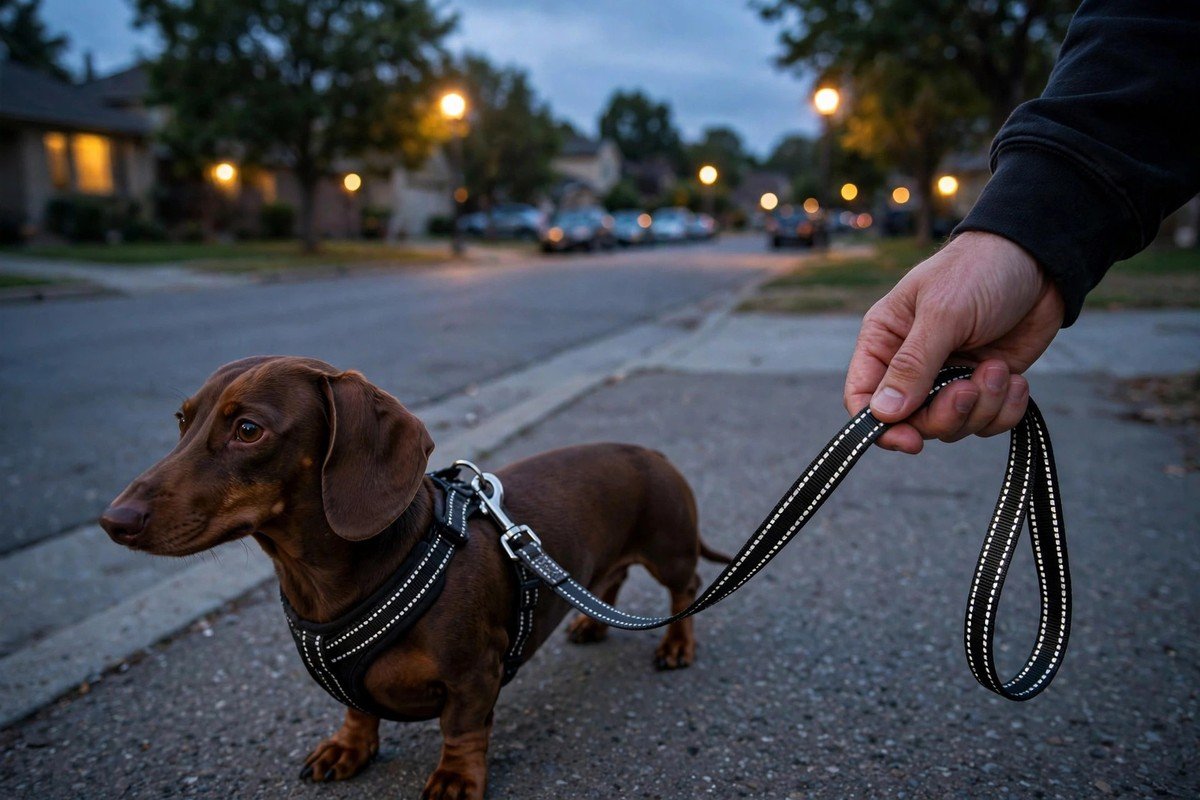
Choose a lead that matches the harness. A flat lead with reflective stitching along its full length is the best choice, because the stitching shines from any angle and the flat shape is easy to hold and to shorten. A retractable lead is a poor choice at night, because it lets the dog wander far from the owner, out of sight, and into the road. A lead of about one to one and a half meters suits a night walk, keeping the dog close enough to see and to control.
Fit the harness with the two-finger check. Slip two fingers under every strap after fastening it, and check that each strap is snug but not tight, with no strap twisted, no buckle pressing on the spine, and no edge rubbing the skin behind the front legs. Let the dog walk around the home for a few minutes, and watch how it moves: a good fit lets the dog walk, sit, and lie down normally, while a bad fit makes the dog walk stiffly or paw at the harness.
Clip the lead to the harness, not to the collar. A Dachshund’s neck is a weak point, and a lead clipped to a collar puts every pull straight onto the throat and the spine, while a lead clipped to the harness spreads the pull across the chest. Keep a loose collar on the dog for its ID tag and its collar light, and keep the lead on the harness. The guide to an LED collar light for night walks explains how a collar light pairs with reflective gear.
4. Walking at Night with Light and Reflection
Choose a lit route and a short lead. A street with street lights, a lit park path, or a well-lit pavement is safer than a dark lane, and a short lead keeps the dog close to the owner, where the reflective strips are easy to see and the dog is easy to control. Shorten the lead at junctions, crossings, and bends, and keep the dog on the pavement side, away from traffic, so the reflective lead stays between the dog and the road.
Use the light and the reflection together. A collar light shines on its own and is visible on an unlit path, while reflective strips shine back when headlights or street lights fall on them, so a dog with both is visible at a distance and up close, in the dark and in a headlight beam. Check both before leaving the house: shine a torch on the harness strips and the lead stitching, and switch the collar light on and off, so a dull strip or a flat battery is found at home.
Walk slowly and watch the dog. A night walk is not the time for a fast pace or a game of fetch in the dark, because a tired or excited dog is more likely to slip, twist, or bolt. Keep the walk short and level, let the dog sniff and toilet, and watch how it moves: a dog that walks evenly, with its back level, is walking well, while a dog that pulls or lags needs a slower pace. Cornell’s information on chondrodystrophy and intervertebral disc disease explains why this breed’s discs are vulnerable, and a calm, slow, well-lit walk is a practical piece of back care.
5. Cleaning, Checking, and Replacing Reflective Gear
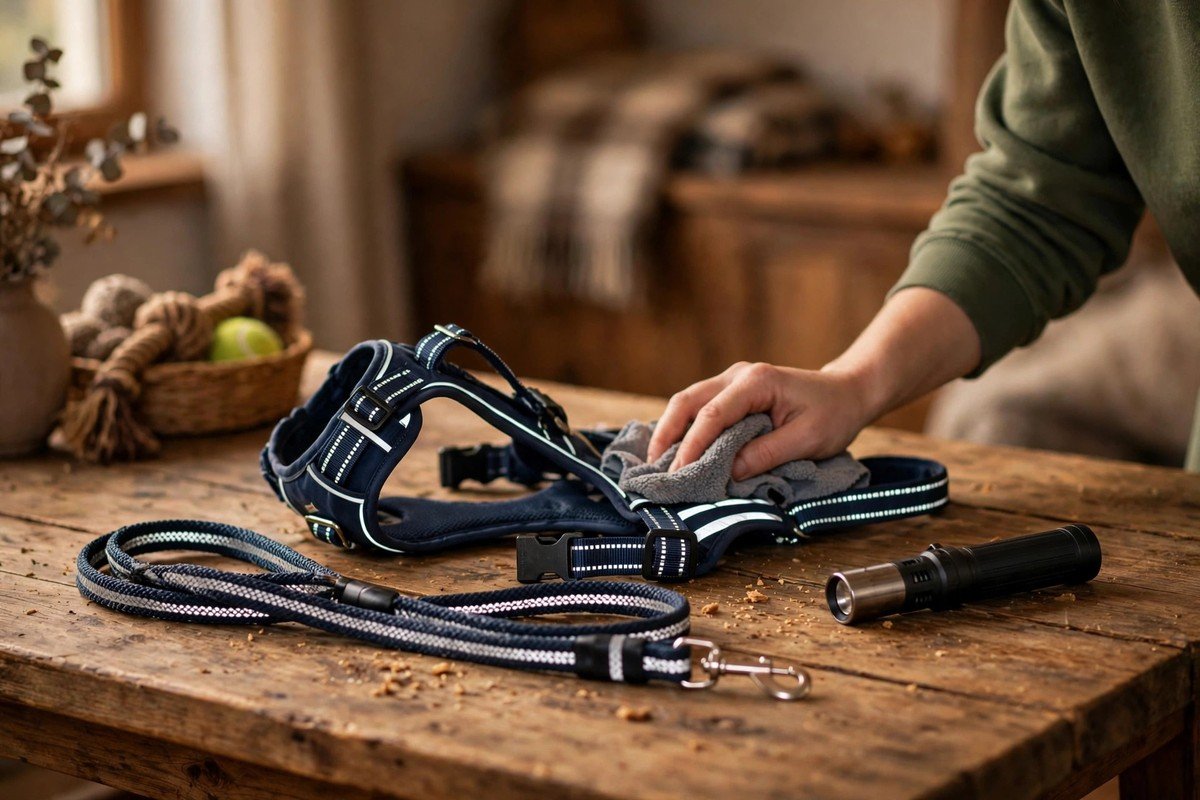
Check the set before every night walk. Shine a torch on the harness strips and the lead stitching in a dark room, and look for strips that have gone dull, cracked, or peeled, and stitching that has frayed or worn thin. A strip that no longer shines is just a stripe, so a quick torch check at home is the only way to know the set still works. Check the buckles, the clips, and the stitching at the same time, because a clip that sticks can fail on a walk.
Clean the harness and the lead weekly. Wash the harness by hand in warm water with a mild soap, rinse it well, and let it dry flat, away from direct sun and radiators, because heat and harsh soap can dull reflective material and shrink the straps. Wipe the lead with a damp cloth, and check it as it dries for fraying or a clip that no longer closes firmly. Do not put a reflective harness in a hot wash or a tumble dryer.
Replace the set when it no longer shines or no longer fits. A harness the dog has outgrown, a lead that has frayed, or a strip that has gone dull should be replaced, not kept for one more walk, because reflective gear is safety gear, and safety gear that does not work gives a false sense of safety. Test a new set under a torch before the first night walk.
Reflective Lead and Harness Comparison Checklist
| Item | Best for | Limit to watch |
|---|---|---|
| Y-shaped reflective harness | Chest pressure, night walks, long backs | Must fit the deep chest; check the neck size |
| Flat reflective lead, 1 to 1.5 meters | Short night walks, full-length shine | Keep it short on roads; check the stitching |
| Reflective vest plus harness | Darkest nights, best visibility from all sides | Two items to fit and to check |
| Collar light plus reflective set | Own light plus reflection, unlit paths | Charge the light after every walk |
Common Mistakes
- Walking a dark-coated dog at night with no reflective gear at all.
- Choosing a harness for its shine and ignoring a poor fit that rubs or twists.
- Clipping the lead to the collar instead of the harness, loading the neck.
- Trusting a reflective strip that has gone dull, cracked, or peeled.
- Walking a long lead on a dark road, behind parked cars.
- Skipping the torch check before the walk, and finding a dead light halfway home.
When to Call Your Vet
Contact a veterinarian if a Dachshund is startled, distressed, or injured on a night walk, or if it limps, yelps when lifted, or refuses to move after a walk in the dark. Contact a veterinarian also if the dog shows back pain, stiffness, weakness in the back legs, or loss of bladder control. This article gives general information only and does not diagnose any condition. A veterinarian can examine the dog and advise whether night walks or a reflective set suits that individual dog.
Pin This: Reflective Lead and Harness Checklist
- Pick a Y-shaped harness with wide strips on chest, back, and sides.
- Choose a flat reflective lead, about one to one and a half meters.
- Fit the harness snugly with two fingers under every strap.
- Clip the lead to the harness, not the collar.
- Pair the set with a collar light and a lit route.
- Check the strips under a torch before every night walk.
- Clean weekly, and replace the set when it stops shining.
Frequently Asked Questions
Is a reflective lead and harness set better than a reflective vest?
They work best together. A harness set gives reflection on the dog’s body and on the lead, from every side, while a vest adds a larger reflective area on the back and chest. On the darkest nights, wear both, and on a lit street, the harness set alone is often enough.
Will a reflective harness fit a Dachshund’s deep chest?
Yes, when it is measured correctly. Measure the chest behind the front legs and the neck at the base, and check the maker’s size guide, because a Dachshund’s deep chest and slim neck mean the size on the label is often wrong.
Can I use a retractable lead with a reflective harness?
It is not a good choice at night. A retractable lead lets the dog wander far from the owner, out of sight, and into the road, where even bright reflection cannot be seen. A flat lead of one to one and a half meters keeps the dog close, visible, and easy to control.
How do I know the reflective strips still work?
Shine a torch on them in a dark room before every night walk. A good strip shines brightly back at the torch, while a worn strip looks dull, gray, or patchy. Replace any harness or lead whose strips no longer shine, and never wash reflective gear in hot water or a tumble dryer.
Does my Dachshund still need a collar light with a reflective set?
Yes, for unlit paths. Reflection needs another light to shine back, so on a path with no street lights and no cars, reflective strips stay dark. A collar light shines on its own, so a dog with both is visible everywhere.
Conclusion
A reflective lead and harness set makes a small Dachshund visible from every side at night: a Y-shaped harness that fits a deep chest, wide strips on the chest, the back, and the sides, a flat reflective lead kept short, and a collar light for the unlit paths. Check it under a torch before every walk, clean it weekly, and the night walk stays calm, visible, and safe for a long back.