Dachshund Barking at Shoes and Lead Cues: Calm Plan
Quick Answer
- Dachshund barking at shoes and lead cues means the dog has learned that shoes, a lead, and a coat predict a walk, and the excitement of the coming walk bursts out as barking.
- The barking is anticipation, not disobedience, and it grows stronger every time the walk starts while the dog is still barking.
- Break the link by picking up the shoes or the lead many times a day without going for a walk, and only walking when the dog is quiet.
- Teach a calm mat wait by the door, and clip the lead on only when the dog is sitting quietly on its mat.
- Most Dachshunds improve within two to three weeks of daily cue practice, with shorter barking bursts and a calmer start to every walk.
Contents
- 1. Dachshund Barking at Shoes and Lead Cues Explained
- 2. How a Shoe Becomes a Barking Trigger
- 3. The Cue Plan: Boring Shoes, Boring Lead, Calm Mat
- 4. Real Walk Moments: The Door, the Hallway, and the Lift
- 5. Keeping Walk Starts Calm for Good
- Shoes and Lead Calm Plan
- Common Mistakes
- When to Call Your Vet
- Pin This: A Quieter Walk Start
- Frequently Asked Questions
- Conclusion
1. Dachshund Barking at Shoes and Lead Cues Explained
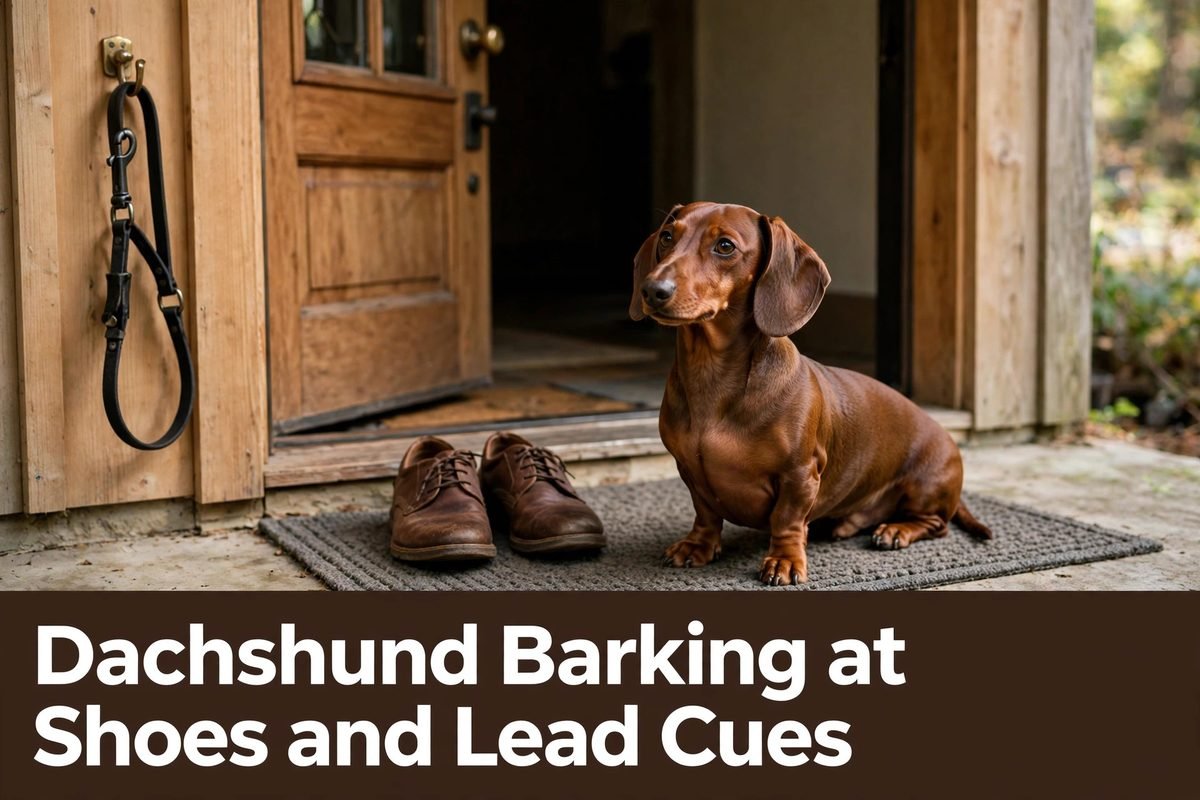
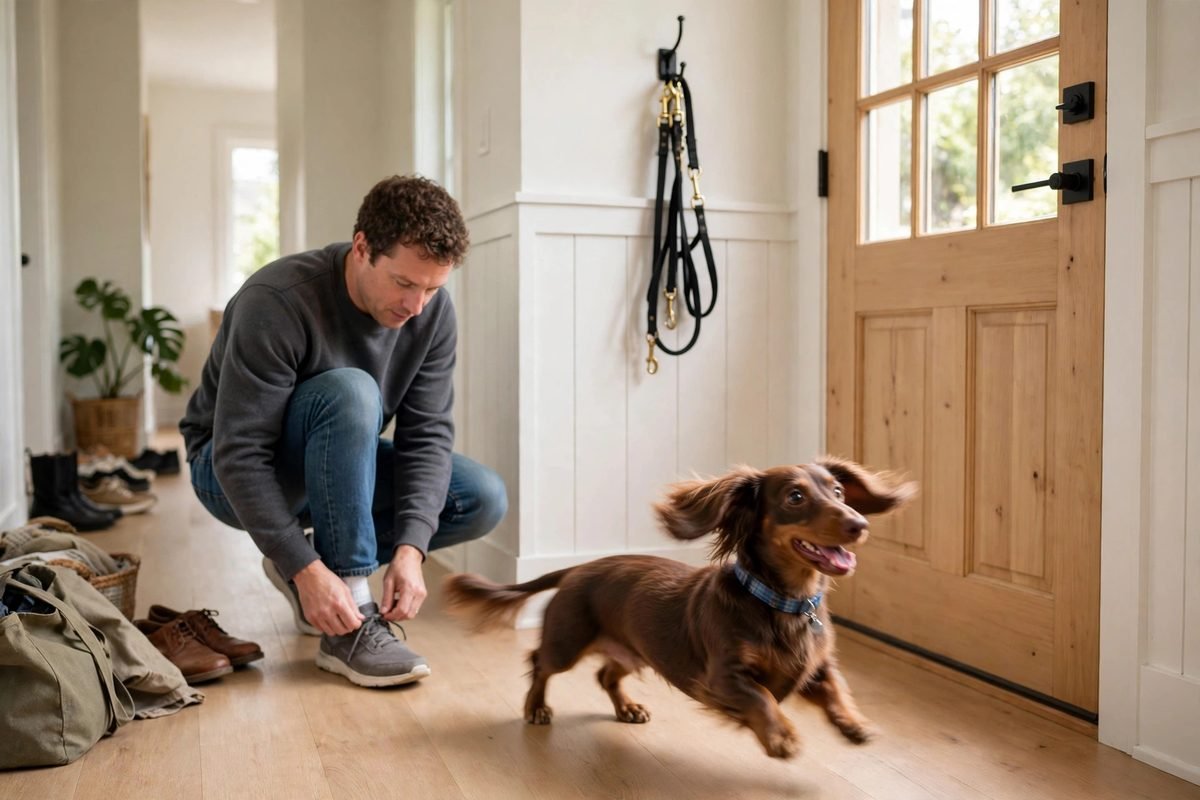
Dachshund barking at shoes and lead cues starts with a sound the dog loves. The owner reaches for shoes, the laces rustle, the lead clip jingles, and the dog knows at once that a walk is coming. The dog races to the door, spins in circles, and barks, and the barking often starts before the owner has even put the second shoe on. The dog is not angry or frightened. It is excited, and the excitement has nowhere to go except into its voice.
The cues are small and everyday, which is what makes them so powerful. Shoes by the door, a lead hanging on a hook, a coat on a peg, and the owner’s keys all predict the same thing: outside, smells, other dogs, and freedom. A Dachshund that has learned these cues will watch the owner all day, waiting for the first sign of a walk, and will bark the moment it sees one. The barking can start earlier and earlier over time, until the dog barks when the owner only stands up from the sofa.
The walk itself rewards the barking. The owner picks up the lead while the dog is barking, opens the door while the dog is barking, and walks out while the dog is still barking, so the dog learns that barking is the fastest way to start a walk. The dog has no reason to be quiet, because noise works. Breaking the pattern means changing what the cues predict, so that shoes and a lead sometimes mean nothing at all, and a walk only starts after quiet.
2. How a Shoe Becomes a Barking Trigger
A trigger is built one walk at a time. The first time the owner puts on shoes, the dog is calm. The tenth time, the dog is alert. The hundredth time, the dog barks before the shoes are even on. Each walk strengthens the link between the cue and the excitement, until the cue alone is enough to set off the barking. The dog is not choosing to bark. The bark is a habit that the daily walk has trained into it, one repetition at a time.
Other cues join in too. The owner may put on a coat, pick up a bag, or say the word walk, and the dog will bark at those as well. Soon the whole getting-ready routine becomes a barking routine, and the owner starts to dread putting on shoes at all. The guide to excitement barking before walks and feeding covers the same build-up of excitement before food and walks, and the shoe and lead cues are the earliest part of that build-up.
The apartment makes it louder. In a small home the dog is only a few steps from the door, the hallway echoes, and the neighbours can hear every bark. The owner feels embarrassed, hurries to get out of the door, and the hurry makes the dog bark even more. A calm start needs time, and the first step is to stop rushing. A walk that starts two minutes later, after quiet, is worth far more than a walk that starts on time with barking.
3. The Cue Plan: Boring Shoes, Boring Lead, Calm Mat
The plan starts by making the cues boring. Pick up the shoes, put them on, and sit back down. Pick up the lead, jingle it, and put it back on the hook. Put on the coat, take it off again, and make a cup of tea. Do this five or six times a day, at times when no walk is coming, and give the dog nothing at all when it barks, and a quiet treat when it stays calm. Within a few days, the shoes and the lead stop predicting a walk every time, and the dog stops barking at every cue.
Next, teach a calm mat wait by the door. Place the mat a few steps from the front door, ask the dog to go to it, and reward it for lying down. Pick up the lead while the dog is on the mat, and only clip it on when the dog is quiet. If the dog barks, put the lead back on the hook and wait for quiet. The dog is learning a new rule: the lead only clips on during quiet, and barking puts the lead away. This is the heart of the whole plan, and it works because the dog wants the walk more than it wants to bark.
The third step is the walk itself. Open the door only when the dog is quiet on its mat, step out calmly, and reward the quiet with the walk. If the dog barks in the hallway, stop, wait for quiet, and then carry on. Never pull the dog forward while it is barking, because a Dachshund pulled hard on a lead can twist, and gentle handling matters for a long-backed breed, since disc degeneration in short-legged breeds can begin in the first year of life. A slow, quiet start teaches the dog that calm behaviour is what makes the walk happen.

4. Real Walk Moments: The Door, the Hallway, and the Lift
The front door is the hardest moment. The dog has waited on its mat, the lead is on, and the door opens onto the hallway, the lift, and the outside world. Keep the routine the same: open the door a crack, wait for quiet, and only then step out. If the dog barks at the open door, close it gently and wait for quiet again. Three calm door openings in a week teach the dog far more than a month of rushed exits.
The hallway and the lift bring new cues. Footsteps, lift doors, and neighbours can restart the barking after a calm start at the front door. Keep the dog close, on a short lead, and reward quiet walking with a treat every few steps. If the dog barks in the lift, stand still, wait for quiet, and reward the pause. A lift ride is short, and a dog that learns to wait quietly in a lift will wait quietly anywhere. Demand barking can look very similar to anticipation barking, and the guide to demand barking for attention and toys covers the same wait-for-quiet rule when the dog is barking to get something it wants.
Evening walks need their own care, because the dog is tired and the owner is in a rush. Keep the same mat routine, the same quiet lead clip, and the same calm door, even when time is short. A rushed start undoes a week of calm starts, while a calm start takes only two extra minutes. If the evening walk is the hardest one, practice the cue plan in the morning, when both the owner and the dog are fresh.
5. Keeping Walk Starts Calm for Good
Walk starts stay calm when the cues stay boring. Keep picking up the shoes and the lead without a walk a few times a week, even after the barking has improved, so the cues never become a certain walk again. Keep the mat by the door, and keep clipping the lead on only during quiet. A dog that sometimes sees the lead and gets no walk will stay calmer than a dog that sees the lead and always gets a walk.
Keep practicing the mat wait even on good days. A short mat session before every walk, with a treat for lying quietly while the lead is clipped on, keeps the routine fresh. If the barking returns after a holiday, a new pair of shoes, or a change in the walk time, go back to boring cues for a few days and rebuild slowly. Setbacks are normal, and they are not a sign that the training has failed. They are a sign that the dog needs a reminder.
Watch the dog’s body as well as its voice. A dog that lies on its mat with a loose body, soft ears, and a slow tail wag is calm and ready for a walk. A dog that spins, paces, and stares at the door is excited, even if it is quiet, and needs more boring-cue practice before the lead is clipped on. The body tells the truth before the voice does, and a calm body is the real goal of the whole plan.

Shoes and Lead Calm Plan
| Step | What to Do | What Good Looks Like |
|---|---|---|
| Days 1 to 3 | Pick up shoes and lead 5 times a day with no walk | Dog stops barking at every cue |
| Days 4 to 7 | Teach the mat wait; clip lead only during quiet | Dog lies quietly while the lead is clipped on |
| Week 2 | Open the door only after quiet; reward the calm exit | Dog waits quietly at the open door |
| Week 3 | Reward quiet walking in the hallway and the lift | Dog walks calmly to the street |
| Every walk | Same mat, same quiet lead clip, same calm door | Walk starts stay calm and quiet |
| Every week | A few boring-cue moments with no walk | Cues stay boring and the habit stays broken |
The plan works best when the cues sometimes mean nothing, the lead only clips on during quiet, and the door only opens after a calm wait. Keep the routine the same every time, and the dog will learn it too.
Common Mistakes
- Picking up the lead only when a walk is coming, so the cue always predicts excitement.
- Clipping the lead on while the dog is barking, which teaches the dog that barking starts walks.
- Opening the door while the dog is barking, to hurry out before the neighbours hear.
- Shouting over the barking, which adds more noise and excitement to the hallway.
- Skipping the mat, so the dog has no calm job to do while the owner gets ready.
- Practicing only before real walks, when the owner is in a rush and cannot wait for quiet.
- Expecting the dog to be quiet at once, instead of building the habit over two or three weeks.
- Stopping the boring-cue practice once the barking improves, so the cues become triggers again.
When to Call Your Vet
Contact a veterinarian if the barking comes with shaking, hiding for hours, loss of appetite, or a refusal to go near the door or the lead at all. Contact a veterinarian promptly if the dog seems in pain, yelps when touched, or shows sudden changes in behavior, such as barking far more than usual or becoming withdrawn. A veterinarian can check whether anxiety, pain, or a health problem is driving the behavior, and can advise on the next steps. This article gives general information only and is not a diagnosis.
Pin This: A Quieter Walk Start
- Pick up the shoes and the lead many times a day with no walk.
- Teach a calm mat wait by the door.
- Clip the lead on only when the dog is quiet.
- Open the door only after a calm wait on the mat.
- Reward quiet walking in the hallway and the lift.
- Keep the cues boring, even after the barking improves.
Frequently Asked Questions
Why does my Dachshund bark the moment I pick up the lead?
The lead has become a trigger that predicts a walk, and the excitement of the coming walk bursts out as barking. Picking up the lead many times a day without a walk breaks the link, so the lead stops predicting excitement every time. A calm mat wait while the lead is clipped on finishes the job.
How do I start if my Dachshund barks at my shoes before I even touch the lead?
Start with the shoes alone. Put them on, sit back down, and give the dog nothing when it barks and a quiet treat when it stays calm. Repeat this five or six times a day. Once the shoes are boring, add the lead in the same way, and only then put the two cues together.
Should I wait for quiet before every walk?
Yes, every time. A walk that starts after quiet teaches the dog that quiet starts walks, while a walk that starts during barking teaches the dog that barking starts walks. The wait only takes a minute or two, and it is the most important minute of the whole walk.
What if my Dachshund barks in the lift after a calm start at the door?
Stand still in the lift, wait for a pause in the barking, and reward the quiet. Keep the dog close on a short lead, and reward quiet walking with a treat every few steps. The lift is a new trigger, and it needs the same wait-for-quiet practice as the front door.
Will my Dachshund ever wait calmly for a walk?
Most Dachshunds learn a calm mat wait within two to three weeks of daily cue practice. The dog will still be excited about walks, and a happy tail wag on the mat is fine. The goal is a quiet, calm dog, not a dog that does not care about walks at all.
Conclusion
Shoes and a lead are small cues with a big effect, because they predict the best part of a Dachshund’s day. Making the cues boring, teaching a calm mat wait, and only starting the walk after quiet turns a barking start into a calm one. As a next step, pick up the lead today, put it back on the hook, and reward the dog for staying calm.