
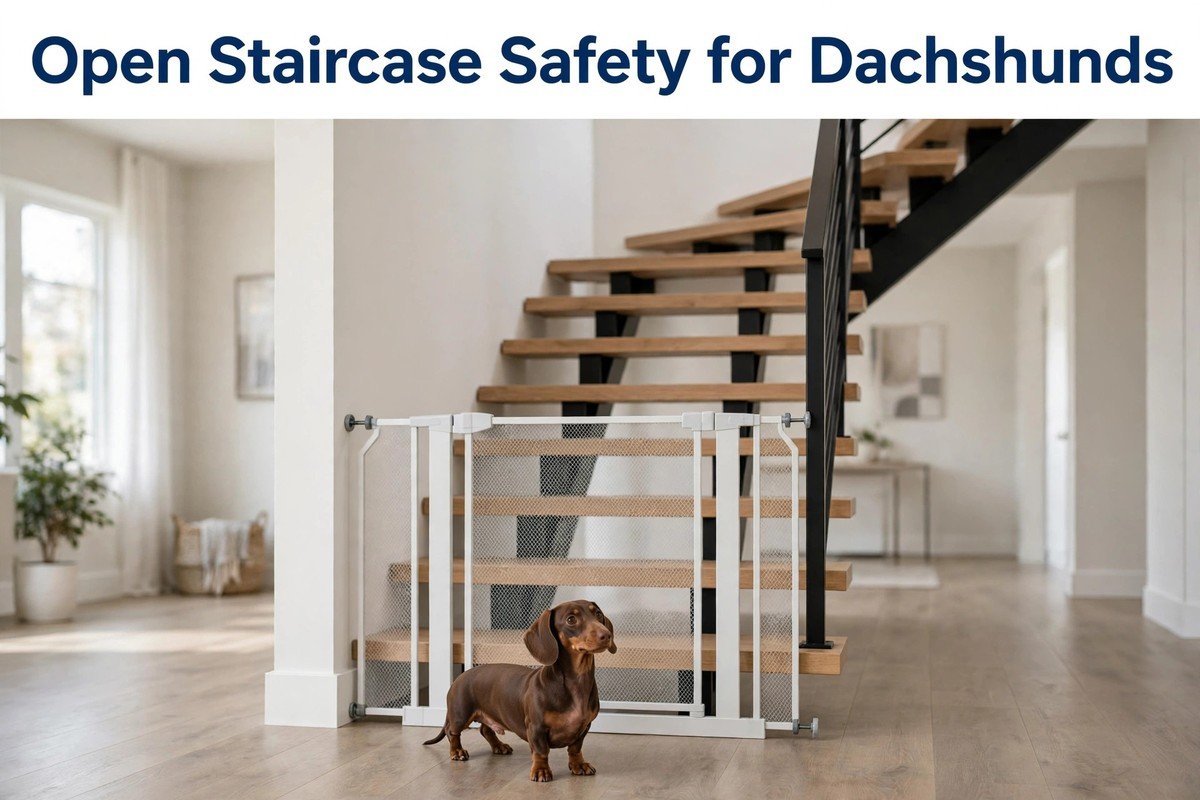
Open-Plan Staircase Safety Guide for Dachshunds at Home
Quick Answer
- An open-plan staircase is risky for a Dachshund because open treads, no risers, and a long drop at the side invite slips, falls, and jumping, all of which load a long spine.
- Block the staircase when the dog is unsupervised, add grip strips or a runner to every tread, and close any open side with a panel, a rail, or a gate made for open stairs.
- Carry the dog up and down, or use a ramp, instead of letting it climb open stairs every day, especially after play, in the wet, or at night.
- Teach a wait at the top and the bottom of the stairs, keep the staircase well lit, and keep toys, shoes, and clutter off every step.
- Contact a veterinarian if the dog falls, limps, yelps, refuses to move, or shows weakness in the back legs after using the stairs.
Contents
- 1. Why an Open-Plan Staircase Is Risky for a Dachshund
- 2. Blocking the Stairs: Gates and Barriers That Fit Open Stairs
- 3. Grip, Treads, and Closing the Open Side
- 4. Carrying, Ramps, and Daily Stair Habits
- 5. Teaching a Wait and Keeping the Staircase Safe at Night
- Open-Plan Staircase Safety Checklist
- Common Mistakes
- When to Call Your Vet
- Pin This: Open-Plan Staircase Safety Checklist
- Frequently Asked Questions
- Conclusion
Open-plan stairs look beautiful in a home. They have no risers between the treads, often no wall on one side, and sometimes a glass panel or a thin rail instead of a solid banister. For a Dachshund, that same design is a hazard: a short-legged dog with a long back can slip through a gap, miss a tread, or tumble down a flight, and this guide explains how to make an open-plan staircase safe without rebuilding the house. This article is general information only, not a diagnosis.
1. Why an Open-Plan Staircase Is Risky for a Dachshund
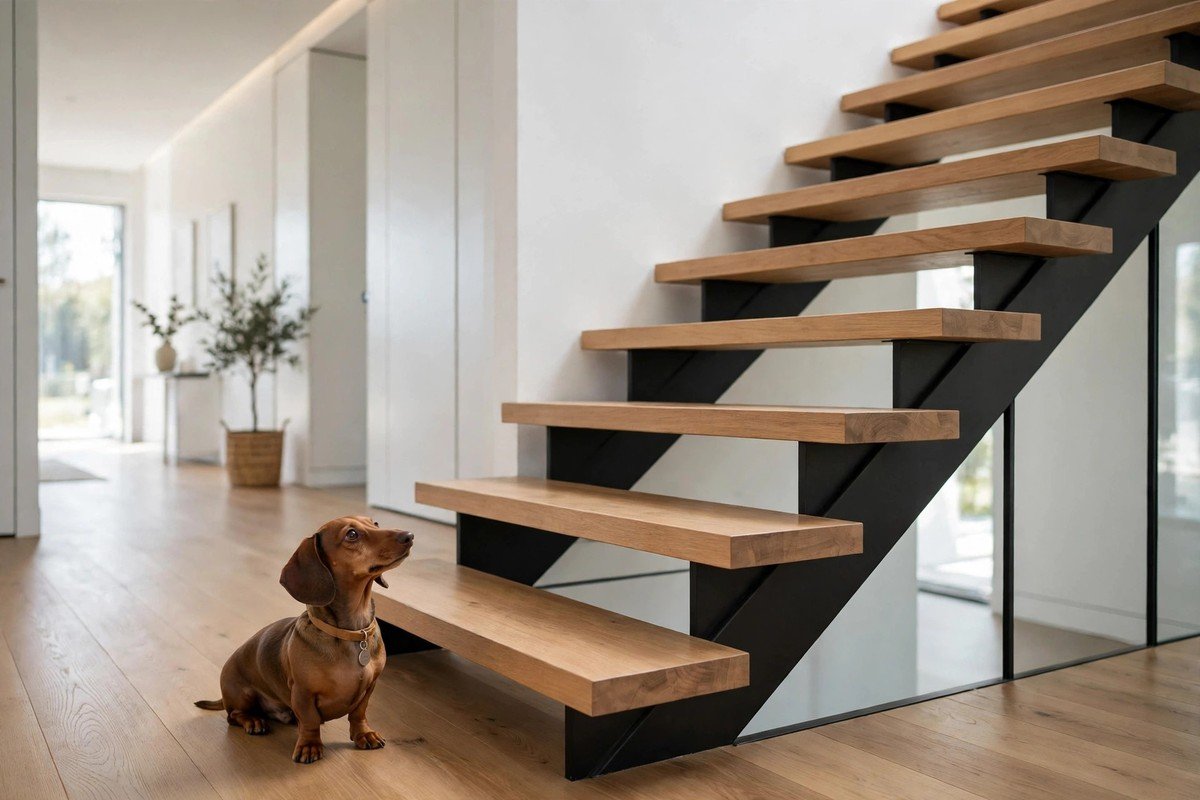
A Dachshund climbs stairs with a body that was not built for them. The legs are short, so each step is a big climb, the back is long, so each step bends and twists the spine, and the chest is deep and low, so the dog’s weight sits forward as it climbs. On a normal closed staircase, the riser behind each tread gives the dog a surface to push against and a clear edge to see. On an open-plan staircase, there is no riser, so the dog sees a gap under each tread, its paw can slip through, and its body can drop between two treads.
The open side adds a second risk. Many open-plan stairs have no wall on one side, only a thin rail, a glass panel, or nothing at all, and the gaps in the rail are often wide enough for a small dog to pass through. A Dachshund that is excited, carrying a toy, or chasing another pet can run to the edge without seeing the drop, and a dog that turns around at the top can step backwards into open air. Puppies and older dogs are at the greatest risk, because puppies have poor balance and older dogs may have weaker legs or poorer sight.
Disc degeneration in short-legged breeds can begin in the first year of life, so daily stair use is not a small matter for this breed. Every climb loads the discs between the vertebrae, and every slip or jump adds a sudden jolt, and the Animal Medical Center guide to intervertebral disc disease in dogs explains how that loading can lead to disc problems. A staircase used ten times a day adds up to thousands of loaded climbs a year.
2. Blocking the Stairs: Gates and Barriers That Fit Open Stairs
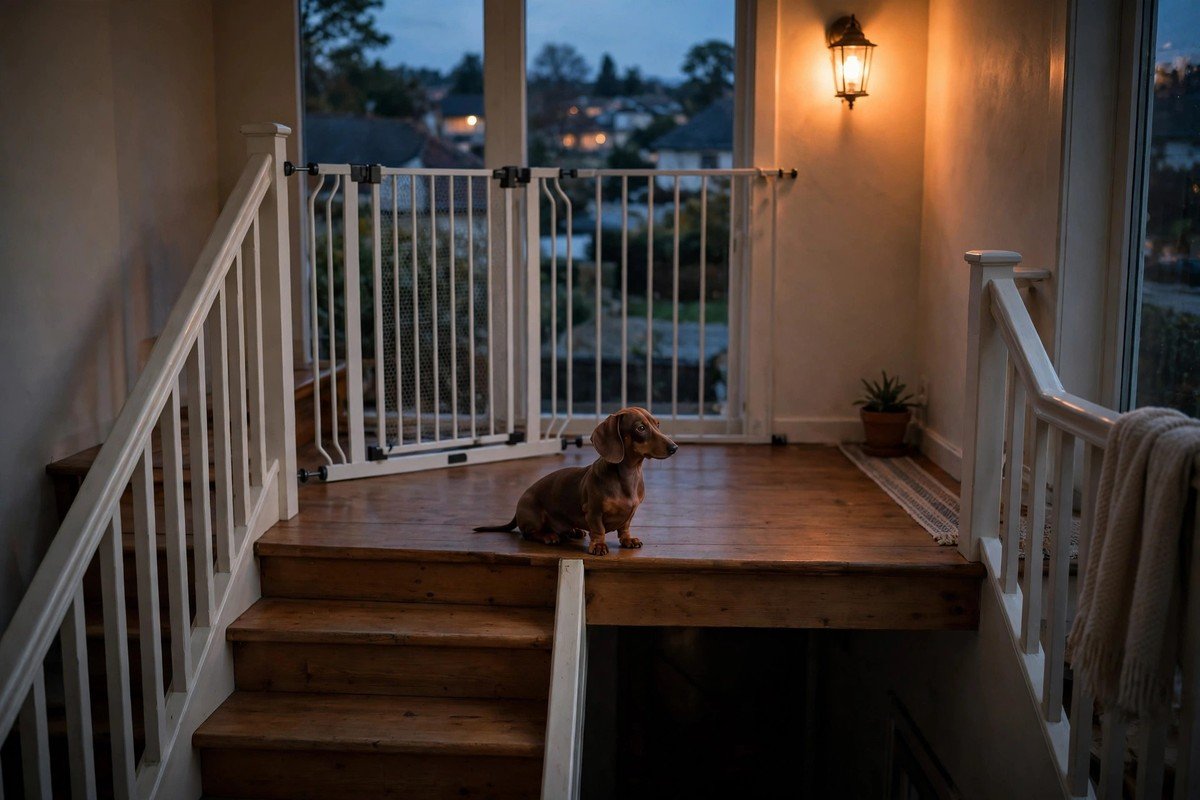
The simplest safety step is to block the staircase when the dog is unsupervised. A gate at the bottom stops the dog climbing up alone, and a gate at the top stops the dog walking to the edge and falling down. A standard pressure-fit gate works where there are two solid walls or posts to press against, but an open-plan staircase often has no wall on one side, so the owner may need a gate with a banister adapter, a clamp that grips a newel post, or a freestanding barrier.
Choose a gate that fits the shape of the stairs, not the other way around. Measure the width of the opening, the height of the newel post, and the angle of the first few treads, and check the gate’s fixing kit before buying. A gate that wobbles, gaps at the side, or can be pushed over is worse than no gate, because it gives a false sense of safety. The guide to a stair gate for apartments covers measuring and fitting, and the same checks apply here, with extra care for the open side. Test the gate every week by pushing it firmly.
3. Grip, Treads, and Closing the Open Side
Even when the dog is allowed on the stairs with help, the treads need grip. Open-plan stairs are often made of smooth wood, polished stone, or glass, and all of those are slippery for a dog’s paws, especially when the paws are wet from the garden or the floor is dusty. Fit a non-slip strip or a tread cover on every step, from the bottom tread to the top, with no gaps, and choose a strip that covers the full depth of the tread so the dog’s whole paw lands on grip. A strip that covers only the front edge leaves the back half of the tread smooth, and that is where the paw lands when the dog is tired.
A runner is the other option, and it suits stairs that the dog uses with supervision. A carpet runner down the middle of the flight gives grip on every step and softens a fall, and it can be fitted with stair rods or adhesive strips so it does not slip. Choose a low, tight pile that the dog’s claws cannot catch on, and avoid a loose rug or a runner that moves, because a moving surface is more dangerous than a bare tread. Check the runner weekly for wear and loose fixings.
Close the open side of the staircase as well as the treads. If there is a gap under the handrail, or between the treads and the side of the stairs, fit a panel of wood, metal mesh, or strong clear plastic that closes it. A panel the dog can see through, such as mesh or clear plastic, keeps the open-plan look while stopping the dog from passing through, and it should be fixed firmly, with no gaps at the top or the bottom. At the top, fit a panel across any open landing edge too.

4. Carrying, Ramps, and Daily Stair Habits
The safest way for a Dachshund to use an open-plan staircase is not to use it at all. Carry the dog up and down, with one hand under the chest and one hand under the hips, holding the back level, and put the dog down gently on a flat floor at the top and the bottom. The guide to carrying a Dachshund up and down stairs safely explains the hold in full. Keep the dog close to the body and away from the open side while carrying, and never carry the dog while also carrying bags or laundry.
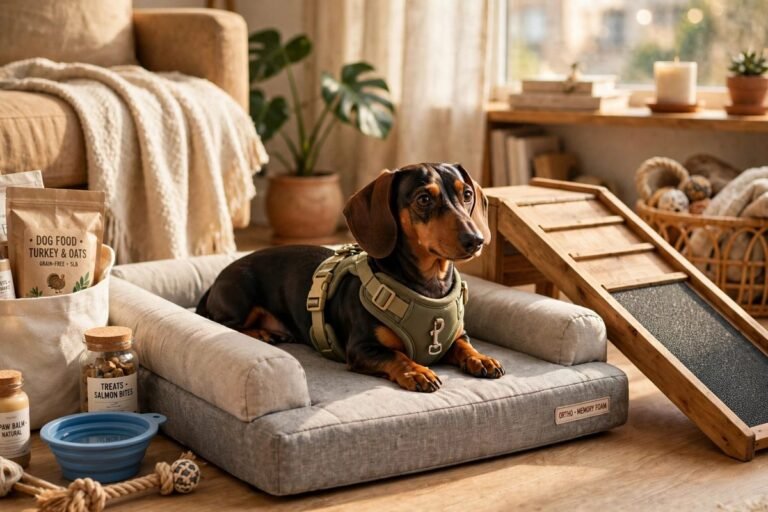
A ramp is a good answer for a home where the dog must change floors every day. A ramp with a gentle slope, side rails, and a non-slip surface lets the dog walk up and down without climbing. Choose a ramp wide enough for the dog to turn on, and test it with the dog on a lead first, guiding the dog slowly until it is confident.
Build daily habits that keep the stairs safe even when the dog is supervised. Keep toys, shoes, bags, and laundry off every step, because a dog that trips over a shoe on an open tread can fall through the gap. Keep the dog’s nails trimmed, because long nails cannot grip a tread, and wipe the dog’s paws when it comes in wet. Do not let the dog run on the stairs or carry a toy while climbing. Slow, supervised, and rare is the right pattern for stairs.
5. Teaching a Wait and Keeping the Staircase Safe at Night
Teach the dog to wait at the top and the bottom of the stairs. Start on a flat floor, away from the stairs, and ask for a sit and a wait, rewarding the dog for staying still, then move the exercise to the bottom step, and then to the top landing, always with the dog on a lead and the owner between the dog and the open side. A dog that waits at the stairs gives the owner time to pick it up or open a gate, and a dog that has learned to stop at the edge is far less likely to run off it.
Night is the most dangerous time for an open-plan staircase. A dog that wakes in the dark, needs the toilet, or hears a noise may walk to the stairs half asleep, and in the dark it cannot see the open treads or the open side. Fit a light at the top and the bottom of the stairs, on a motion sensor or a timer, and keep the gate closed at night so the dog cannot reach the stairs while the owner is asleep. If the dog sleeps upstairs, keep water and a toilet pad on the same floor.
Check the whole staircase once a month, in daylight, from the dog’s point of view. Walk up and down slowly, look for loose tread strips, worn grip, gaps in panels, or a wobbly gate, and fix anything that has loosened. Cornell’s information on chondrodystrophy and intervertebral disc disease explains why this breed’s discs are vulnerable, and a staircase that is checked monthly is a practical piece of back care.
Open-Plan Staircase Safety Checklist
| Risk | Fix | Check |
|---|---|---|
| Open treads with gaps | Non-slip strips or a runner on every tread | Weekly, for wear and loose edges |
| Open side with no wall | Panel, mesh, or rail that closes every gap | Monthly, for gaps wider than the dog’s head |
| Dog using stairs alone | Gate at the bottom and a barrier at the top | Weekly, push the gate firmly |
| Daily climbing loads the back | Carry the dog, or use a ramp | Daily, keep the carry hold level |
| Dark stairs at night | Lights at top and bottom, gate closed | Nightly, before bed |
Common Mistakes
- Assuming an open-plan staircase is safe because it looks safe to a person.
- Fitting a gate that leaves a gap at the open side, or bars a small dog can pass through.
- Adding grip strips to only some treads, and leaving the rest smooth and slippery.
- Letting the dog run up and down the stairs, or chase another pet on them.
- Leaving the gate open at night, when the dog may wander to the stairs in the dark.
- Forgetting to check the gate, the panels, and the grip strips as they wear and loosen.
When to Call Your Vet
Contact a veterinarian at once if a Dachshund falls on the stairs, limps, yelps when lifted or touched, refuses to move, or shows weakness in the back legs. Contact a veterinarian urgently if the dog cannot move its back legs, loses bladder control, or is in severe pain after a fall. This article gives general information only and is not a diagnosis. A veterinarian can examine the dog and advise whether the staircase routine or the carrying hold needs to change.
Pin This: Open-Plan Staircase Safety Checklist
- Block the stairs with a gate when the dog is unsupervised.
- Add grip strips or a runner to every tread.
- Close the open side with a panel or mesh.
- Carry the dog, or use a ramp, instead of daily climbing.
- Teach a wait at the top and the bottom.
- Light the stairs at night and keep the gate closed.
- Check the gate, panels, and grip every month.
Frequently Asked Questions
Can a Dachshund ever use an open-plan staircase?
A healthy adult Dachshund can use one rarely, slowly, and with supervision, on treads fitted with grip, but daily climbing is best avoided. Carry the dog or use a ramp for everyday trips between floors, and keep the stairs blocked when the dog is unsupervised.
What kind of gate fits an open-plan staircase?
A gate with a banister adapter or a clamp that grips a newel post suits most open stairs, because there is often no wall on one side. Measure the opening and the post before choosing, and test the gate firmly every week.
Do grip strips really help on smooth wooden stairs?
Yes, when they cover the full depth of every tread. A strip that covers only the front edge leaves the back half smooth, and that is where a tired dog’s paw lands. Check the strips weekly for wear, curling, or loose edges.
How do I stop my Dachshund from jumping off the top step?
Teach a wait at the top landing, keep the gate closed, and never call the dog down the stairs for food or play. A dog that waits to be picked up has no reason to jump, and a landing panel closes the edge if it does step forward.
Is a ramp better than carrying for open stairs?
Both are good, and the best choice depends on the dog. Carrying suits a light dog and an owner who can lift safely, while a ramp suits a heavier dog, an older dog, or a home where the dog changes floors many times a day.
Conclusion
An open-plan staircase can be made safe for a Dachshund without rebuilding the house: a gate that fits the open side, grip on every tread, a panel that closes the gaps, a carry or a ramp instead of daily climbing, a wait at the top and the bottom, and lights and a closed gate at night. Check it monthly, and the staircase stops being a daily risk to a long back.




One Comment